
Blocking & Neutralization Evaluation Service for Veterinary (Pet) Antibody

Creative Biolabs develops fit-for-purpose blocking and neutralization assays to determine whether canine and feline therapeutic antibody candidates interrupt the intended molecular interaction or suppress target-driven biological activity, providing quantitative evidence to support mechanism-of-action assessment, potency comparison, and lead selection.

Service Overview

Functional Evidence Beyond Antibody Binding

Binding confirms that an antibody recognizes its target; blocking or neutralization testing asks a different question: does that interaction alter the biological process the candidate is intended to control? Creative Biolabs designs species-relevant in vitro assays for veterinary therapeutic antibodies that quantify inhibition of ligand-receptor engagement, cytokine or growth-factor activity, pathogen entry or infectivity, and other target-dependent responses.

Programs are configured around the intended mechanism of action, target format, species context, available reagents, assay window, and downstream decision. Recombinant interaction assays can establish direct competition, while cell-based systems can show whether blockade translates into altered signaling, reporter activity, cytokine output, infectivity, or another functional endpoint. The resulting data support comparative candidate ranking without treating a single assay readout as proof of clinical efficacy.

Evaluation Services

Blocking and Neutralization Assays Matched to Antibody Mechanism

The most informative assay depends on what the antibody is expected to block and how that blockade should be observed. We combine biochemical interaction measurements with cell-based functional endpoints when orthogonal evidence is needed.

Ligand-Receptor Blocking Assays

Evaluate whether an antibody interferes with a defined protein-protein interaction using competitive or inhibition formats.

  • Competitive ELISA or ligand-binding inhibition
  • Soluble receptor or ligand competition
  • Cell-surface binding inhibition where appropriate
  • Percent inhibition and concentration-response analysis
Cytokine and Growth-Factor Neutralization

Measure whether antibody binding suppresses a target-driven cellular response rather than only reducing recombinant ligand binding.

  • Reporter gene readouts
  • Phosphorylation or signaling-response endpoints
  • Cytokine production or response inhibition
  • Species-relevant canine or feline cell models

Pathogen Neutralization Evaluation

Assess reduction of pathogen infectivity using target-appropriate neutralization formats and defined biological controls.

  • Virus microneutralization or infectivity reduction
  • Cytopathic-effect or reporter-based readouts
  • Pre-incubation, attachment, and post-attachment neutralization designs where scientifically appropriate
  • Comparative testing across candidate concentrations

Potency and Candidate Comparison

Generate quantitative, assay-specific evidence to compare antibody candidates under a consistent experimental design.

  • IC50 or other predefined inhibitory metrics
  • Maximum inhibition and response-window assessment
  • Reference, isotype, untreated, and target-relevant controls
  • Replicate-level data and curve-quality review
Interpretation note: IC50 is an assay-dependent functional concentration, not an intrinsic binding-affinity constant. Where affinity or kinetics are required, SPR/BLI or another dedicated binding method should be evaluated separately and interpreted alongside the functional assay.
Stage-Gated Execution

Veterinary Antibody Blocking and Neutralization Evaluation Workflow

The workflow links target biology, assay selection, species-relevant model setup, controlled execution, and decision-oriented reporting so each stage produces evidence that can guide the next project decision.

01
Target & Pathway ReviewDefine species, indication, target interaction, biological response, and intended inhibitory mechanism.
02
Assay Strategy DesignSelect biochemical, cell-based, or pathogen-neutralization formats with appropriate controls and endpoints.
03
Model & Reagent SetupSource or prepare ligand, receptor, cell system, pathogen model, detection reagents, and reference controls.
04
Functional TestingRun concentration-response studies and collect inhibition, signaling, reporter, infectivity, or response data.
05
Analysis & InterpretationReview curve behavior, replicate consistency, control performance, potency metrics, and candidate ranking.

Recommended Starting Information

  • Antibody sequence, format, and concentration
  • Target and source species
  • Intended blocking or neutralizing mechanism
  • Known ligand-receptor pair or pathogen strain
  • Available positive or reference antibody
  • Preferred endpoint and downstream decision

Typical Deliverables

  • Assay design and control scheme
  • Concentration-response plots
  • Percent inhibition or neutralization data
  • IC50 or relevant potency metrics
  • Raw and analyzed datasets
  • Methods, conclusions, and follow-up recommendations
Assay Planning

Choose the Readout That Answers the Functional Question

A blocking result is strongest when the assay architecture reflects the biological mechanism and the control set shows that the observed effect is attributable to the antibody rather than nonspecific assay interference.

Research Question Representative Assay Primary Readout Interpretive Value
Does the antibody prevent ligand-receptor binding? Competitive ELISA or recombinant interaction-inhibition assay Residual binding, percent inhibition, concentration-response Quantitative evidence of interference with the defined molecular interaction in the assay system.
Does blocking alter downstream signaling? Species-relevant cell assay, reporter assay, or phosphorylation readout Reporter signal, phospho-protein level, pathway response Links target blockade to a cellular consequence rather than binding alone.
Does a cytokine-targeting antibody suppress biological activity? Cytokine-responsive cell system Cell response, reporter signal, cytokine-dependent output Quantifies functional neutralization under defined assay conditions.
Does an antiviral antibody reduce infectivity? Virus microneutralization or infectivity assay CPE, infection signal, neutralization endpoint, IC50 Measures pathogen neutralization directly in a suitable cell system.
Which candidate should advance? Standardized comparative dose-response panel Potency, maximum inhibition, curve quality, consistency Supports lead ranking when candidates are tested under matched conditions.

Need to distinguish binding from functional blockade?

Share the target, species, antibody format, and intended mechanism. We can recommend a focused assay sequence that connects interaction-level evidence with a biologically relevant functional endpoint.

Peer-Reviewed Veterinary Evidence

Published Data on Canine PD-1/PD-L1 Blocking Activity

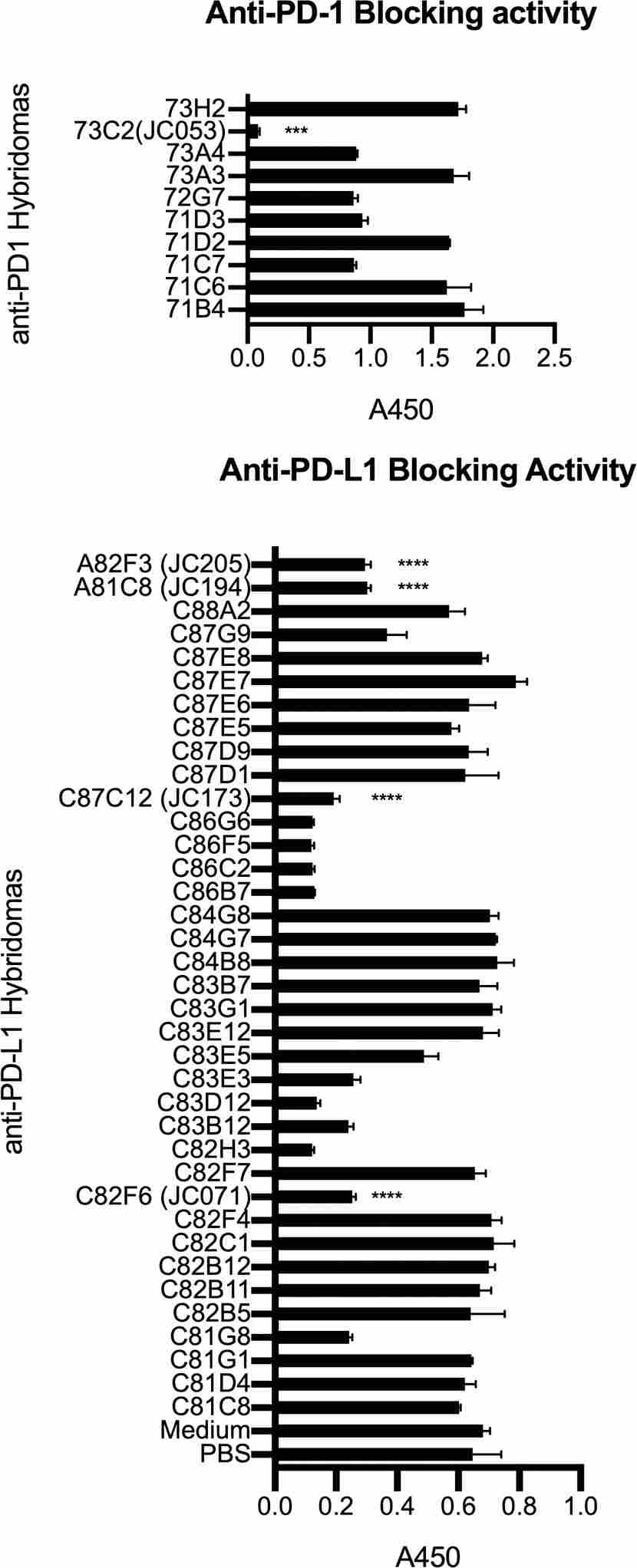
Choi et al. developed canine PD-1- and PD-L1-specific monoclonal antibodies and used a blocking ELISA to determine whether the candidates interfered with the PD-1/PD-L1 interaction. The published figure shows candidate-dependent differences in residual ligand binding, illustrating how a defined competitive format can distinguish antibodies with measurable blocking activity from binders that do not effectively disrupt the target interaction.

The same study advanced selected blocking antibodies into canine cell-based testing and showed that PD-L1 blockade could increase IFN-γ production in stimulated canine PBMC cultures. This progression from interaction-level blocking to a functional cellular readout reflects the service logic used by Creative Biolabs: direct competition assays can establish molecular interference, while orthogonal species-relevant cell assays can test whether that blockade produces the intended biological effect.

Fig.1 Evaluation of blocking activity by anti-canine PD-1 and PD-L1 antibodies.1,2
Service Advantages

Why Choose Creative Biolabs for Blocking and Neutralization Evaluation?

Assay design is aligned to the biological question, species context, and candidate-selection decision rather than forcing every antibody into one generic functional format.

Veterinary-Relevant Design

Canine and feline target biology guides model, reagent, control, and endpoint selection.

Orthogonal Evidence

Interaction-level blockade can be paired with cell-based functional confirmation where appropriate.

Quantitative Comparison

Matched dose-response designs support transparent potency and candidate-ranking decisions.

Flexible Assay Development

Custom models address novel targets, limited reagents, and non-standard veterinary mechanisms.

Frequently Asked Questions

Blocking & Neutralization Evaluation FAQs

A blocking assay usually measures inhibition of a defined molecular interaction, such as ligand-receptor binding. A neutralization assay measures suppression of biological activity, such as cytokine-driven signaling or pathogen infectivity. Depending on mechanism, both can be used sequentially to connect direct target interference with functional consequence.

References

  1. Choi, Jin Wook, et al. "Development of canine PD-1/PD-L1 specific monoclonal antibodies and amplification of canine T cell function." PLoS ONE 15.7 (2020): e0235518. https://doi.org/10.1371/journal.pone.0235518
  2. Distributed under Open Access license CC BY 4.0, without modification.

This site is protected by reCAPTCHA and the Google Privacy Policy and Terms of Service apply.