Fragment Engineering Service for Veterinary (Pet) Antibody

Convert canine and feline antibodies into purpose-built Fab, F(ab')2, scFv, multivalent, fusion, and, where appropriate, single-domain formats through coordinated molecular design, expression, purification, biophysical assessment, and functional comparison.

Service Introduction

Engineer the Molecular Format Around the Veterinary Use Case

Full-length antibodies provide Fc-mediated biology and familiar manufacturing routes, but they are not always the optimal molecular architecture. Removing or reconfiguring the Fc region can reduce molecular size, improve access to sterically restricted epitopes, eliminate unwanted Fc effector activity, enable modular fusion, or support multivalent and multispecific designs. Those benefits must be balanced against changes in half-life, avidity, expression, solubility, aggregation, and purification behavior.

Creative Biolabs develops antibody fragments for canine, feline, and other veterinary discovery programs with an integrated design-build-test strategy. We examine the parental sequences, target biology, intended route and duration of exposure, required valency, and downstream assay needs before selecting a format. Each construct is evaluated as a complete molecule rather than as a sequence alone, helping project teams identify a fragment that retains target recognition while meeting practical developability and production requirements.

FabMonovalent antigen binding with separate heavy- and light-chain contributions and no Fc effector domain.
F(ab')2Bivalent recognition and avidity without an intact Fc region, suitable when crosslinking is beneficial.
scFvCompact linked variable domains for modular fusion, display, targeting, and multispecific assembly.
CustomMultivalent, bispecific, tagged, half-life-extension, and, where appropriate, single-domain configurations built around program goals.
Antibody Fragment Engineering Services

Modular Solutions for Size, Valency, Function, and Developability

Service modules can be combined into a single comparison campaign and adapted to available sequence information, material, and project maturity.

Fab

Fab and F(ab')2 Engineering

Generate monovalent or bivalent antigen-binding fragments through recombinant design or controlled cleavage strategies. Construct boundaries, hinge elements, chain pairing, purification tags, and disulfide behavior are planned to preserve binding and support reproducible production.

scFv

scFv Orientation and Linker Optimization

Compare VH-linker-VL and VL-linker-VH orientations, linker length and composition, signal peptides, and optional stabilization changes. Expression, monomer content, thermal behavior, and antigen binding are considered together when ranking designs.

sdAb

Single-Domain Antibody Engineering

Where appropriate, develop compact single-domain binders using suitable scaffolds such as camelid-derived VHH, engineered conventional VH domains, or other validated sdAb formats. Conventional canine or feline VH domains are not assumed to function as standalone binders; exposed VH/VL interface liabilities, solubility, aggregation, affinity retention, and expression behavior are evaluated during design and screening.

2x

Multivalent and Multispecific Fragments

Assemble tandem scFvs, diabody-like formats, dual-target constructs, or other multivalent architectures. Domain order, linker geometry, chain pairing, avidity, and unwanted self-association are evaluated against the desired mechanism.

Fn

Fusion Design and Half-Life Extension

Fc or albumin-binding strategies may be incorporated to extend systemic exposure, while enzymes, cytokines, payloads, or other partners can be introduced to add complementary biological functions. Junctions and linkers are engineered to preserve access and activity across the resulting fusion format.

QC

Biophysical and Functional Characterization

Assess identity, purity, oligomeric state, aggregation, stability, yield, target binding, kinetics, and fit-for-purpose cell activity. Comparative data distinguish a potent but fragile molecule from a format suitable for continued development.

Workflow

A Six-Stage Antibody Fragment Design-Build-Test Workflow

Our workflow uses connected engineering gates so that format, expression, biophysical quality, and biological function can be iteratively optimized as new data emerge.

Assessment & Strategy

Define target biology, species, intended application, valency, Fc requirement, dosing assumptions, controls, and candidate-ranking criteria.

Fragment Construction

Design boundaries, orientation, linkers, tags, fusion partners, and species-relevant sequence or constant-region elements where applicable, supported by sequence analysis.

Expression & Purification

Express selected constructs in a suitable host, establish purification conditions, and confirm identity, purity, recovery, and homogeneity.

Biophysical & Functional Tests

Measure binding, kinetics, stability, aggregation, oligomeric state, and project-specific cell or biochemical activity.

Format Optimization

Refine linkers, orientation, valency, species adaptation, fusion design, or expression conditions using comparative evidence.

Report & Integration

Deliver sequences, construct records, production and assay data, candidate ranking, and options for scale-up or downstream evaluation.

Gate Activity Evidence Generated Decision
Project Assessment & Design Strategy Translate the veterinary mechanism and product concept into molecular-format, valency, species, expression, and assay requirements. Design brief, risk register, and comparison plan. Which fragment architectures should be built?
Antibody Fragment Construction Create sequence-verified Fab, F(ab')2, scFv, multivalent, fusion, and, where appropriate, single-domain constructs with suitable controls and scaffold-specific design criteria. Expression-ready plasmids and construct map. Do the designs represent the intended comparison?
Expression & Purification Screen host and purification conditions, then assess yield, identity, purity, and size distribution. Qualified fragment samples and analytical QC. Which constructs provide usable, homogeneous material?
Biophysical & Functional Characterization Compare stability and aggregation with antigen binding, kinetics, avidity, and relevant functional readouts. Cross-assay performance matrix. Does molecular performance support the mechanism?
Format Optimization & Multispecies Adaptation Iterate orientation, linkers, valency, fusion junctions, species-aware sequence choices, constant-region elements where applicable, or production parameters. Optimized variants and confirmatory data. Which changes improve the overall profile?
Comprehensive Reporting & Next-Step Integration Consolidate methods and data and define scale-up, conjugation, formulation, characterization, or in vivo study options. Final report, sequences, data files, and material. What is required to advance the selected fragment?

Not sure whether Fab, scFv, or another format fits?

Share the parental antibody sequence, target, species, and intended function; we can propose a practical comparison set.

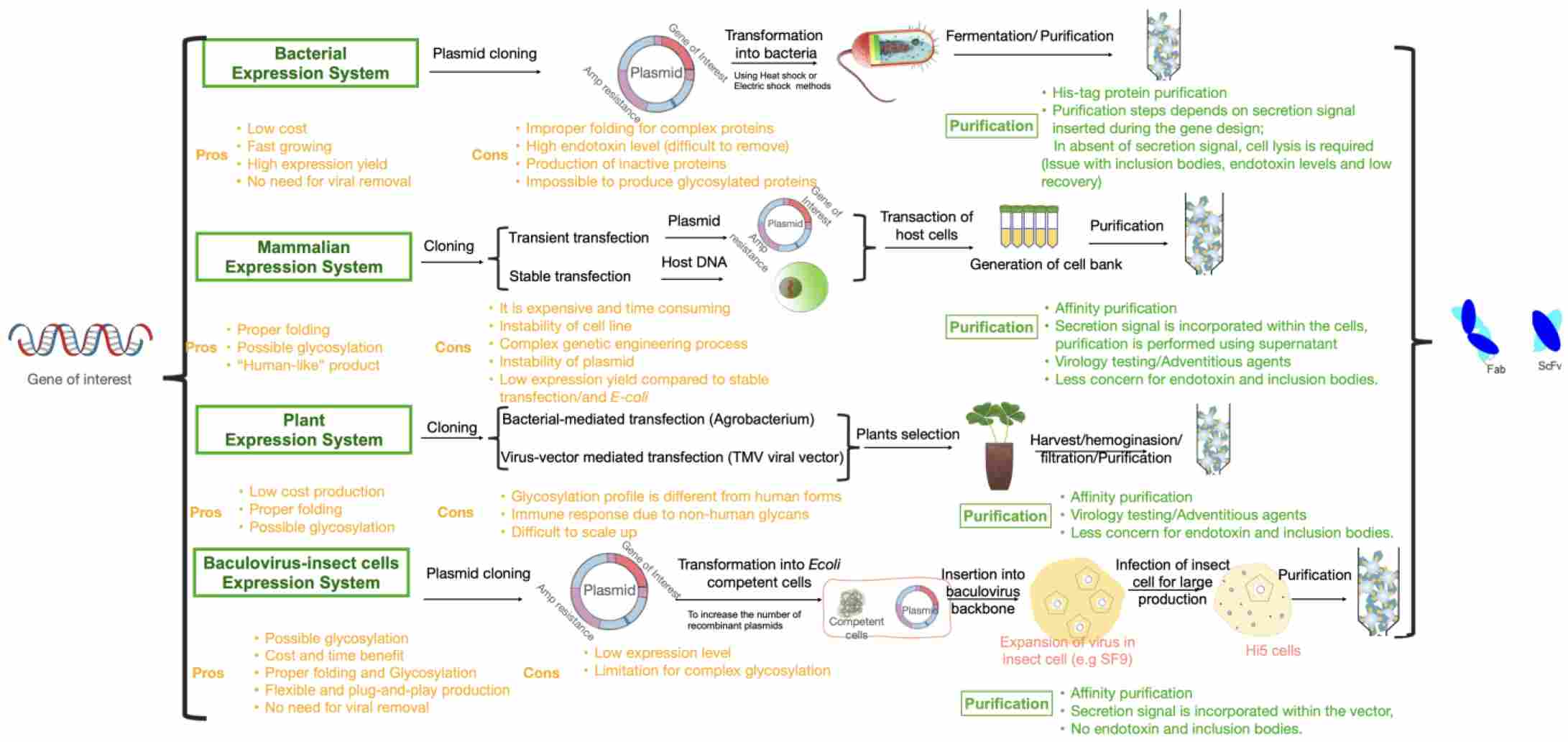
Comparison of expression systems used to bioengineer Fab and scFv antibody fragments. (OA Literature)
Fig.1 Expression-platform considerations for bioengineering Fab and scFv antibody fragments.1,2
Peer-Reviewed Engineering Evidence

Published Data Comparing Expression Platforms for Fab and scFv Bioengineering

Pirkalkhoran et al. summarized the opportunities and constraints of bacterial, mammalian, plant, and baculovirus-insect expression platforms for Fab and scFv production. The comparison shows why fragment development cannot treat expression as a downstream commodity: molecular complexity, folding, post-translational processing, endotoxin control, yield, purification burden, and cost can alter both the practical route and the quality of material available for testing.

This evidence supports an integrated engineering approach in which fragment architecture and production platform are selected together. Creative Biolabs can screen construct orientation, linker design, secretion strategy, expression host, and purification conditions before comparing antigen binding, stability, oligomeric state, and functional activity. For veterinary programs, that coordinated workflow helps avoid advancing a sequence that performs in an isolated binding assay but cannot be produced as a stable, homogeneous development candidate.

Why Choose Us?

Integrated Fragment Engineering for Veterinary Discovery

Our service connects molecular architecture to manufacturability and biological function, with the flexibility to support a single construct or a comparative format campaign.

Format-Neutral AdviceRecommendations follow the mechanism, not a predetermined molecular scaffold.
Design-to-Data ContinuitySequences, production, QC, binding, and function remain traceable across variants.
Veterinary AdaptationCanine, feline, and other species requirements inform sequence choices, molecular format, applicable constant-region elements, and assays.
Flexible DeliverablesReceive purified material, constructs, sequences, reports, and next-step options.
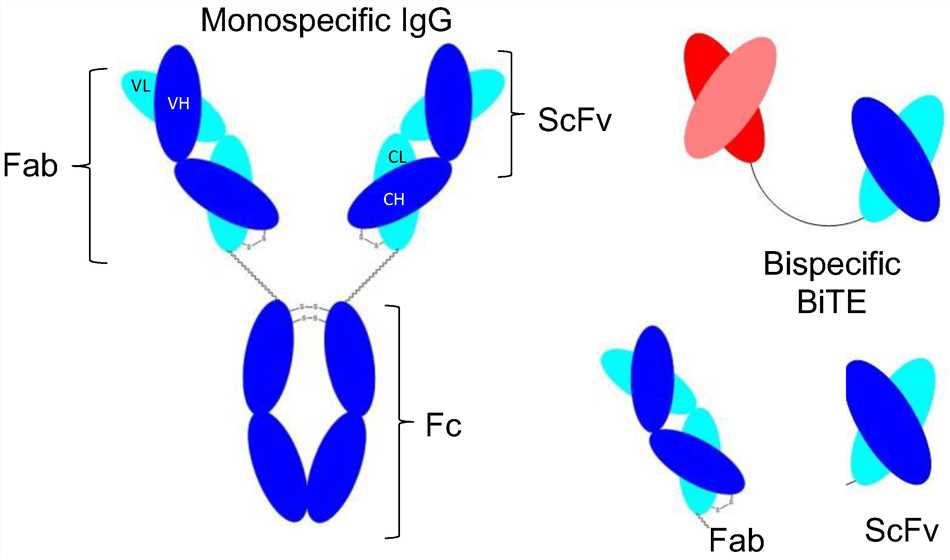
Representative antibody fragment formats and molecular architectures
Frequently Asked Questions

Veterinary Antibody Fragment Engineering FAQs

Selection depends on required valency, tissue access, exposure, Fc activity, target geometry, expression route, and downstream use. We translate those requirements into a short comparison set so decisions can be supported by production, stability, binding, and functional data rather than size alone.
Yes. Heavy- and light-chain variable-region sequences are typically sufficient to begin Fab, scFv, and related recombinant format design. For conventional canine or feline antibodies, a single VH domain is not assumed to behave as a stable single-domain antibody; sdAb options require an appropriate scaffold or additional VH engineering and experimental validation. Existing full-length material, binding data, epitope information, and assay methods are useful as controls.
We consider structural context, variable-domain interfaces, desired monomeric or multimeric behavior, fusion geometry, and expression experience. When the preferred orientation is uncertain, VH-linker-VL and VL-linker-VH designs or multiple linkers can be produced and ranked experimentally.
Options include intact mass or identity testing, SEC, electrophoresis, purity, concentration, thermal stability, aggregation, antigen binding, affinity or kinetics by SPR/BLI, avidity comparison, and project-specific biochemical or cell-based activity. The test panel is matched to the format and intended decision.
Please provide available variable-region sequences, antibody species and isotype, target and mechanism, desired fragment or application, binding and functional data, assay requirements, preferred tags or fusion partners, material quantities, and downstream plans. If the format is undecided, the program can begin with a design consultation.

References

  1. Pirkalkhoran, Sama, et al. "Bioengineering of Antibody Fragments: Challenges and Opportunities." Bioengineering 10.2 (2023): 122. https://doi.org/10.3390/bioengineering10020122
  2. Distributed under Open Access license CC BY 4.0, without modification.

This site is protected by reCAPTCHA and the Google Privacy Policy and Terms of Service apply.