
Our induction media delicately balance Wnt pathway modulators (such as CHIR99021) to efficiently direct hPSCs toward metanephric mesenchyme, ensuring a high-yield foundation for nephron formation.
The human kidney is a marvel of biological engineering, relying on an intricate network of nephrons to filter blood, regulate osmolality, and excrete metabolic waste. Traditional 2D renal cultures inevitably fail to capture the complex 3D architecture of the glomerular filtration barrier or the polarized function of the proximal tubules. At Creative Biolabs, we engineer highly specialized reagent ecosystems designed to drive the precise differentiation, structural patterning, and physiological maturation of human kidney organoids.
By delivering the exact morphogen gradients and matrix cues necessary for nephrogenesis, our solutions empower researchers to build patterned, multi-segmented renal tissues in vitro.
Contact our scientific support team today to build a specialized reagent package and secure a quotation tailored to your laboratory's needs.
Directing human pluripotent stem cells (hPSCs) to form organized kidney structures requires masterful control over the Wnt and FGF signaling pathways. Without highly calibrated biochemical support, cultures often yield off-target cell types or fail to form continuous epithelial structures. Our targeted formulations directly resolve these developmental challenges:
Our induction media delicately balance Wnt pathway modulators (such as CHIR99021) to efficiently direct hPSCs toward metanephric mesenchyme, ensuring a high-yield foundation for nephron formation.
Maintaining the delicate foot processes of podocytes outside the body is notoriously difficult. We provide specialized maturation supplements that upregulate key slit-diaphragm proteins like Nephrin and Podocin, enhancing barrier integrity.
Functional kidneys require strict apical-basal polarity to perform active transport. Our tailored extracellular environments promote correct lumen formation, enabling reliable modeling of tubular secretion and reabsorption.
Our reagent suites are rigorously formulated to support the simultaneous co-development of multiple nephron segments, including Bowman's capsule-like structures, proximal tubules, and distal convoluted tubules.
Renal toxicology demands a pristine, serum-free baseline to prevent protein binding from skewing drug clearance data. Our core differentiation media are 100% chemically defined, eliminating the unpredictability of animal-derived components.
Because consistent differentiation is the bedrock of reliable research, we put every lot through exhaustive sterility, endotoxin, and targeted functional testing. This means you receive the exact same high-performance baseline every single time, keeping your nephrotoxicity data clean and free of batch-to-batch artifacts.
We offer a comprehensive portfolio designed to support every critical phase of your renal organoid protocols:
From complex genetic disease modeling to high-throughput drug clearance profiling, our specialized reagent portfolio is explicitly calibrated to empower your most critical preclinical endpoints:
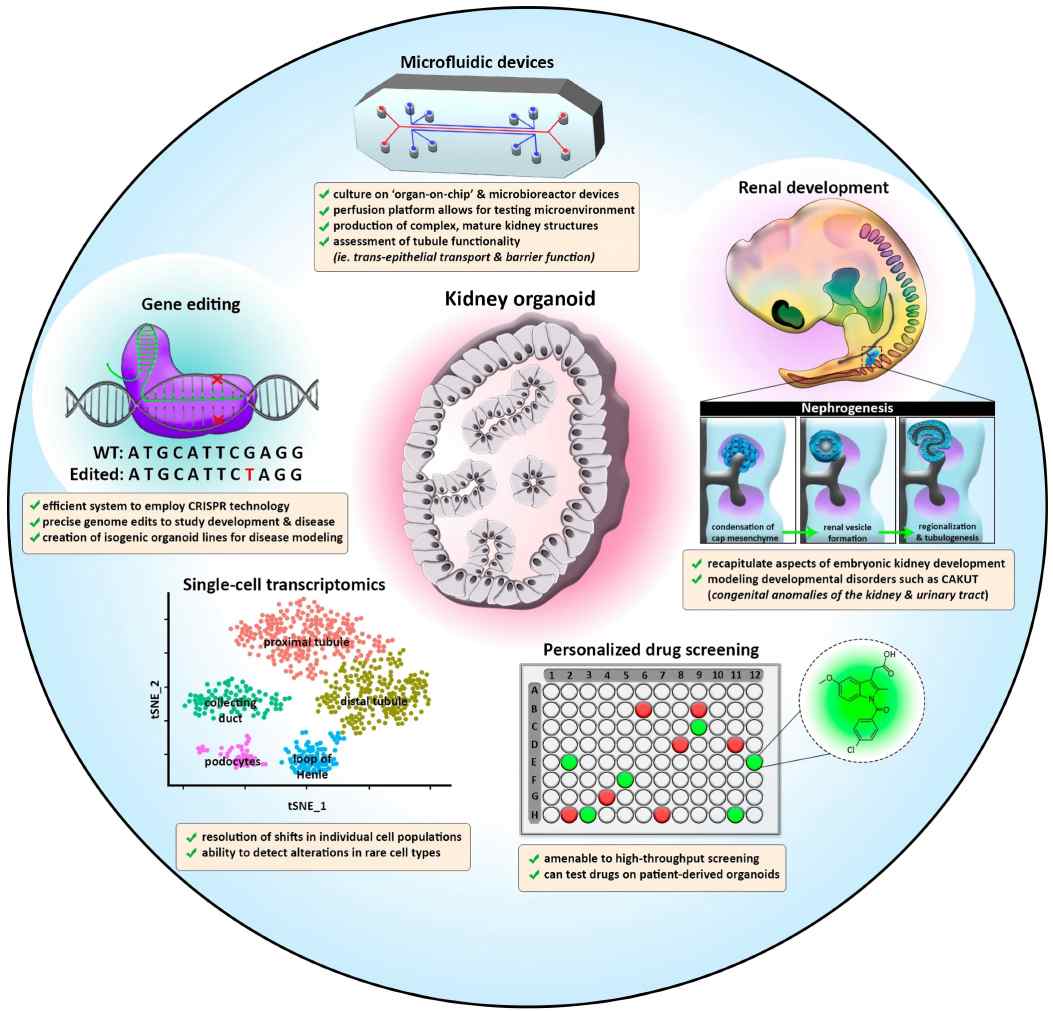 Fig.1 Diagram illustrating evolving applications of kidney organoid technologies.1
Your translational kidney research cannot afford the setbacks of poor structural patterning or inconsistent differentiation. Don't let generic cell culture media limit the predictive power of your assays. Partner with Creative Biolabs to cultivate highly organized, physiologically relevant kidney organoids that meet the exact demands of modern nephrology.
To discuss your specific toxicity screening requirements, request detailed differentiation protocols, or secure a custom pricing package, please email our scientific team at or call us directly at +1-631-357-2254.
Reference
For Research Use Only. Not For Clinical Use.