Organoid Differentiation Medium & Kits
Products
Introduction Science Systems Advantages Applications FAQsContact
Introduction
One of the greatest challenges in organoid culture is controlling cellular heterogeneity. While spontaneous differentiation can generate a mix of cell types, it often results in "noisy" models with inconsistent ratios of target cells. For research focusing on specific cell populations—such as dopaminergic neurons in the brain or goblet cells in the gut—reliance on random development is inefficient.
Creative Biolabs' Differentiation Media Platform provides the specific molecular cues required to guide stem cells down defined lineage paths. By strictly modulating key developmental signaling pathways (Notch, Wnt, BMP, FGF), our reagents ensure high-efficiency commitment to your target tissue identity.
Contact our technical team to discuss lineage-specific induction protocols.
The Science of Directed Differentiation
Organoid formation mimics embryonic development. To create a specific tissue, stem cells must receive the right signals at the right time. "Home-brew" differentiation protocols often struggle with:
-
Off-Target Cells: The presence of unwanted tissue types (e.g., non-neural ectoderm in brain organoids) that complicate analysis.
-
Low Efficiency: A small percentage of cells differentiates into the desired type.
-
Timing Variability: Inconsistent onset of differentiation markers between batches.
Our Chemically Defined Differentiation Kits replace stochastic processes with deterministic outcomes. We provide optimized cocktails of small molecules and recombinant proteins that lock cells into specific developmental trajectories.
Targeted Differentiation Systems
Our portfolio covers critical stages of lineage specification for both iPSC and ASC-derived models:
1. Neural Induction & Patterning Kits
Designed to guide iPSCs efficiently into neuroectoderm and further pattern them into specific brain regions.
-
Dorsal Forebrain Kit: Promotes cortical identity for studying corticogenesis.
-
Ventral Forebrain Kit: Induces inhibitory interneuron lineages.
-
Midbrain Specificity: Drives dopaminergic neuron differentiation for Parkinson's disease modeling.
2. Intestinal Lineage Bias Kits
Adult intestinal organoids naturally contain a mix of cell types. These media skew the population towards specific lineages for targeted studies.
-
Secretory Differentiation Medium: Inhibits Notch signaling to enrich for Goblet and Paneth cells, essential for mucus barrier studies.
-
Enteroendocrine Induction: Promotes the formation of rare hormone-secreting cells for metabolic research.
3. Definitive Endoderm & Hepatic Specification
A stepwise system to guide iPSCs through definitive endoderm induction, foregut specification, and finally into hepatoblast-like organoids, preparing them for final maturation.
Key Advantages
Why use a commercial differentiation kit over a published cytokine cocktail?
-
High Efficiency: Our protocols are optimized to maximize the percentage of target cells (e.g., >80% FOXG1+ cells in forebrain models), reducing the noise from non-target tissues.
-
Temporal Precision: Reagents are formulated to act within specific time windows, synchronizing the developmental clock of your culture.
-
Simplified Protocol: Complex differentiation often requires adding 5-10 different factors at varying concentrations. Our kits consolidate these into stable, ready-to-use supplements.
-
** reproducibility:** Standardized manufacturing ensures that the "instruction" given to the cells is identical every time, yielding consistent tissue architecture.
Applications
-
Developmental Biology: dissecting the molecular mechanisms of fate decisions and tissue patterning in a controlled environment.
-
Cell-Type Specific Toxicology: Enriched cultures allow you to test toxicity specifically on susceptible cell types (e.g., dopaminergic neurons) without the dilution effect of other cells.
-
Disease Modeling: Creating models of diseases caused by lineage allocation defects (e.g., Hirschsprung's disease or specific cortical malformations).
-
Regenerative Medicine Research: Generating pure populations of progenitor cells for potential therapeutic screening.
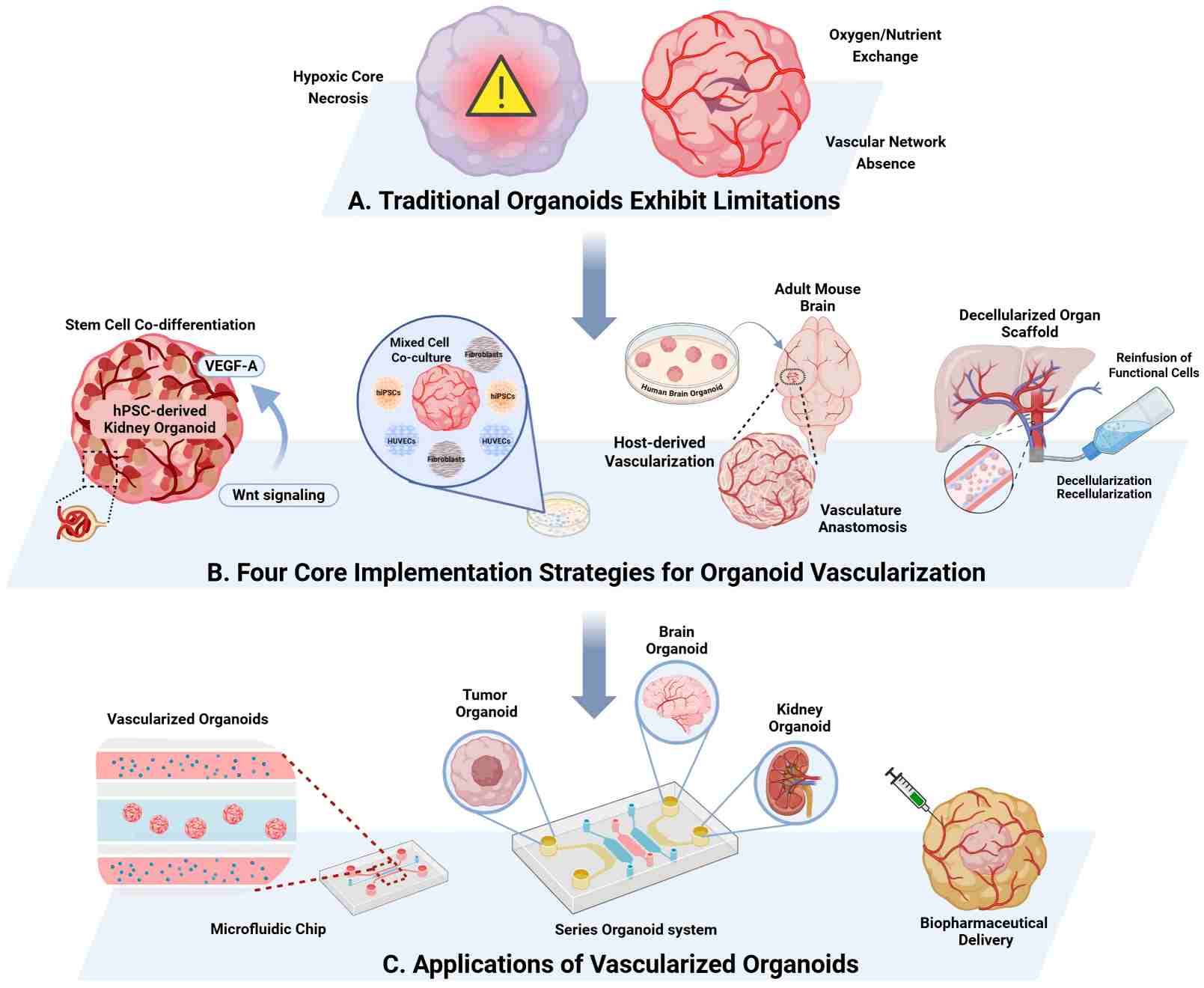 Fig.1 Strategies and applications of vascularized organoids.1
FAQs
-
1: How does this differ from Maturation Media?
A: Differentiation focuses on identity (determining what kind of tissue the cell will become, e.g., turning an iPSC into a forebrain progenitor). Maturation focuses on function (making that progenitor behave like an adult cell, e.g., making the neuron fire). Often, differentiation media are used first, followed by maturation media.
-
2: Are these kits compatible with any iPSC line?
A: While optimized for standard reference lines, iPSCs can have innate lineage biases. Our kits are robust, but some cell line-specific optimization of induction timing may be required.
-
3: Can I combine these with gene editing?
A: Yes. Differentiating isogenic pairs (wild-type and mutant) using these standardized kits is the gold standard for studying the developmental impact of specific mutations.
How to Contact Us
Move beyond random differentiation. Ensure your organoids contain the specific cell types relevant to your research question.
To explore our differentiation portfolio or request a quote for your lab, please contact our specialists at info@creative-biolabs.com or call +1-631-357-2254.
Contact Us
Reference
-
Zhao, Rui et al. "Iteration of Tumor Organoids in Drug Development: Simplification and Integration." Pharmaceuticals (Basel, Switzerland) vol. 18,10 1540. 13 Oct. 2025. Distributed under Open Access license CC BY 4.0, without modification. https://doi.org/10.3390/ph18101540
For Research Use Only. Not For Clinical Use.
Species Reactivity Human
Application Organoid Differentiation
Size 1 Kit
Species Reactivity Human
Application Organoid Differentiation
Size 1 Kit (1T)
Species Reactivity Human
Application Organoid Differentiation
Size 1 Kit (1T)
Species Reactivity Human
Application Organoid Differentiation
Size 1 Kit
Species Reactivity Human
Application Organoid Differentiation
Size 1 Kit
Species Reactivity Human
Application Organoid Differentiation
Size 1 Kit
Species Reactivity Human
Application Colorectal Lineage Maturation
Size 100 mL, 500 mL
Species Reactivity Human
Application Lineage Specification & Patterning
Size 100 mL
Species Reactivity Human
Application ATII Cell Differentiation
Size 100 mL, 500 mL
Species Reactivity Human
Application 3D Epidermal Model Construction (ALI)
Size 100 mL, 500 mL
Species Reactivity Mouse
Application Differentiation
Size 100 mL, 500 mL
Species Reactivity Human
Application Differentiation
Size 100 mL, 500 mL
Species Reactivity Human
Application Differentiation
Size 100 mL, 500 mL
Species Reactivity Mouse
Application Differentiation
Size 100 mL, 500 mL