Tumoroid & Patient-derived Cancer Organoid Model Products
Products
Introduction Dynamics Benchmark Portfolio Breakthrough FAQsContact
Introduction
Traditional 2D cancer cell lines rapidly undergo clonal selection, losing the mutational landscape and spatial architecture of the original human tumor. Creative Biolabs engineers highly specialized reagent matrices and media systems designed specifically for the establishment, long-term expansion, and therapeutic screening of patient-specific organoids and tumoroids.
By supplying the exact pro-tumorigenic factors and defined microenvironments your models require, our solutions empower researchers to capture the true malignant plasticity and intra-tumor heterogeneity of primary biopsies in vitro.
Contact our oncology support team today to discuss your patient-specific organoid derivation protocols and secure a customized pricing proposal tailored to your laboratory.
Preserving Malignant Heterogeneity & Clonal Dynamics
Deriving predictive models from primary patient tissue is a race against cellular stress and phenotypic drift. Without highly calibrated biochemical support, cultures often succumb to normal cell contamination or lose critical mutant clones. Our specialized tumoroid formulations tackle these exact oncological challenges:
Suppressing Normal Epithelial Overgrowth
-
Primary biopsies contain healthy stroma and epithelia that can easily outcompete slow-growing tumor clones. Our expansion media utilize targeted small molecule combinations to selectively suppress wild-type cell proliferation while accelerating malignant growth.
Maintaining Genomic Instability
-
Unlike standard media that induce artifactual genetic drift, our defined formulations are rigorously calibrated to preserve the original mutational burden, copy number variations (CNVs), and transcriptomic signatures of the patient's tumor over continuous passaging.
TME Co-Culture Compatibility
-
Modeling the tumor microenvironment (TME) is critical for immunotherapy testing. We offer clean, serum-free basal systems that permit the stable, extended co-culture of tumoroids with cancer-associated fibroblasts (CAFs) and autologous immune infiltrates.
The Creative Biolabs Standard for Precision Oncology
High-Throughput Adaptability
Formulated for scalability, our liquid media and paired matrices transition seamlessly into 384-well formats, enabling massive libraries of chemotherapeutic and targeted screening without viscosity-related pipetting errors.
Xeno-Free Pharmacological Clarity
Drug efficacy and IC50 values are easily skewed by the unpredictable protein binding of animal serum. Our oncology portfolio is entirely chemically defined, providing a biologically pristine background for precise pharmacological readouts.
Stringent Batch Uniformity
Because clinical translation demands absolute reproducibility, we subject every lot to rigorous endotoxin, osmolality, and primary tumoroid expansion assays. You receive an unwavering baseline that eliminates false positives in your drug screens.
Specialized Reagent Suites for Patient-Specific Organoid Workflows
We supply a comprehensive catalog of solutions to support every stage of your precision oncology research:
-
1. Primary Biopsy Digestion & Isolation Kits Optimized enzymatic cocktails designed to gently dissociate solid human tumors (including heavily desmoplastic tissues) while preserving the maximum viability of rare cancer stem cell (CSC) populations.
-
2. Universal Tumoroid Expansion Media A highly enriched, serum-free formula that supports the robust derivation and biobanking of diverse epithelial carcinomas, preventing premature senescence during the critical early passages.
-
3. Lineage-Specific Oncology Supplements Targeted nutrient packs tailored to the unique metabolic and signaling dependencies of specific malignancies, ensuring the survival of distinct subtypes like KRAS-mutant colorectal or EGFR-amplified lung cancer tumoroids.
-
4. TME-Mimetic Hydrogel Scaffolds Advanced 3D matrices engineered to replicate the stiff, highly crosslinked extracellular matrix characteristic of solid tumors, physically supporting invasive cellular phenotypes and invadopodia formation.
Driving Next-Generation Cancer TherapiesEnabling High-Fidelity Developmental Modeling
Purpose-built to navigate the complexities of precision medicine, our defined reagent platforms provide the uncompromising biological accuracy required for your most critical oncological assays:
-
Personalized Drug Screening: Generate patient-specific organoid libraries to prospectively predict clinical responses to chemotherapies, biologics, and novel small molecules.
-
Immuno-Oncology Efficacy: Utilize our co-culture compatible baselines to evaluate CAR-T cell infiltration, immune checkpoint inhibitor (ICI) effectiveness, and macrophage polarization.
-
Mechanisms of Resistance: Cultivate tumoroids under selective drug pressure to uncover acquired resistance pathways and identify secondary therapeutic targets.
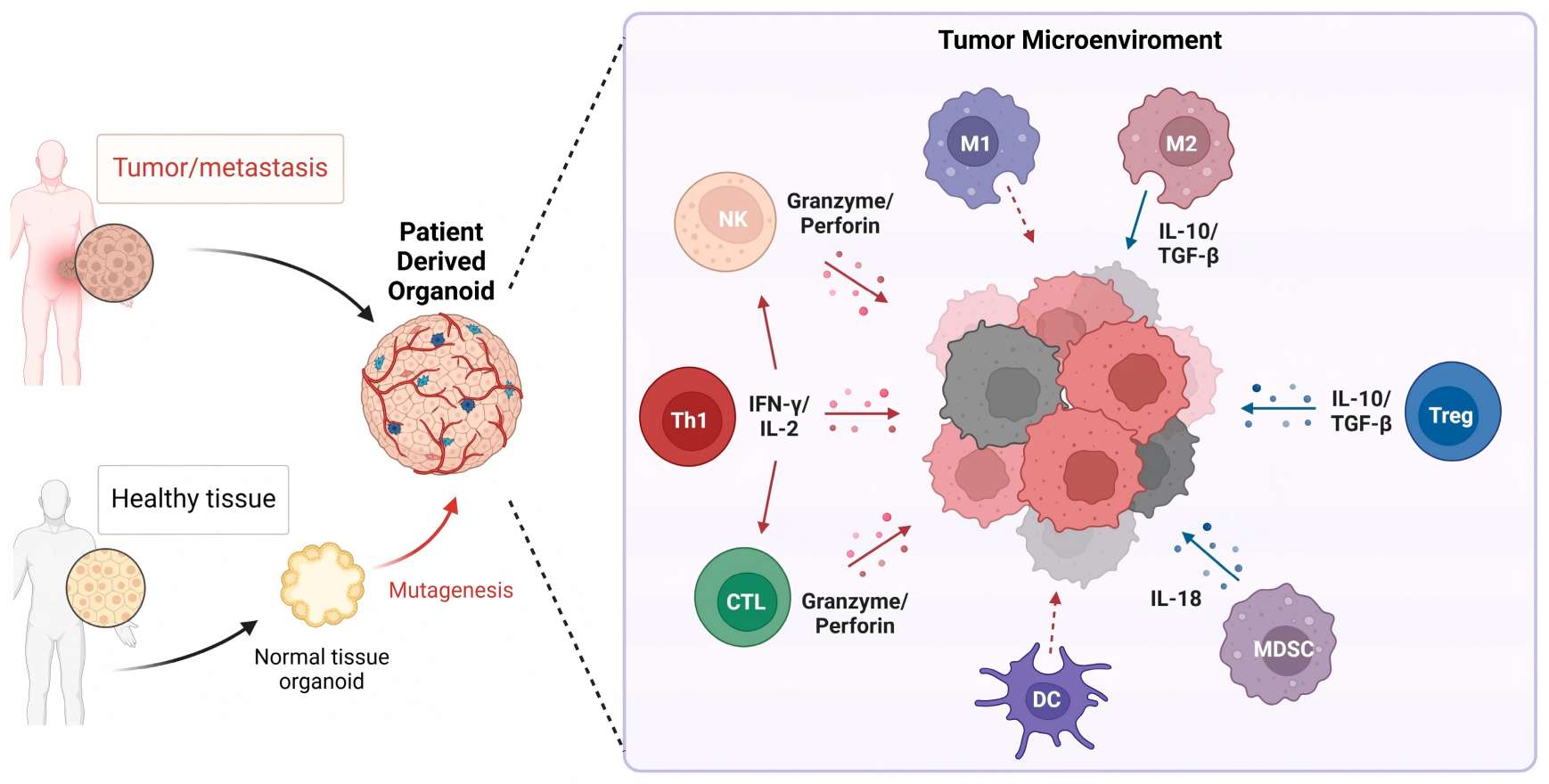 Fig.1 A patient-derived organoid replicates the tissue's architecture, function, and cellular heterogeneity of origin, including the tumor microenvironment.1
FAQs
-
1. How can I ensure normal healthy cells don't take over my tumoroid culture?
We provide detailed application protocols utilizing targeted inhibitors (like Nutlin-3a for p53-mutant tumors) or specific growth factor withdrawal strategies alongside our media to effectively select against wild-type epithelial outgrowth.
-
2. Are your matrices compatible with automated liquid handlers for drug screening?
Yes. Our media and optimized hydrogel formulations are engineered with specific rheological properties, making them highly suitable for automated dispensing in high-throughput screening (HTS) pipelines.
-
3. Can I use these reagents for immunotherapy cytotoxicity assays?
Absolutely. The chemically defined, serum-free nature of our basal media provides a highly stable environment for introducing PBMCs or isolated T-cells, allowing you to accurately assess immune-mediated cytotoxicity without serum-induced background interference.
How to Contact Us
Connect with our oncology application scientists at or dail +1-631-357-2254 today to receive custom pricing and advanced protocol support for your tumoroid workflows.
Contact Us
Reference
-
Palacios, Pablo A et al. "Patient-Derived Organoid Models for NKT Cell-Based Cancer Immunotherapy." Cancers vol. 17,3 406. 26 Jan. 2025. Distributed under Open Access license CC BY 4.0, without modification. https://doi.org/10.3390/cancers17030406
For Research Use Only. Not For Clinical Use.
Species Reactivity Mouse
Application Organoid Culture
Size 100 mL
Species Reactivity Human
Application Organoid Co-culture
Size 1 Kit
Species Reactivity Mouse
Application Organoid Culture
Size 100 mL
Species Reactivity Mouse
Application Organoid Culture
Size 100 mL
Species Reactivity Mouse
Application Organoid Culture
Size 100 mL
Species Reactivity Mouse
Application Organoid Culture
Size 100 mL
Species Reactivity Mouse
Application Organoid Culture
Size 100 mL
Species Reactivity Mouse
Application Organoid Culture
Size 100 mL
Species Reactivity Mouse
Application Organoid Culture
Size 100 mL
Species Reactivity Mouse
Application Organoid Culture
Size 100 mL, 500 mL
Species Reactivity Human
Application Organoid Culture
Size 100 mL
Species Reactivity Human
Application Organoid Culture
Size 100 mL
Species Reactivity Human
Application Organoid Culture
Size 100 mL
Species Reactivity Human
Application Organoid Co-culture
Size 1 Kit
Species Reactivity Human
Application Organoid Co-culture
Size 1 Kit
Species Reactivity Human
Application Organoid Co-culture
Size 1 Kit
Species Reactivity Human
Application Air-Liquid Interface (ALI) Culture, Organoid Culture
Size 1 Kit
Species Reactivity Human
Application Organoid Culture
Size 1 Kit (5T)
Species Reactivity Human
Application Organoid Culture
Size 1 Kit (5T)
Species Reactivity Human
Application Cancer-associated fibroblast culture
Size 500 mL
Species Reactivity Human
Application Culturing human sarcoma organoids
Size 100 mL, 1000 mL
Species Reactivity Human
Application Culturing human tongue cancer organoids
Size 100 mL, 1000 mL
Species Reactivity Human
Application Culturing human non-small cell lung cancer organoids
Size 100 mL, 1000 mL
Species Reactivity Human
Application Organoid Establishment & Maintenance
Size 100 mL, 500 mL
Species Reactivity Human
Application Organoid Establishment & Maintenance
Size 100 mL, 500 mL
Species Reactivity Human
Application Organoid Establishment & Maintenance
Size 100 mL, 500 mL
Species Reactivity Human
Application Organoid Establishment & Maintenance
Size 100 mL, 500 mL
Application Establishment, Expansion
Size 100 mL
Application Establishment, Expansion
Size 100 mL
Application Establishment, Expansion
Size 100 mL
Species Reactivity Human
Application Establishment, Expansion
Size 100 mL
Species Reactivity Human
Application Establishment, Expansion
Size 100 mL, 500 mL
Species Reactivity Human
Application Establishment, Expansion
Size 100 mL, 500 mL
Species Reactivity Human
Application Establishment, Expansion
Size 100 mL, 500 mL
Species Reactivity Human
Application Establishment, Expansion
Size 100 mL, 500 mL
Species Reactivity Human
Application Establishment, Expansion
Size 100 mL, 500 mL
Species Reactivity Human
Application Establishment, Expansion
Size 100 mL, 500 mL
Species Reactivity Human
Application Establishment, Expansion
Size 100 mL, 500 mL
Species Reactivity Human
Application Establishment, Expansion
Size 100 mL, 500 mL
Species Reactivity Human
Application Establishment, Expansion
Size 100 mL
Species Reactivity Human
Application Establishment, Expansion
Size 100 mL, 500 mL
Species Reactivity Human
Application Establishment, Expansion
Size 100 mL, 500 mL
Species Reactivity Human
Application Establishment, Expansion
Size 100 mL, 500 mL
Species Reactivity Human
Application Establishment, Expansion
Size 100 mL, 500 mL
Species Reactivity Human
Application Establishment, Expansion
Size 100 mL, 500 mL
Species Reactivity Human
Application Establishment, Expansion
Size 100 mL, 500 mL
Species Reactivity Human
Application Establishment, Expansion
Size 100 mL, 500 mL
Species Reactivity Human
Application Establishment, Expansion
Size 100 mL, 500 mL
Species Reactivity Human
Application Establishment, Expansion
Size 100 mL, 500 mL
Species Reactivity Human
Application Establishment, Expansion
Size 100 mL, 500 mL