Nervous System & Brain Organoid Model Products
Products
Introduction Engineering Excellence Portfolio Impact FAQsContact
Introduction
The human brain represents the ultimate frontier of biological complexity. Replicating its intricate synaptic networks, regional identities, and multi-layered cortical structures in vitro requires far more than conventional media. At Creative Biolabs, we engineer highly calibrated reagent ecosystems designed to guide human pluripotent stem cells (hPSCs) through embryoid body formation, neural induction, and extended functional maturation.
By providing the precise morphogen gradients and neurotrophic support your 3D models demand, our formulations empower you to construct electrically active, architecturally accurate cerebral tissues.
Contact our scientific support team today to build a specialized reagent package and secure a quotation tailored to your neurobiology laboratory.
Engineering the Complexity of the Human CNS
Directing neural rosettes into stratified brain spheroids requires masterful manipulation of developmental pathways. Without precise biochemical control, cultures suffer from off-target induction or premature collapse. Our media directly resolve these hurdles:
Optimized Dual-SMAD Inhibition
-
Our basal media deliver the exact stoichiometric ratios of Noggin and SB431542 to rapidly drive hPSCs toward a highly pure neuroectoderm fate.
Precise Spatial Patterning
-
We provide targeted morphogen cocktails (including Wnt, Sonic Hedgehog, and FGF) to accurately specify forebrain, midbrain, or spinal cord identities.
Long-Term Homeostasis
-
Culturing brain organoids requires maintaining tissues for months. Our maturation formulations feature specialized antioxidants and lipid carriers to minimize necrotic cores and sustain deep-tissue viability.
The Creative Biolabs Standard for Neuroscience
Cortical Stratification
Our suites support the directed migration of neural progenitor cells, promoting the development of distinct ventricular zones and mature cortical layers.
Robust Synaptic Activity
We supply essential neurotrophins (BDNF, GDNF) to drive robust dendritic arborization, synaptogenesis, and spontaneous network bursting suitable for MEA recordings.
Stringent Media Validation
Neurotoxicity assays demand a pristine background. Every batch undergoes exhaustive endotoxin screening and functional validation utilizing live 3D neural cultures. You receive an unwavering, biologically clean foundation that eliminates experimental noise.
Targeted Reagent Suites for Neurobiology
-
1. Rapid Neural Induction Media A defined system that accelerates the transition from hPSCs to highly proliferative neural progenitor cells (NPCs), minimizing batch-to-batch variability.
-
2. Region-Specific Patterning Modulators Tailored growth factor cocktails engineered to push unpatterned neuroepithelium toward specific fates, such as dopaminergic midbrain organoids or retinal spheroids.
-
3. Terminal Maturation & Glial Cocktails A serum-free, neurotrophin-rich supplement that downregulates proliferation, driving differentiation into mature neurons while supporting the critical emergence of astrocytes.
-
4. Biomimetic Neural Matrices Standard hydrogels can physically restrict neurite extension. We supply dynamically tuned scaffolds replicating the soft, hyaluronic acid-rich environment of the native brain.
Accelerating Neurological Discoveries
Our neural portfolio is explicitly calibrated to empower your most critical preclinical endpoints:
-
Neurodegenerative Disease Modeling: Sustain healthy, long-term cultures to model amyloid-beta and tau aggregation in Alzheimer's.
-
Neurodevelopmental Teratology: Evaluate the impact of environmental toxins or viral infections (like Zika) on early organogenesis.
-
Neurotoxicity Screening: Perform highly predictive safety pharmacology using functionally mature networks.
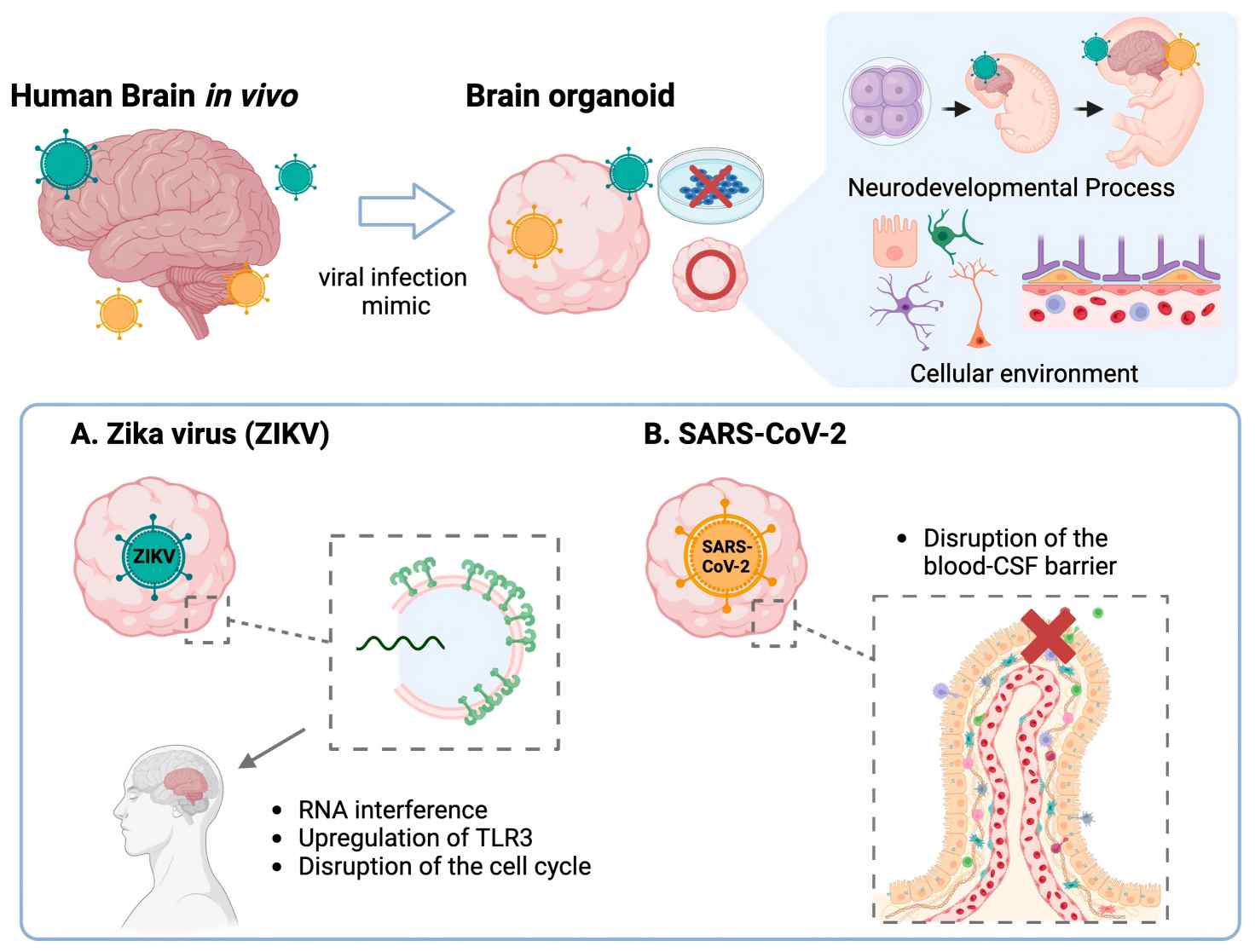 Fig.1 Schematic illustration of the advantages of using organoids in CNS viral infection, compared with the conventional 2D viral infection model.1
FAQs
-
1. Do your differentiation media support the co-development of glial cells?
Yes. Our long-term terminal maturation media are specifically formulated to support the intrinsic developmental timeline of the CNS, allowing for the natural emergence and proliferation of astrocytes alongside mature neurons after prolonged culture (typically >60 days).
-
2. Can I use these reagents to generate midbrain-specific organoids?
Absolutely. We offer specialized patterning modulators enriched with precise concentrations of Shh agonists and FGF8 to efficiently direct neural progenitors toward a mature, neuromelanin-producing dopaminergic phenotype.
-
3. How do your media formulations address the issue of necrotic cores in large brain organoids?
Our maturation supplements are optimized with specific neuroprotective agents, enhanced lipid carriers, and optimized osmolarity to enhance nutrient diffusion. While agitation (spinning bioreactors) is still recommended, our media significantly delays and reduces deep-tissue hypoxia.
How to Contact Us
To discuss your specific screening requirements, request detailed protocols, or secure a custom pricing package, email our scientific team at or call +1-631-357-2254.
Contact Us
Reference
-
Lue, Jaida C, and Derek C Radisky. "From Embryogenesis to Senescence: The Role of Mammary Gland Physiology in Breast Cancer Risk." Cancers vol. 17,5 787. 25 Feb. 2025. Distributed under Open Access license CC BY 4.0, without modification. https://doi.org/10.3390/cancers17050787
For Research Use Only. Not For Clinical Use.
Species Reactivity Mouse
Application Differentiation
Size 100 mL, 500 mL
Species Reactivity Mouse
Application Establishment, Expansion
Size 100 mL, 500 mL
Species Reactivity Human
Application Differentiation
Size 100 mL, 500 mL
Species Reactivity Human
Application Establishment, Expansion
Size 100 mL, 500 mL
Application Establishment, Expansion
Size 100 mL
Species Reactivity Human
Application Establishment, Expansion
Size 100 mL