Introduction Architecture Excellence Portfolio Discoveries FAQsContact
Introduction
The human skin is a remarkably dynamic barrier, integrating stratified epithelia, dense connective tissues, and complex appendages to protect against environmental stressors. Traditional 2D keratinocyte cultures completely miss the vital crosstalk at the dermal-epidermal junction (DEJ) and the protective cornification process. At Creative Biolabs, we specialize in advanced reagent formulations designed to drive the robust morphogenesis of 3D skin organoids and full-thickness cutaneous equivalents.
By providing the exact calcium gradients and morphogen cocktails your cells require, our solutions empower you to build multi-layered, functional epidermal models in vitro.
Contact with our tissue engineering specialists today to establish a tailored reagent framework and secure a quotation customized to your dermatological research.
Mastering Epidermal Stratification & Dermal Crosstalk
To properly model the epidermis, basal stem cells must proliferate, differentiate, and ultimately cornify. Without the precise biochemical milieu, cultures fail to form a competent stratum corneum or rapidly lose their regenerative basal pool. Our solutions tackle these specific cutaneous challenges head-on:
Controlled Cornification
-
Our media utilize carefully calibrated calcium gradients and specialized lipid supplements to trigger proper keratinocyte terminal differentiation, establishing a robust, impermeable physical barrier.
Appendage Morphogenesis
-
For advanced hair-bearing models, our specialized morphogen cocktails manipulate Wnt and BMP signaling to successfully induce the invagination of functional hair follicles and sebaceous glands.
Melanocyte Integration
-
We provide the specific neurotrophic factors and endothelins required to seamlessly co-culture melanocytes within the basal layer, allowing for highly accurate modeling of pigmentation and UV radiation responses.
The Creative Biolabs Benchmark for Cutaneous Fidelity
Uncompromised Barrier Integrity
Our stratification supplements ensure the development of tight junctions and a mature lipid matrix. This generates models that routinely pass rigorous trans-epidermal water loss (TEWL) and trans-epithelial electrical resistance (TEER) validation.
Dependable Lot-to-Lot Consistency
Dermatological toxicity testing leaves no room for variable reagents. We put every single media batch through rigorous sterility, trace-endotoxin, and functional stratification tests. You receive an unwavering baseline that guarantees your irritation and sensitization readouts are authentic, cutting out frustrating experimental noise.
Chemically Defined & Xeno-Free
To meet the increasingly stringent regulatory standards of the cosmetic and pharmaceutical industries, our core differentiation kits are entirely free of undefined animal sera.
Comprehensive Reagents for Integumentary Workflows
We offer a targeted portfolio designed to support every critical phase of your skin organoid generation:
-
1. Keratinocyte Progenitor Expansion Media A highly defined formula that aggressively expands primary epidermal keratinocytes while strictly preserving their p63+ basal stem cell phenotype, preventing premature differentiation during biobanking.
-
2. Epidermal Stratification Cocktails Explicitly designed for Air-Liquid Interface (ALI) transitions, this supplement provides the high-calcium, ascorbate-rich environment needed to sequentially construct the spinous, granular, and cornified layers.
-
3. Appendage-Inducing Modulators A precise blend of small molecules and growth factors engineered to drive the aggregation of dermal papilla cells, initiating hair follicle cycling and sebaceous gland formation in vitro.
-
4. Dermal-Mimetic Scaffolding Matrices We supply finely tuned collagen and hyaluronic acid-based hydrogels that offer the exact mechanical stiffness required to support fibroblast contraction, vascularization, and proper dermal-epidermal alignment.
Pioneering Dermatological Discoveries
Engineered to replicate native epidermal architecture and barrier function, our optimized culture formulations provide a rigorous, highly reproducible foundation for your advanced experimental workflows:
-
Cosmetic & Topical Toxicity: Conduct highly predictive skin irritation, corrosion, and sensitization screening without animal testing, fully complying with global OECD regulatory guidelines.
-
Wound Healing & Regeneration: Evaluate the efficacy of novel therapeutics and re-epithelialization kinetics using metabolically active, full-thickness cutaneous models.
-
Cutaneous Disease Modeling: Accurately replicate the pathogenesis of inflammatory disorders (like psoriasis and atopic dermatitis) and invasive melanomas using patient-derived cells.
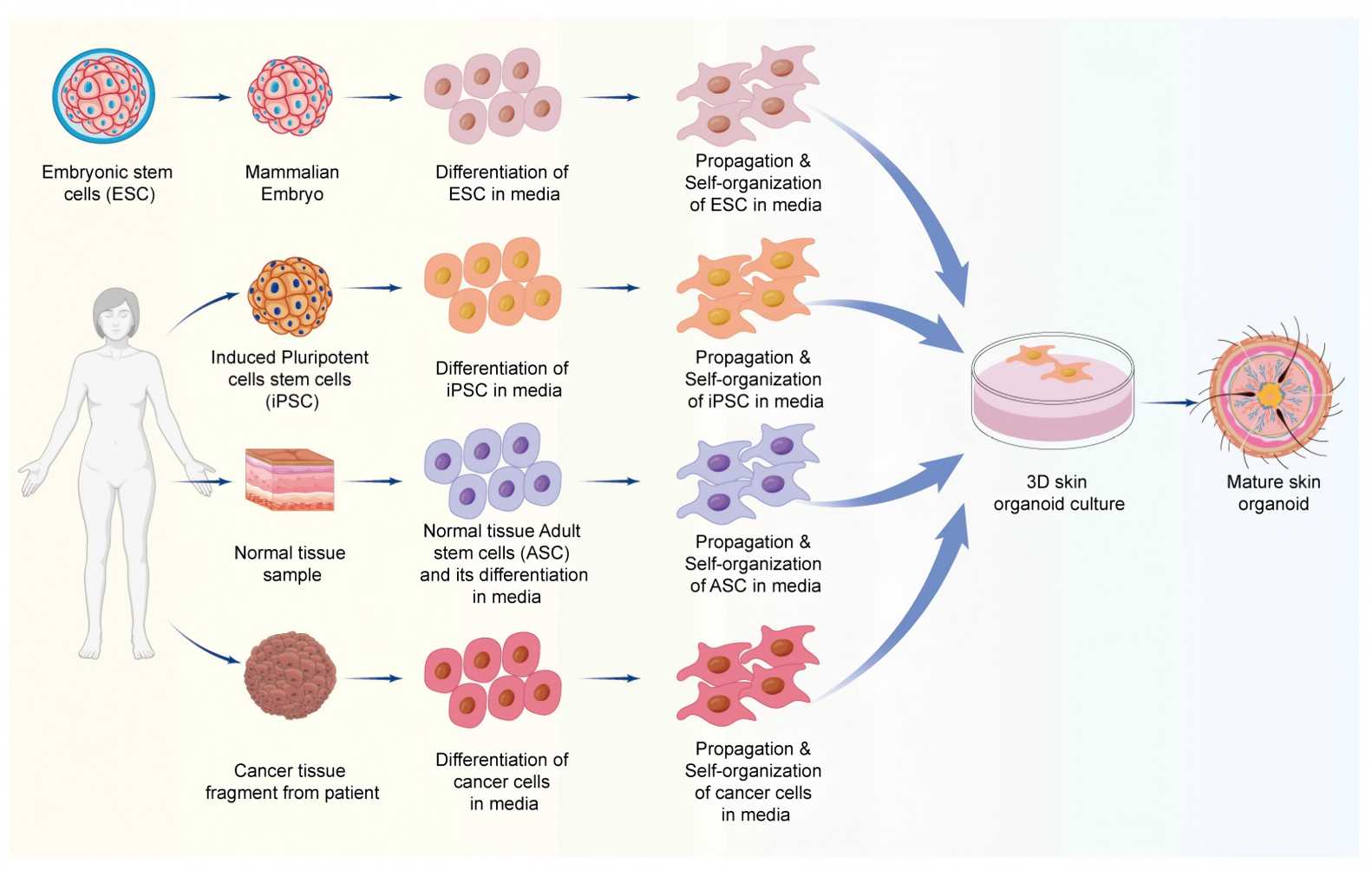 Fig.1 A schematic representation of the general process of skin organoid development from various sources of stem cells, viz., embryonic stem cells (ESCs), induced pluripotent cells (iPSCs), adult stem cells (ASCs), and cancer tissue cells in a culture media.1
FAQs
-
1. Do these media support the Air-Liquid Interface (ALI) technique?
Yes. Our epidermal stratification cocktails are specifically engineered to perform optimally when your tissue constructs are raised to the ALI, which is a necessary mechanical step for triggering terminal cornification.
-
2. Can I incorporate immune cells into these cutaneous models?
Absolutely. Our serum-free basal formulations provide a clean biological slate, allowing researchers to successfully co-culture Langerhans cells, macrophages, or T-cells to study inflammatory skin conditions without undefined background activation.
-
3. Do your reagents support the generation of hair-bearing organoids?
Yes. By utilizing our specialized appendage-inducing modulators with pluripotent stem cells, you can direct the self-organization of complex cutaneous organoids complete with functional hair follicles and integrated sensory neurons.
How to Contact Us
To discuss your specific irritation assays, request detailed ALI protocols, or secure a tailored pricing proposal, please email our experts directly at or ring us at +1-631-357-2254 today.
Contact Us
Reference
-
Wang, Xin-Yu et al. "Organoids as Tools for Investigating Skin Aging: Mechanisms, Applications, and Insights." Biomolecules vol. 14,11 1436. 12 Nov. 2024. Distributed under Open Access license CC BY 4.0, without modification. https://doi.org/10.3390/biom14111436
For Research Use Only. Not For Clinical Use.
Species Reactivity Mouse
Application Organoid Culture
Size 1 Kit (5T)
Species Reactivity Human
Application Organoid Culture
Size 100 mL
Species Reactivity Human
Application Primary Cell Isolation
Size Digestion Solution I: 5 mL
Digestion Solution II: 5 mL
Species Reactivity Human
Application Keratinocyte Expansion & Maintenance
Size 100 mL, 500 mL
Species Reactivity Human
Application 3D Epidermal Model Construction (ALI)
Size 100 mL, 500 mL