Mammary Organoid Model Products
Products
Introduction Fidelity Excellence Solutions Impact FAQsContact
Introduction
The human mammary gland is a uniquely dynamic organ, undergoing massive structural remodeling during puberty, pregnancy, and lactation. Standard monolayer cultures completely fail to capture the complex ductal branching, bi-layered epithelial architecture, and extreme hormone responsiveness of native breast tissue. At Creative Biolabs, we specialize in advanced culture formulations engineered to support the reliable establishment, morphological expansion, and functional maturation of normal mammary and breast cancer organoids.
By providing the precise endocrine cues and structural scaffolding your models demand, our reagents empower you to faithfully replicate the in vivo mammary microenvironment.
Contact our scientific support team today to discuss your protocols and secure a quotation tailored to your laboratory.
Capturing the Dynamic Mammary Microenvironment
Directing proper ductal elongation and alveolar formation requires a delicately balanced hormonal and growth factor milieu. Without this targeted biochemical support, cultures often lose their defining cellular compartments or fail to respond to exogenous endocrine cues. Our specialized media directly address these physiological requirements:
Hormonal Baseline Clarity
-
Endocrine studies and oncology screens require absolute precision. We offer strictly defined, steroid-free basal media to ensure your organoids respond exclusively to the specific estrogens, progesterones, or therapeutics you introduce.
Preserving Bi-Layered Architecture
-
Our advanced supplements maintain the critical equilibrium between the inner luminal epithelial cells and the outer contractile myoepithelial layer, preventing unwanted lineage drift and maintaining ductal integrity.
Lactogenic Competence
-
We provide the precise, prolactin-driven signaling cascades required to mature branching ductal structures into fully functional, milk-protein-secreting alveoli.
The Creative Biolabs Benchmark for Breast Models
Receptor Status Fidelity
For oncology applications, our tumoroid formulations are rigorously optimized to preserve the original ER, PR, and HER2 expression profiles of patient-derived breast cancer tissues over prolonged passaging.
Architectural Complexity
Our reagent combinations promote genuine 3D branching morphogenesis, allowing researchers to study terminal end bud (TEB) formation and invasive cellular behaviors in vitro.
Stringent Quality Assurance
To ensure your highly sensitive endocrine assays are never compromised by background contaminants, we subject every lot to exhaustive sterility, endotoxin, and functional performance testing. You receive a biologically pristine, highly reproducible foundation for every single experiment.
Tailored Reagent Suites for Breast Tissue Modeling
We supply a comprehensive catalog of reagents tailored to the distinct developmental and pathological stages of the mammary gland:
-
1. Mammary Epithelial Expansion Media A highly optimized, growth-factor-dense formulation that drives the rapid proliferation of adult mammary stem cells while rigorously maintaining their bipotent differentiation potential for biobanking.
-
2. Lactogenic Maturation Supplements Designed to mimic the physiological changes of pregnancy and lactation, this specialized cocktail induces alveolar differentiation and stimulates the production of specific milk proteins, such as beta-casein.
-
3. Breast Cancer Tumoroid Formulations Specifically calibrated to support the diverse metabolic and signaling demands of luminal, HER2-enriched, and triple-negative breast cancer (TNBC) organoids without selecting against original tumor heterogeneity.
-
4. Ductal-Optimized Extracellular Matrices (ECM) We supply specialized 3D hydrogels featuring the exact mechanical stiffness and laminin composition necessary to support extensive ductal elongation and branching behavior without restricting growth.
Catalyzing Translational Breast Research
Engineered for absolute experimental confidence, our culture ecosystems are functionally verified to drive success across your most demanding preclinical and analytical workflows:
-
Targeted Breast Cancer Therapy: Perform high-throughput drug screening on patient-derived tumoroids that accurately reflect the therapeutic resistance profiles of native carcinomas.
-
Endocrine Disruptor Screening: Evaluate the impact of environmental chemicals and toxins on mammary development using highly sensitive, hormone-responsive 3D networks.
-
Developmental Morphogenesis Studies: Investigate the cellular mechanisms driving epithelial branching, tissue invasion, and functional lactation during normal gland remodeling.
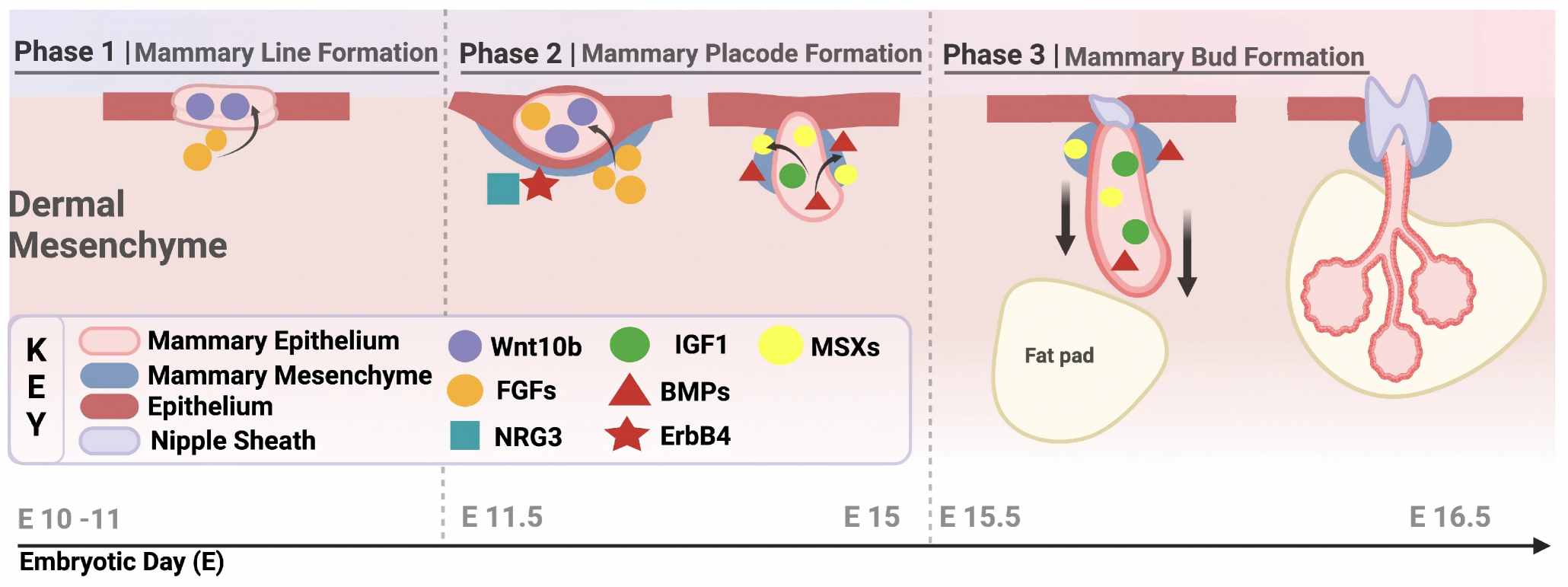 Fig.1 The key stages of embryonic mammary gland development.1
FAQs
-
1. Can these media maintain ER/PR expression in breast cancer organoids?
Yes. Traditional media often cause a rapid loss of hormone receptors. Our specialized tumoroid formulations are explicitly designed to maintain the Estrogen Receptor (ER) and Progesterone Receptor (PR) positivity of patient-derived models.
-
2. Do your reagents support both normal and malignant mammary tissues?
Absolutely. We offer distinct protocols and media kits: one designed to support the ordered branching of normal bipotent stem cells, and another formulated to sustain the aggressive growth and heterogeneity of tumoroids.
-
3. Can I model triple-negative breast cancer (TNBC) with your reagents?
Yes. Our tumoroid expansion media seamlessly support the robust growth of patient-derived TNBC models, preserving their highly aggressive, basal-like phenotypes for therapeutic screening.
How to Contact Us
Your research into breast development and oncology requires reagents that respect the profound complexity of the mammary gland. Partner with Creative Biolabs to cultivate structurally intricate, hormone-responsive organoids that elevate the impact and reproducibility of your assays.
For tailored protocol guidance, specific assay troubleshooting, or to secure a personalized quotation, please email our scientific support team at or call us directly at +1-631-357-2254.
Contact Us
Reference
-
Lue, Jaida C, and Derek C Radisky. "From Embryogenesis to Senescence: The Role of Mammary Gland Physiology in Breast Cancer Risk." Cancers vol. 17,5 787. 25 Feb. 2025. Distributed under Open Access license CC BY 4.0, without modification. https://doi.org/10.3390/cancers17050787
For Research Use Only. Not For Clinical Use.
Species Reactivity Mouse
Application Organoid Culture
Size 100 mL
Species Reactivity Porcine
Application Culturing porcine mammary gland tissue organoids
Size 100 mL, 1000 mL
Species Reactivity Human
Application Establishment, Expansion
Size 100 mL, 500 mL
Species Reactivity Human
Application Establishment, Expansion
Size 100 mL, 500 mL
Species Reactivity Human
Application Establishment, Expansion
Size 100 mL, 500 mL