Urogenital System Organoid Model Products
Products
Introduction Solutions Guarantee Portfolio Discoveries FAQsContact
Introduction
The human urogenital system—encompassing the urinary tract and reproductive organs—presents highly distinct in vitro challenges. These tissues are uniquely governed by strict endocrine regulation and feature specialized mucosal barriers designed to withstand harsh osmotic environments. Standard culture approaches rapidly strip these cells of their hormone responsiveness and complex cellular hierarchies. At Creative Biolabs, we specialize in chemically defined reagent suites formulated specifically to drive the precise establishment, differentiation, and long-term expansion of prostate, bladder, and female reproductive organoids.
By delivering the exact steroid gradients, growth factors, and structural matrices your models require, our solutions empower you to build functionally accurate genitourinary microenvironments.
Equip your laboratory with the biochemical tools to replicate true genitourinary biology. Contact our technical team today to discuss your specific protocols and secure a customized quotation.
Resolving Endocrine and Mucosal Culture Bottlenecks
Generating predictive urological and gynecological models requires mastering tissue-specific developmental cues. Without highly targeted media, prostate organoids lose their secretory function, and bladder models fail to form impermeable barriers. Our specialized formulations tackle these inherent plasticity challenges:
Hormone Receptor Retention
-
Patient-derived prostate and endometrial models are notorious for rapidly downregulating Androgen (AR) and Estrogen (ER) receptors in standard media. Our targeted supplements are formulated to sustain these critical nuclear receptors, enabling authentic hormone-driven growth and therapeutic screening.
Urothelial Stratification
-
The bladder lining requires a robust, multilayered defense. We provide specific morphogen cocktails that guide basal stem cells to differentiate into mature, impermeable "umbrella cells," successfully replicating the transitional epithelium.
Steroid-Neutral Baselines
-
Endocrine-disruptor and oncology assays require absolute background clarity. We offer premium steroid-stripped, serum-free basal media, ensuring your organoids respond exclusively to the precise exogenous hormones or anti-androgens you apply.
The Creative Biolabs Guarantee for Genitourinary Assays
Endometrial & Secretory Fidelity
Our culture systems go beyond mere expansion, specifically supporting the cyclical secretory capabilities of reproductive epithelia, including the production of prostate-specific antigen (PSA) and mucins.
Stringent Phenotypic Stability
To ensure reliable oncology modeling, our media are rigorously validated to preserve the original genetic heterogeneity and transcriptomic signatures of primary patient biopsies over extended serial passaging.
Pristine Quality Control
Urogenital assays are highly sensitive to trace contaminants. We subject every reagent lot to exacting endotoxin, osmolality, and functional hormone-responsiveness testing, providing you with a rock-solid, artifact-free experimental foundation.
Targeted Reagents for the Genitourinary Tract
We offer a focused portfolio to support the diverse tissues of the urogenital system:
-
1. Prostate Tumoroid & Epithelial Media A highly refined formulation engineered to support the efficient generation and robust biobanking of both normal prostate epithelial organoids and aggressive, patient-derived prostate cancer (PCa) tumoroids.
-
2. Transitional Urothelium Maturation Kits Designed specifically for bladder and urethral modeling, this differentiation kit drives the maturation of urothelial progenitors into a fully stratified, tight-junction-expressing mucosal barrier.
-
3. Endometrial & Ovarian Cycling Supplements A highly specialized suite of Wnt-activating and R-spondin-rich modulators that support the long-term expansion of female reproductive tract organoids, optimized to respond dynamically to estrogen and progesterone profiling.
-
4. Genitourinary-Specific Matrix Hydrogels We supply structurally tuned 3D scaffolds that replicate the distinct mechanical compliance and laminin-rich basement membranes of pelvic and urological tissues, supporting optimal luminal organization.
Catalyzing Urological & Gynecological Discoveries
Our reagent portfolios are functionally verified to ensure flawless performance across your most sensitive translational workflows:
-
Advanced Prostate Oncology: Accurately model Castration-Resistant Prostate Cancer (CRPC) and evaluate the efficacy of next-generation androgen receptor axis-targeted (ARAT) therapies.
-
Urinary Tract Infections (UTIs): Cultivate mature bladder organoids to study host-pathogen interactions, bacterial adhesion (such as UPEC), and localized mucosal immunity.
-
Reproductive Biology & Disease: Investigate the underlying mechanisms of endometriosis, polycystic ovary syndrome (PCOS), and endometrial implantation within a highly controlled, hormone-responsive environment.
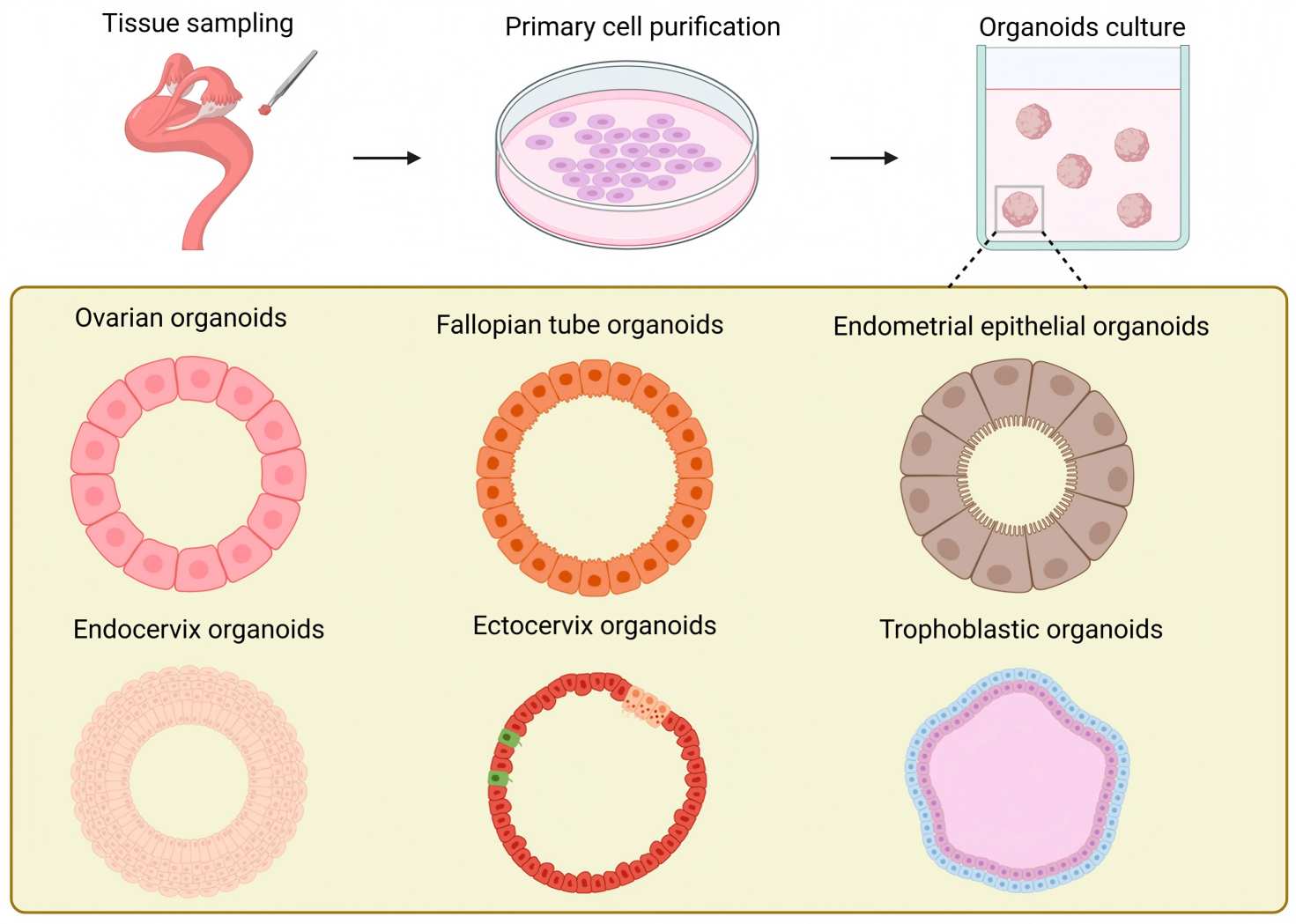 Fig.1 Schematic illustration of the generation and models of organoids in various female reproductive tracts.1
FAQs
-
1. How do you address the need for apical-out bladder organoids in infection studies?
For researchers studying UTIs, we provide specialized suspension culture protocols and media adaptations that reliably invert the polarity of urothelial organoids, exposing the apical umbrella cells to the external media for direct bacterial inoculation.
-
2. Can I use these reagents to model Benign Prostatic Hyperplasia (BPH)?
Absolutely. Our prostate epithelial expansion media excellently support the robust growth of primary cells derived from BPH patient biopsies, maintaining their hyperplastic characteristics for downstream drug testing.
-
3. Can your urothelial media support the establishment of patient-derived bladder cancer organoids?
Yes. Our transitional urothelium kits are highly effective for establishing both non-muscle-invasive (NMIBC) and muscle-invasive bladder cancer (MIBC) tumoroids. They strictly preserve the distinct mutational profiles, spatial architectures, and drug-resistance phenotypes of the primary tumors for personalized oncology screening.
How to Contact Us
Reach out to our scientific experts at or dial +1-631-357-2254 today for tailored protocol development and exclusive pricing solutions.
Contact Us
Reference
-
Zhang, Xingwu et al. "Advances and Applications of Lung Organoids in the Research on Acute Respiratory Distress Syndrome (ARDS)." Journal of clinical medicine vol. 13,2 346. 8 Jan. 2024. Distributed under Open Access license CC BY 4.0, without modification. https://doi.org/10.3390/jcm13020346
For Research Use Only. Not For Clinical Use.
Species Reactivity Mouse
Application Organoid Culture
Size 100 mL
Species Reactivity Mouse
Application Organoid Culture
Size 100 mL
Species Reactivity Mouse
Application Culturing mouse ovarian tissue organoids
Size 100 mL, 1000 mL
Species Reactivity Mouse
Application Culturing mouse bladder tissue organoids
Size 100 mL, 1000 mL
Species Reactivity Human
Application Culturing human bladder tissue organoids
Size 100 mL, 1000 mL
Species Reactivity Human
Application Culturing human ovarian tissue organoids
Size 100 mL, 1000 mL
Species Reactivity Human
Application Culturing human cervical tissue organoids
Size 100 mL, 1000 mL
Species Reactivity Human
Application Organoid Establishment & Maintenance
Size 100 mL, 500 mL
Species Reactivity Human
Application Establishment, Expansion
Size 100 mL, 500 mL
Species Reactivity Human
Application Establishment, Expansion
Size 100 mL, 500 mL
Species Reactivity Human
Application Establishment, Expansion
Size 100 mL, 500 mL
Species Reactivity Human
Application Establishment, Expansion
Size 100 mL
Species Reactivity Human
Application Establishment, Expansion
Size 100 mL, 500 mL
Species Reactivity Human
Application Establishment, Expansion
Size 100 mL, 500 mL