Organoid Culture Supplement & Extracellular Matrix Products
Products
Introduction ECM Solutions Supplements Quality Matters Guidelines FAQsContact
Introduction
In organoid culture, the "scaffold" and the "signals" are just as critical as the cells themselves. To successfully recapitulate in vivo architecture and function, stem cells require a supportive 3D matrix rich in laminin and collagen, alongside a precise cocktail of growth factors and small molecules to modulate signaling pathways.
Creative Biolabs provides the structural foundation and biochemical cues necessary for robust organoid establishment. Our Basement Membrane Matrices and Culture Supplements are rigorously tested for bioactivity and batch consistency, ensuring that your culture system remains a controlled variable in your research.
Contact our team to verify lot-specific data and bulk availability.
Extracellular Matrix (ECM) Solutions
The ECM provides essential physical support and integrin signaling. We offer specialized grades of Basement Membrane Extract (BME) derived from tumor tissues, optimized for different experimental needs.
1. Reduced Growth Factor (RGF) Basement Membrane Matrix
A purified matrix where endogenous growth factors (such as TGF-beta, EGF, and IGF) are depleted.
-
Application: Ideal for signaling pathway studies and drug screening where undefined background signals must be minimized. It provides a "blank slate" scaffold for defined media formulations.
2. Standard Basement Membrane Matrix
Contains the native complement of ECM proteins and growth factors.
-
Application: Suitable for general expansion of robust organoid lines (e.g., CRC tumoroids) where rapid biomass generation is the priority.
Essential Culture Supplements
Defining the stem cell niche requires high-activity recombinant proteins and small molecules. Our supplements are QC-tested specifically on organoid cultures to guarantee potency.
-
R-Spondin 1: A critical agonist of the Wnt pathway. Essential for maintaining Lgr5+ stem cell populations in intestinal, liver, and pancreatic organoids.
-
Noggin: A BMP inhibitor that prevents spontaneous differentiation, crucial for maintaining the "stemness" of the niche.
-
EGF (Epidermal Growth Factor): A potent mitogen driving epithelial cell proliferation.
-
Y-27632 (ROCK Inhibitor): A small molecule essential for single-cell survival. It prevents anoikis (cell death upon detachment) during passaging and thawing.
-
A83-01: An ALK5 inhibitor used to suppress TGF-beta signaling, preventing differentiation and senescence during long-term expansion.
Why Quality Matters in Supplements
The variability of reagents is a leading cause of experimental failure in 3D biology. Creative Biolabs addresses this through:
-
Rigorous Stiffness Testing: Our ECM lots are screened to ensure consistent tensile strength and gelation kinetics, preventing "runny" domes that fail to support 3D structure.
-
High Biological Activity: Recombinant proteins are tested not just for purity (SDS-PAGE), but for functional bioactivity (e.g., phosphorylation assays) to ensure they effectively trigger downstream signaling.
Handling & Storage Guidelines
Proper handling is vital to preserve the activity of these temperature-sensitive reagents.
-
ECM Thawing: Must be thawed slowly on ice at 4°C (typically overnight). Never thaw at room temperature, as irreversible gelation will occur.
-
Aliquoting: To avoid freeze-thaw cycles, we recommend aliquoting growth factors and small molecules upon first thaw and storing them at -20°C or -80°C.
-
Gelation: Our matrix typically polymerizes rapidly at 37°C. Ensure your plate is pre-warmed for optimal dome formation.
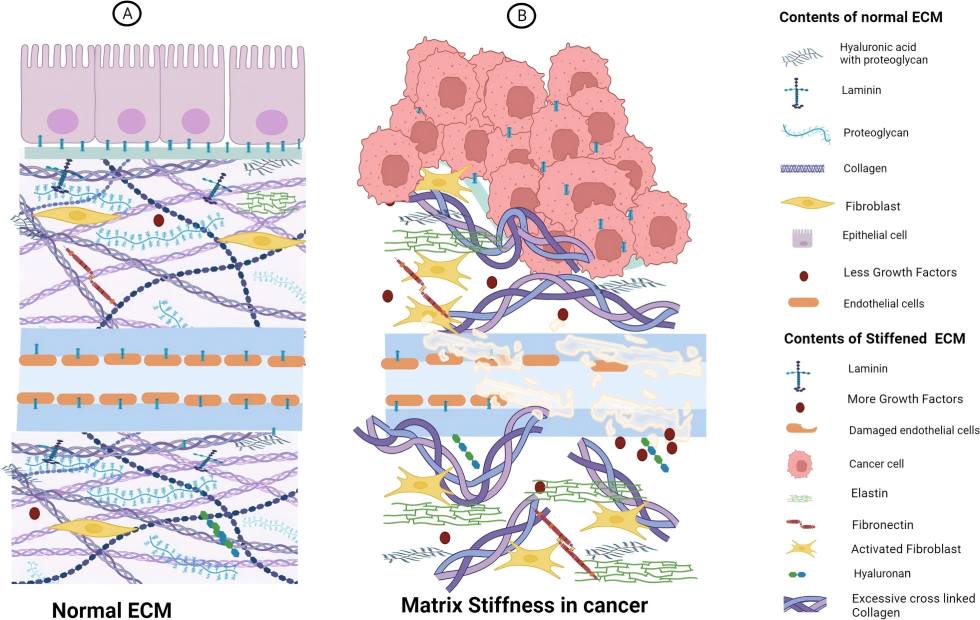 Fig.1 Schematic representation of variable Extra Cellular Matrix (ECM) components in healthy ECM and TME.1
FAQs
-
1: Can I dilute the matrix?
A: Yes, for certain applications like coating plates or co-culture, the matrix can be diluted with cold basal medium. However, diluting below a critical concentration may prevent proper gelation.
-
2: Is the matrix animal-free?
A: Standard BME is derived from murine tumor tissue. For clinical translation research requiring xeno-free conditions, please inquire about our synthetic hydrogel options.
-
3: Why do I need to add Y-27632 when passaging?
A: Dissociating organoids into individual cells disrupts cell-cell adhesion, triggering apoptosis. ROCK inhibitor blocks this death signal, significantly increasing recovery efficiency. It is typically removed after the initial recovery phase.
How to Contact Us
Ensure your organoids have the best structural and biochemical support.
To request detailed Certificates of Analysis (CoA) or pricing, please contact our support team at or call +1-631-357-2254.
Contact Us
Reference
-
Bhattacharya, Anamitra et al. "Exploring the interaction between extracellular matrix components in a 3D organoid disease model to replicate the pathophysiology of breast cancer." Journal of experimental & clinical cancer research : CR vol. 42,1 343. 16 Dec. 2023. Distributed under Open Access license CC BY 4.0, without modification. https://doi.org/10.1186/s13046-023-02926-4
For Research Use Only. Not For Clinical Use.
Species Reactivity Human, Mouse, Other mammals
Application Ensuring a sterile environment for cell culture
Size 100 mL
Application Cell Culture Supplement
Size 0.5 mL
Application Cell culture / Organoid culture
Size 20 mg
Species Reactivity Human
Application Used in combination with serum-free neuronal basal medium or DMEM/F12 medium supplemented with growth factors such as bFGF and EGF
Size 10 mL
Species Reactivity Human, Mouse, Other mammals
Application Mammalian cell culture
Size 500 mL
Application Organoid Thawing & Collection
Size 100 mL
Application Organoid Passaging & Dissociation
Size 100 mL
Species Reactivity Universal (Human, Mouse, etc. )
Application Scaffold, Culture Support
Size 5 mL, 10 mL
Species Reactivity Universal (Human, Mouse, etc. )
Application Scaffold, Culture Support
Size 5 mL, 10 mL
Species Reactivity Universal (Human, Mouse, etc. )
Application Scaffold, Culture Support
Size 5 mL, 10 mL
Species Reactivity Universal (Human, Mouse, etc. )
Application Scaffold, Culture Support
Size 5 mL, 10 mL
Species Reactivity Universal (Human, Mouse, etc. )
Application Scaffold, Culture Support
Size 5 mL, 10 mL
Species Reactivity Universal (Human, Mouse, etc. )
Application Scaffold, Culture Support
Size 5 mL, 10 mL
Species Reactivity Universal (Human, Mouse, etc. )
Application Scaffold, Culture Support
Size 5 mL, 10 mL
Species Reactivity Universal (Human, Mouse, etc. )
Application Scaffold, Culture Support
Size 5 mL, 10 mL
Species Reactivity Universal (Human, Mouse, etc. )
Application Scaffold, Culture Support
Size 5 mL, 10 mL