
Identity & differentiation
Assess whether cultures retain a sebocyte-relevant transcriptional profile alongside morphology and other agreed characterization endpoints.
iPSC-derived sebocyte characterization
Resolve sebocyte identity, lipid metabolism, hormone response, and inflammatory state with a configurable RT-qPCR marker panel designed around your model and treatment question.
Design a Marker Panel Discuss Your StudyFrom Ct values to phenotype
mRNA profiling can support the characterization of iPSC-derived sebocytes and quantify how their phenotype changes after a defined perturbation. The panel is selected according to the biological question within iPSC-facilitated discovery for acne and hyper/hyposeborrhea.
Because transcript abundance depends on cell state, exposure time, RNA quality, and normalization, interpretation is built around a set of markers and controls. A single marker alone is not treated as proof of cell identity or function.
Conceptual visualization only; colors are not assay performance data or expected biological results.
Configurable marker architecture
Candidate genes are examples for study planning. The final panel is tailored to the cell model, differentiation stage, treatment, and intended interpretation.
Assess whether cultures retain a sebocyte-relevant transcriptional profile alongside morphology and other agreed characterization endpoints.
Track transcriptional programs associated with lipid-droplet formation, fatty-acid desaturation, cholesterol synthesis, and triglyceride production. The FADS2 analysis service can provide a related functional context.
Profile pathways involved in androgen and PPAR signaling when the project examines sebum regulation or candidate compounds. Pairing with an androgen receptor stimulation assay can add functional evidence.
Measure stimulus- or compound-dependent inflammatory transcription. Complementary IL-6 monitoring, IL-8 monitoring, or TNF monitoring may be considered separately.
Assay design
Creative Biolabs can incorporate targeted mRNA analysis into a customized stem cell-based assay development program. The study map connects biological replication, sample handling, and the analysis method.
Scope the StudyDefine the iPSC-derived sebocyte source, differentiation stage, passage, density, and baseline characterization.
Set vehicle and untreated controls, concentrations, exposure windows, washout or recovery groups, and biological replicates.
Align harvest timing, RNA extraction, DNase treatment, quantity and integrity checks, and reverse-transcription inputs.
Select reference genes that are sufficiently stable in the proposed model and perturbation; no single universal reference is assumed.
Predefine technical replicate handling, acceptance criteria, ΔCt or ΔΔCt calculations, comparator groups, and reporting format.
Project workflow
Each step produces a recorded checkpoint, so final comparisons can be interpreted in the context of the cell model and sample history.
Confirm targets, controls, groups, time points, replicates, and reporting endpoints.
Prepare and document the agreed iPSC-derived sebocyte model.
Apply the candidate compound, stimulus, vehicle, and control conditions.
Harvest cells, isolate and assess RNA, then perform reverse transcription.
Measure target and reference-gene amplification with defined technical controls.
Normalize, compare groups, visualize the panel, and integrate agreed endpoints.
Deliverables
The final package is defined during project scoping and can combine raw amplification outputs with normalized, presentation-ready summaries.
| Marker | Module | Control ΔCt | Treated ΔCt | Relative change |
|---|---|---|---|---|
| PPARG | Identity | — | — | Calculated |
| FADS2 | Lipid handling | — | — | Calculated |
| AR | Hormone response | — | — | Calculated |
| CXCL8 | Inflammation | — | — | Calculated |
Research applications
Targeted expression analysis can be deployed at characterization, perturbation, and mechanism-of-action stages of a sebocyte research program.
Support the characterization of iPSC-derived cell models with a targeted transcriptional profile.
Compare dose, time, and recovery effects within stem cell-facilitated drug discovery.
Connect transcript changes with lipid, cytokine, receptor, and cell proliferation and survival endpoints.
Share the cell model, perturbation, marker candidates, and comparison groups.
Open-access evidence
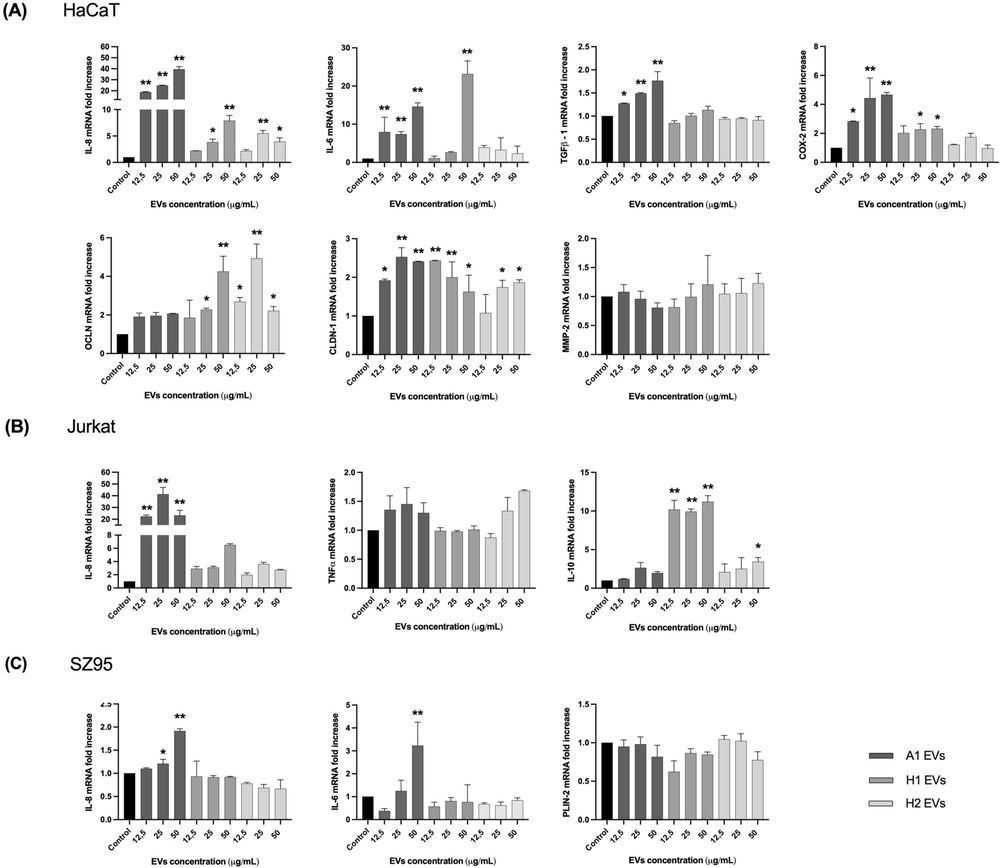
Cros et al. examined extracellular vesicles from different Cutibacterium acnes strains in keratinocytes, SZ95 sebocytes, and human iPSC-derived sebocytes. In the iPSC-derived sebocyte model, vesicles from a virulent strain strongly activated IL8 and IL6 expression, whereas PLIN2 was not substantially increased.
Assay relevance: The work directly illustrates how inflammation and lipid-droplet markers can be measured together to distinguish response programs in iPSC-derived sebocytes.
Frequently asked questions
Panels are configured for the study question. Candidate groups may cover sebocyte identity, differentiation, lipid metabolism, androgen or PPAR response, and inflammation. Final targets are reviewed against the model and treatment design.
Feasibility depends on sample amount, preparation method, storage history, quality information, and the requested panel. Share these details during project scoping for review.
Reference genes are selected and assessed for the specific model and perturbation. Relative expression can then be reported using a predefined ΔCt or ΔΔCt approach with an agreed comparator.
Yes. Depending on the project, targeted expression can be considered alongside FADS2 analysis, cytokine monitoring, androgen receptor stimulation, lipid-related assays, or cell proliferation and survival testing.
No. This service is for research use only and is not intended for diagnostic or clinical use.