
Applications
Online Inquiry
For research use only. Not intended for any clinical use.
This site is protected by reCAPTCHA and the Google Privacy Policy and Terms of Service apply.
Non-Human Primate (NHP) Applications in Fibrosis & Rare Diseases
Are you currently facing long drug development cycles, challenges in developing targeted therapies for complex diseases, or a high risk of clinical trial failure? At Creative Biolabs, our preclinical research services help you accelerate drug discovery, obtain critical translational data, and streamline regulatory submissions through our advanced NHP models and innovative translational science platforms. Our expertise is focused on providing the data you need to confidently advance your pipeline in Fibrosis & Rare Diseases.
Gene and Biologic Therapy by NHP in Rare Disease and Fibrosis.
Preclinical research for gene therapy and biologics in rare diseases and fibrosis is challenging. NHP models provide essential translational data on vector biodistribution and immune response, offering a critical bridge between preclinical and clinical development.
Overview of NHP Applications
What Are Our Research Areas?
The development of new therapeutics for fibrosis and rare genetic diseases requires a profound understanding of disease pathophysiology and the ability to test novel treatments in a model that closely mimics human biology. Our services are anchored in the use of nonhuman primate models to study these complex conditions. The high genetic and physiological similarity of NHPs to humans makes them invaluable for accurately modeling fibrotic diseases, such as pulmonary fibrosis, and providing critical proof-of-concept for gene therapies targeting rare genetic disorders.
- Liver Fibrosis & Organ-Specific Pathology: We utilize NHP models to study organ-specific pathological changes and chronic inflammation in fibrotic diseases, such as pulmonary fibrosis and liver fibrosis. This allows us to investigate the subtle disease progression that is difficult to replicate in other animal models.
- Rare Genetic Disease Proof-of-Concept: For rare diseases with no suitable small-animal model, NHPs serve as a crucial platform to demonstrate a gene therapy's in vivo efficacy, safety, and therapeutic window, providing essential proof-of-concept data that de-risks clinical translation.
Why Choose Us?
Nonhuman primates are the gold standard for preclinical research in complex human diseases due to their unique biological and physiological attributes. In the context of fibrosis and rare diseases, their advantages are particularly crucial for generating high-quality, translatable data.
- Genetic and Immunological Similarities: NHPs share a high degree of genetic and immunological homology with humans, which is essential for studying complex conditions involving immune responses, such as the inflammatory component of fibrosis or immunogenicity to a gene therapy vector.
- Clinical Translational Relevance: The physiological parallels between NHPs and humans enable more accurate predictions of drug efficacy and safety, reducing the risk of clinical trial failure.
- Data Types Required for Regulatory Submissions: Regulatory agencies often require data from a relevant non-rodent species, and NHPs are the preferred model for testing human-specific biologics and gene therapies.
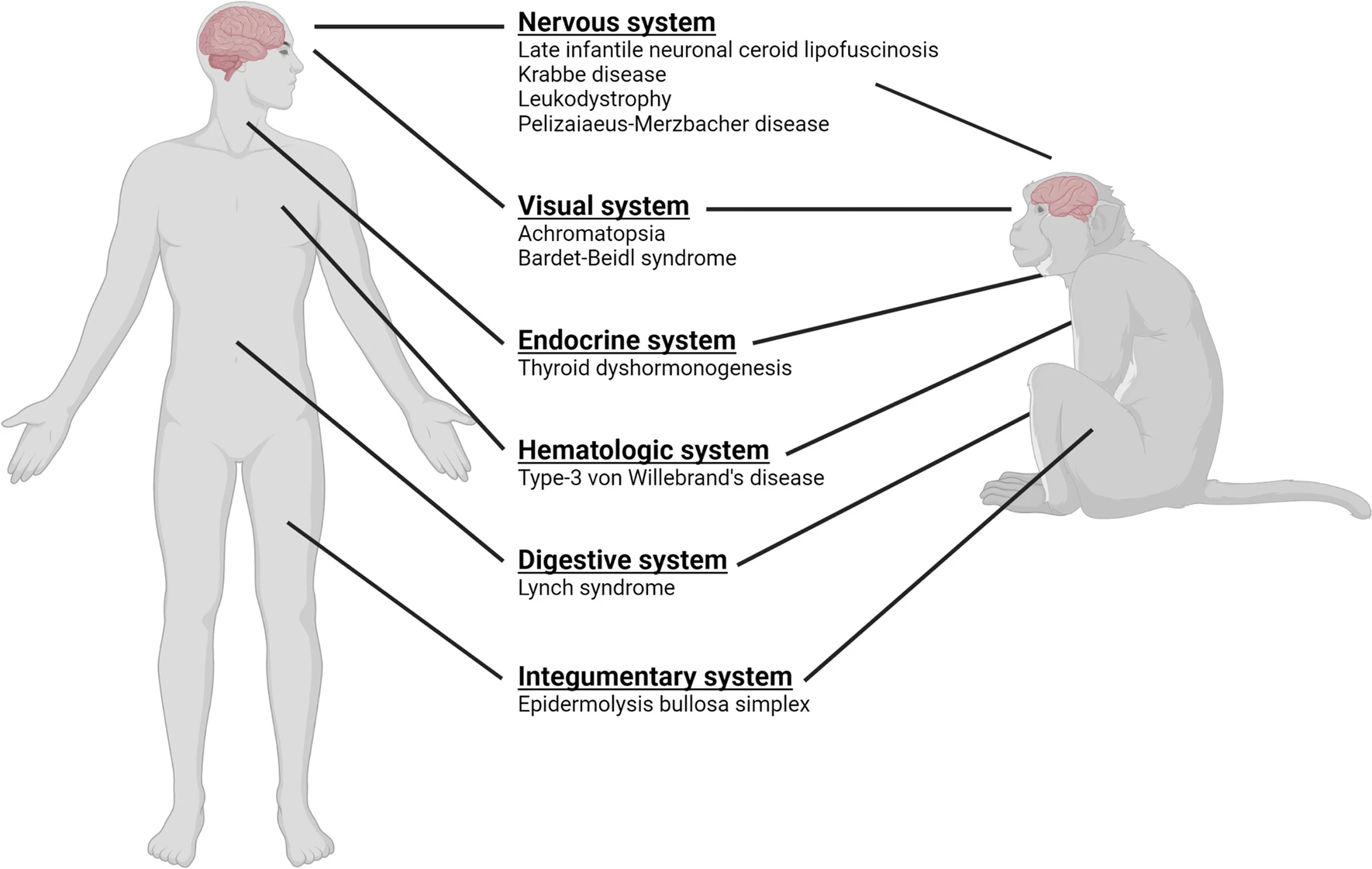 Fig.1 Graphical overview of selected rare diseases with established genetic models in NHPs.1
Key Applications
- Nonhuman primates play a pivotal role in advancing therapeutic candidates for fibrosis and rare diseases by enabling critical preclinical studies that cannot be performed in other models.
- Modeling Chronic Inflammation and Fibrosis: NHPs can be used to create models that accurately reflect the chronic inflammatory and fibrotic processes seen in human diseases, allowing for the evaluation of anti-inflammatory and anti-fibrotic drug candidates. This provides a clear picture of a drug's efficacy and mechanism of action.
- Proof-of-Concept for Rare Disease Therapies: For genetic diseases with no suitable small-animal model, NHPs can serve as a crucial platform to demonstrate a therapy's in vivo efficacy, safety, and therapeutic window, providing essential proof-of-concept data that de-risks clinical translation.
- Biomarker Identification and Validation: The clinical relevance of NHP models allows for the identification and validation of key disease biomarkers, which can later be used to monitor patient response in clinical trials. This streamlines trial design and accelerates the path to market.
How Do Creative Biolabs Support Your Projects?
Our comprehensive service portfolio provides the tools you need to successfully navigate the preclinical development process for fibrosis and rare diseases. We highlight the most relevant service capabilities below.
| Service Capability | Corresponding Application Area |
| Fibrosis Model Development | Offers a pathway to develop specific Fibrosis Models and Neurological Disorders models that are essential for testing the efficacy of your therapeutic candidates. |
| Advanced Therapy Efficacy Studies | Provides the platform for Gene Therapy Models (AAV, Lentivirus) and Antibody & Biologic Efficacy studies, which are critical for demonstrating a therapy's effectiveness in a clinically relevant model. |
| In Vitro Cell-Based Safety Assays | Features Immunotoxicity & Cytokine Release Assays (CRAs) and Complement Activation Assays to predict potential immune-related adverse events. |
| NHP Bio-specimen Bank | Provides access to a wide range of samples including FFPE & Frozen Tissue Panels and Blood, Serum & Plasma that are essential for comprehensive analysis. |
Translational Impact
Leveraging NHP models provides significant advantages in drug development for fibrosis and rare diseases. Our platforms enable early detection of immune responses and potential toxicities, which can prevent costly delays and failures in later clinical phases. This robust preclinical data is often required by regulatory bodies for gene therapy IND submissions, offering a more reliable early proof of concept and a reduced risk of IND failure.
Frequently Asked Questions
Q: What kind of data quality can I expect from your NHP models for fibrosis research?
A: Our platforms are designed for high-resolution, high-sensitivity data. We provide comprehensive data packages that include molecular, histological, and functional endpoints, giving you a detailed understanding of your drug's effect on fibrotic tissue.
Q: How do you address the limited availability of NHP models for specific rare genetic diseases?
A: We work closely with our clients to develop custom-tailored models for rare diseases, including exploring donor-matched cohorts and custom collection services to meet your specific research needs.
Q: What is the turnaround time for receiving data from an NHP study?
A: Turnaround times are project-specific and depend on the study design. We provide a clear timeline upfront and our team works diligently to ensure timely delivery of high-quality data.
Q: How do NHP models provide more translatable data than rodent models in fibrosis and rare disease research?
A: NHPs offer superior translational relevance due to their closer genetic, physiological, and immunological similarities to humans. This allows for a more accurate evaluation of human-specific biologics and a better prediction of clinical outcomes, particularly for diseases involving complex immune pathways.
Contact Us
Creative Biolabs is a leading provider of preclinical research services using NHP models, offering unparalleled expertise for the development of therapeutics for fibrosis and rare diseases. Ready to leverage our NHP platform for your next study? Contact our team for more information and to discuss your project.
Reference
- Vallender, Eric J., et al. "Nonhuman primate genetic models for the study of rare diseases." Orphanet journal of rare diseases 18.1 (2023): 20. Distributed under Open Access license CC BY 4.0, without modification. DOI: https://doi.org/10.1186/s13023-023-02619-3