
Applications
Online Inquiry
For research use only. Not intended for any clinical use.
This site is protected by reCAPTCHA and the Google Privacy Policy and Terms of Service apply.
Non-Human Primate (NHP) Applications in Gene Therapy
Are you currently facing complex challenges in translating gene therapies from the lab to the clinic, particularly with ensuring safety and efficacy? Our NHP Applications in Gene Therapy service at Creative Biolabs helps you accelerate your drug discovery and de-risk clinical development. We achieve this by leveraging NHP models for their unparalleled genetic and physiological similarities to humans, ensuring that your preclinical data is robust, predictive, and satisfies critical regulatory requirements.
Gene Therapy in Non-Human Primates: Accelerate Your Drug Discovery Process!
Gene therapy is a promising new way to treat diseases, but bringing it to patients requires a deep understanding of its behavior in a human-like system. NHP models are indispensable for this translational research, providing essential data on the safety, biodistribution, and efficacy of gene therapy vectors.
Overview of NHP Applications
What Are Our Research Areas?
Creative Biolabs specializes in providing a comprehensive preclinical research platform centered on the use of non-human primates for gene therapy applications. Our services are designed to address the critical questions that regulatory bodies require for Investigational New Drug (IND) submissions. These questions include the precise behavior of gene vectors in vivo and their long-term effects. We conduct rigorous studies covering:
- Why NHPs for AAV/Lentiviral Gene Therapies: Both AAV and lentiviral vectors are crucial delivery systems for gene therapies. While AAVs like the AAV9 serotype are known for their ability to cross the blood-brain barrier for CNS delivery, lentiviral vectors offer the advantage of stably integrating genetic material into the host genome. However, their behavior, especially in complex systems like the CNS or immune system, cannot be fully predicted in rodent models. NHPs provide the high-fidelity preclinical data necessary to bridge this gap.
- Vector Biodistribution & Shedding Studies: We trace the distribution of the gene vector throughout the body to understand its spread, persistence, and potential off-target effects. We also evaluate vector shedding—the release of the vector from the body through secretions or excretions—which is a critical safety parameter.
- Transgene Expression, Durability & Immunogenicity: We assess whether the therapeutic gene is being expressed in the target tissue at the desired level and for a sufficient duration. We also meticulously evaluate the host's immune response to the vector and the expressed protein, as immunogenicity can compromise both safety and the long-term efficacy of the therapy.
- Safety & Toxicology for Gene Vectors: Our platform is equipped to evaluate potential toxicities, from acute, dose-dependent effects to long-term chronic issues, providing essential data to establish a safe dose range for human trials.
Why Choose Us?
Choosing Creative Biolabs means leveraging the unique benefits of NHP models. Their close similarity to humans provides more reliable and clinically relevant data than any other model.
- Genetic and Immunological Similarities: NHPs share a high degree of genetic homology and have an immune system that functions much like a human's, making them ideal for predicting immune-related toxicities and transgene immunogenicity.
- Clinical Translational Relevance: The physiological and anatomical parallels between NHPs and humans, particularly in the brain, allow for accurate modeling of complex human diseases and therapeutic outcomes.
- Data Types Required for Regulatory Submissions: Our studies are designed to meet or exceed the requirements of global regulatory bodies. Data on biodistribution, shedding, and immunogenicity from NHPs are often non-negotiable for IND submissions.
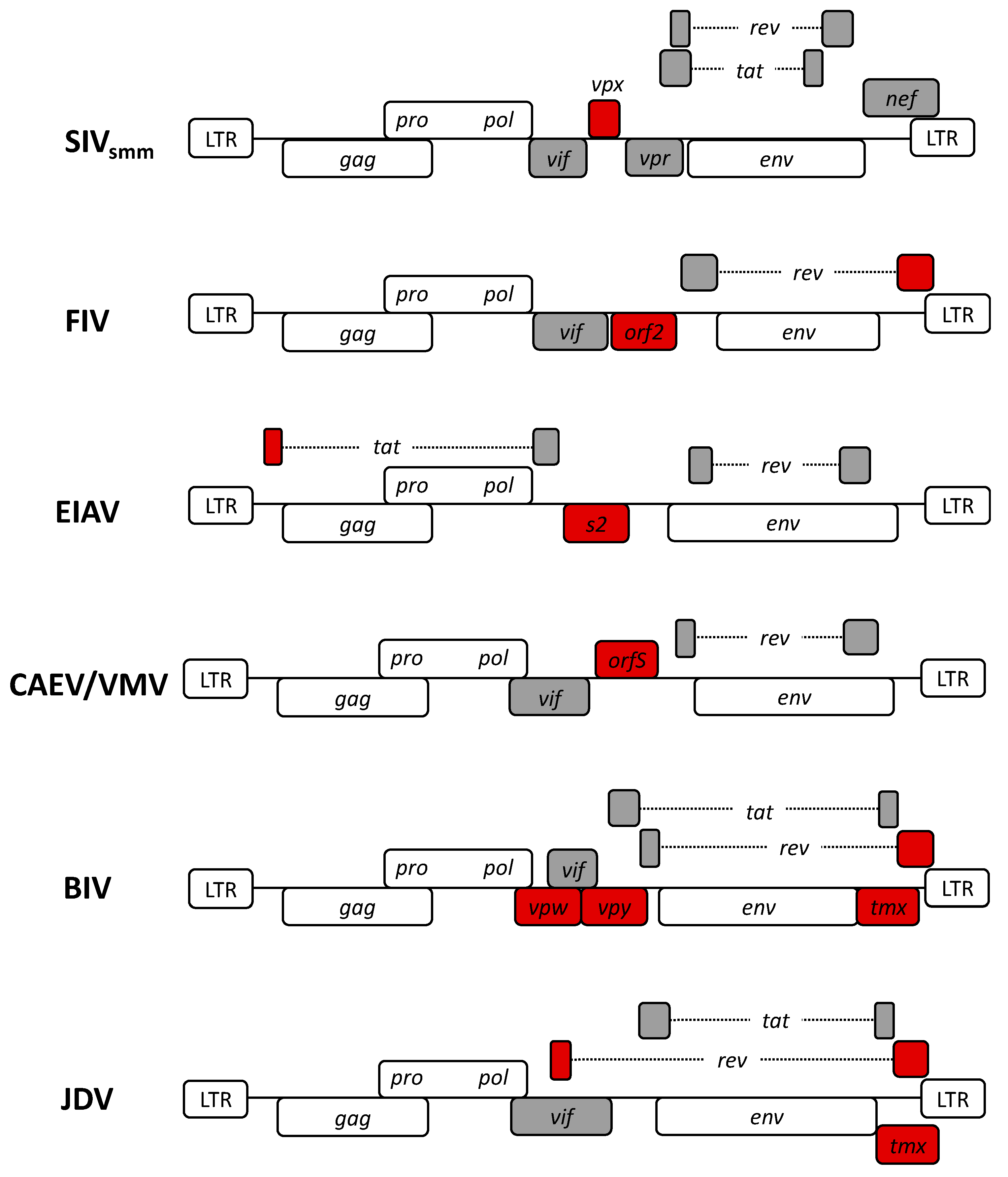 Fig.1 Genomic architecture of non-human lentiviruses.1
Key Applications
Our NHP platform supports critical preclinical studies across a range of therapeutic areas:
- AAV Vector Biodistribution and Shedding Studies: We use quantitative polymerase chain reaction (qPCR) to precisely measure vector DNA and RNA levels in various tissues and fluids following a single administration. This provides crucial safety data on where the vector goes and how long it persists.
- Modeling Neurological Disorders: Using advanced genome-editing technologies, we create highly relevant NHP models for complex neurological diseases. These models allow for the evaluation of therapeutic delivery and efficacy in a physiologically relevant system.
- Safety and Toxicology Assessment for All Gene Vectors: Our comprehensive studies assess potential dose-limiting toxicities, off-target effects, and systemic immune responses.
- Long-Term Efficacy and Durability: We conduct extended studies to evaluate the long-term persistence of transgene expression and its therapeutic effect, which is critical for treating chronic diseases and ensuring the sustained benefit for patients.
How Do Creative Biolabs Support Your Projects?
We offer specialized service capabilities that correspond to each stage of your gene therapy development process.
| Service Capability | Corresponding Application Area |
| Vector Copy Number (qPCR, ddPCR) Detection | Provides comprehensive analysis for all AAV and lentiviral vectors. |
| PK/TK Sample Analysis | Measures the pharmacokinetics of your therapeutic gene and protein. |
| Safety & Toxicology Studies | Assesses acute and chronic toxicities and helps determine a safe dose range. |
| Immunogenicity Assessment | Identifies and characterizes host immune responses to vectors and transgenes. |
Translational Impact
Utilizing NHP models is not just a scientific best practice; it is a strategic imperative. The data generated in these studies is the most predictive of human outcomes, which directly reduces the risk of costly IND failures. The anatomical and physiological similarities between NHPs and humans allow for the early detection of immune responses and toxicities that might not be seen in other animal models. For example, biodistribution data from NHP studies is a standard requirement for gene therapy IND submissions to regulatory agencies. By conducting these pivotal studies with Creative Biolabs, you can build a more robust and compelling data package, accelerating your path from preclinical success to clinical trials.
Frequently Asked Questions
Q: What is the resolution/sensitivity of your biodistribution assays?
A: Our assays are highly sensitive and validated to detect very low levels of vector DNA. We use quantitative PCR (qPCR), which is the gold standard for measuring gene vector copy numbers in tissue and fluid samples. This ensures the highest quality data for your regulatory submissions.
Q: What is the cell source and sample stability for immunogenicity studies?
A: We use a variety of primary cells and tissues sourced from NHPs, including blood-derived PBMCs, to assess immunogenicity. All samples are processed and stored under strict, validated protocols to ensure their stability and the integrity of the data.
Q: How do you address the ethical concerns and high costs associated with NHP research?
A: We adhere to the highest ethical standards and guidelines for animal care. To mitigate cost and time, we employ advanced genetic engineering techniques to reduce mosaicism, ensuring a high-quality, phenotypically consistent model from a limited number of animals.
Q: What is the turnaround time for study results and what data format do you provide?
A: Turnaround times are project-specific and depend on the scope of the study. We provide clear timelines at the start of each project. Data is delivered in a comprehensive report, including raw data, analysis, and detailed interpretations, in a format that is ready for regulatory submission.
Q: How do AAV and lentiviral vectors compare in NHP models, and which is better for my study?
A: The choice of vector depends on your therapeutic goal. AAVs are excellent for CNS and ocular delivery, while lentiviral vectors are optimal for stable integration in long-lived cell types. Our team of experts can help you select the most suitable vector system and study design based on your specific needs.
Contact Us
Creative Biolabs is a leader in applying non-human primate models for preclinical gene therapy research, from AAV and lentiviral vector biodistribution to disease modeling. Our comprehensive platform and expertise are designed to provide the predictive, high-quality data you need to confidently advance your therapeutic programs. Contact our team today to learn more about our NHP Applications in Gene Therapy services and to discuss your project in detail.
Reference
- Chiang, Chih-Yuan, et al. "Proteomic Analysis of Non-human Primate Peripheral Blood Mononuclear Cells During Burkholderia mallei Infection Reveals a Role of Ezrin in Glanders Pathogenesis." Frontiers in microbiology 12 (2021): 625211. Distributed under Open Access license CC BY 4.0, without modification. DOI: https://doi.org/10.3390/v12101106