
Introduction to iPSC-Derived Digestive System Cell Models
The digestive system is one of the most complex biological systems in the human body. It includes multiple organs and cell types that work together to digest food, absorb nutrients, regulate metabolism, maintain epithelial barriers, communicate with immune and microbial communities, and detoxify xenobiotics.
- The gastrointestinal tract alone contains regionally distinct epithelial populations, including absorptive enterocytes, mucus-producing goblet cells, hormone-secreting enteroendocrine cells, Paneth cells, tuft cells, stem/progenitor cells, and specialized gastric or colonic epithelial cells.
- The liver and biliary system add further complexity through hepatocytes, cholangiocytes, stellate cells, Kupffer-like macrophages, sinusoidal endothelial cells, and ductal epithelial structures.
- The pancreas contributes endocrine and exocrine lineages, including insulin-producing beta-like cells, glucagon-producing alpha-like cells, pancreatic progenitors, and ductal cells.
Traditional in vitro models have provided valuable insights, but they are often limited by immortalized phenotypes, incomplete differentiation, donor scarcity, limited expansion capacity, inter-donor variability, and poor long-term reproducibility. iPSCs can be expanded extensively, gene-edited, banked, and differentiated into digestive system lineages using stage-wise protocols that mimic embryonic development.
Most digestive lineage differentiation strategies begin with induction of definitive endoderm, followed by regional patterning toward foregut, midgut, hindgut, hepatic, biliary, or pancreatic fate. For example, colon organoid protocols commonly include definitive endoderm induction, hindgut endoderm specification, and maturation of colon spheroids into organoids. Pancreatic beta-like cell differentiation workflows also generally progress through definitive endoderm, pancreatic progenitors, endocrine progenitors, and beta-like cell maturation. Liver organoid research similarly includes both tissue-derived and pluripotent stem cell-derived approaches, supporting applications in disease modeling, development, and biomedical research.
Our Digestive System Cell Differentiation Service Portfolio
Creative Biolabs provides a broad portfolio of iPSC-derived digestive system cell types and related models. Each project can be tailored to the client's target application, iPSC line background, desired scale, functional maturity, and validation requirements.
| Services | Descriptions |
|---|---|
| iPSC-Derived Intestinal Epithelial Cell Differentiation |
We support differentiation toward small intestinal, colonic, and regionally specified epithelial phenotypes. Depending on project needs, differentiated cells can be delivered as 2D monolayers, 3D organoids, spheroids, cryopreserved cell preparations, or assay-ready cultures. Our team can enrich or characterize multiple intestinal epithelial cell populations, including:
|
| iPSC-Derived Gastric Cell and Gastric Organoid |
Creative Biolabs offers customized differentiation services for iPSC-derived gastric epithelial cells and gastric organoid models. Depending on the desired model, we can design differentiation strategies toward anterior foregut endoderm and gastric epithelial progenitors, followed by maturation into regionally relevant gastric cell populations. Our services may include the generation or characterization of:Semi-quantitative scoring systems for features such as compactness, border sharpness, and granularity.
|
| iPSC-Derived Hepatocyte-Like Cell Differentiation |
Creative Biolabs offers customized iPSC-to-hepatocyte-like cell differentiation services with options for both standard and advanced characterization. Our workflow can include:
|
| iPSC-Derived Cholangiocyte and Biliary Lineage Differentiation |
Creative Biolabs provides customized differentiation toward cholangiocyte-like cells and biliary epithelial-like structures. Service options may include:
|
| iPSC-Derived Pancreatic Lineage Cell Differentiation |
Creative Biolabs offers iPSC-derived pancreatic lineage differentiation services for diabetes research, pancreatic development studies, endocrine cell maturation, drug screening, genetic disease modeling, and regenerative medicine research. Depending on the project scope, we can support generation and characterization of:
|
| Digestive Organoid Development and Assay-Ready Models |
In addition to cell differentiation, Creative Biolabs provides digestive organoid development services for researchers requiring more complex 3D systems. Our digestive organoid services may include:
|
Technical Workflow for iPSC-Derived Digestive System Cell Differentiation
Creative Biolabs follows a flexible but quality-driven workflow for digestive system cell differentiation. Each project is planned according to the target lineage, iPSC source, required cell quantity, maturity level, intended downstream application, and validation package.
-
Project Consultation and Model Design
Every project begins with a detailed technical consultation. Our scientists work with you to define the biological question, target cell type, organ region, disease context, assay requirements, and preferred deliverables. -
iPSC Line Selection, Qualification, or Generation
Clients may provide their own iPSC lines, choose from available iPSC resources, or request upstream iPSC generation services. Creative Biolabs also provides custom iPSC-derived cell services and supports iPSC line selection or generation as part of broader custom workflows. -
Definitive Endoderm Induction
Most digestive lineages originate from definitive endoderm. This step is therefore a critical foundation for successful downstream differentiation. Creative Biolabs optimizes definitive endoderm induction using controlled signaling modulation, culture timing, cell density management, and marker monitoring. -
Lineage Patterning Toward Digestive Organ Fate
After definitive endoderm induction, cells are patterned toward the desired digestive lineage. This stage is customized according to whether the project targets anterior foregut, posterior foregut, midgut, hindgut, hepatic endoderm, biliary lineage, or pancreatic progenitors. -
Maturation, Expansion, and Model Formatting
Digestive system cells often require extended maturation to acquire tissue-relevant morphology, marker expression, polarity, secretory function, transporter activity, metabolic capacity, or hormone responsiveness. Creative Biolabs can support multiple maturation formats. -
Phenotypic and Functional Characterization
Creative Biolabs offers customizable characterization packages to confirm cell identity, differentiation efficiency, purity, and functional relevance.
Customization Options
Creative Biolabs understands that digestive system research rarely fits a standard template. We therefore provide broad customization options across cell source, lineage target, format, scale, characterization, and downstream application.
| Customization Options | Descriptions |
|---|---|
| Custom iPSC Backgrounds |
We can work with:
|
| Custom Digestive Lineage Targets |
We can develop differentiation strategies for:
|
| Custom Culture Formats |
Available model formats may include:
|
| Custom Functional Assays |
We can help establish or support:
|
| Custom Scale and Delivery | Creative Biolabs supports small exploratory projects as well as larger-scale production for screening and multi-batch studies. |
Published Data
Efficient generation of human induced pluripotent stem cell (hiPSC)-derived human intestinal organoids (HIOs) would facilitate the development of in vitro models for a variety of diseases that affect the gastrointestinal tract, such as inflammatory bowel disease or Cystic Fibrosis. The researchers reported a directed differentiation protocol for the generation of mesenchyme-free HIOs that can be primed towards more colonic or proximal intestinal lineages in serum-free defined conditions. Using a CDX2eGFP iPSC knock-in reporter line to track the emergence of hindgut progenitors, they followed the kinetics of CDX2 expression throughout directed differentiation, enabling the purification of intestinal progenitors and robust generation of mesenchyme-free organoids expressing characteristic markers of small intestinal or colonic epithelium.
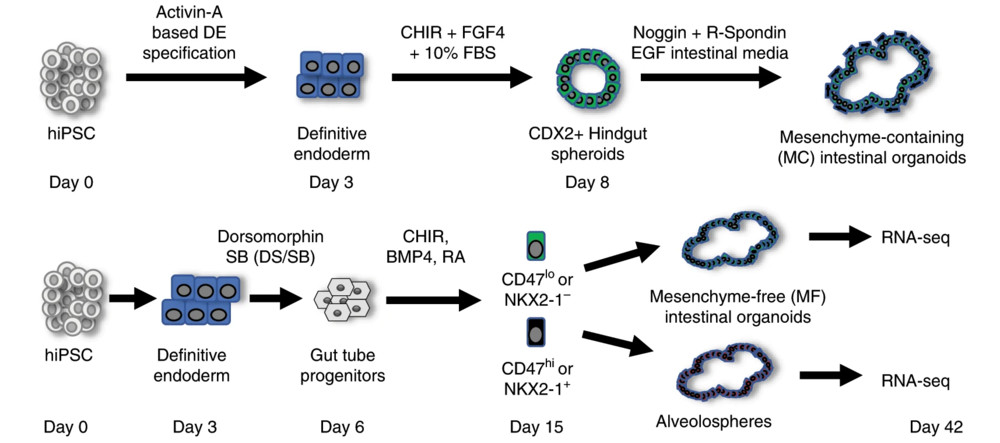 Fig. 1 Emergence of intestinal-competent progenitors from iPSCs.1,3
The protocol presented here allows the researcher to improve the beta like cell yield using 3D-based culture conditions that promote the expansion of cells at an intermediate progenitor stage. Additionally, differentiating the cells in 3D Matrigel domes facilitate scaling up the experiment to increase the amounts of beta-like cells obtained. This differentiation recapitulates the key pancreatic developmental stages including definitive endoderm (DE), primitive gut tube (PGT), posterior foregut (PF), pancreatic progenitor (PP) and includes the intermediary pancreatic organoid (PO) expansion and final islet-like differentiation.
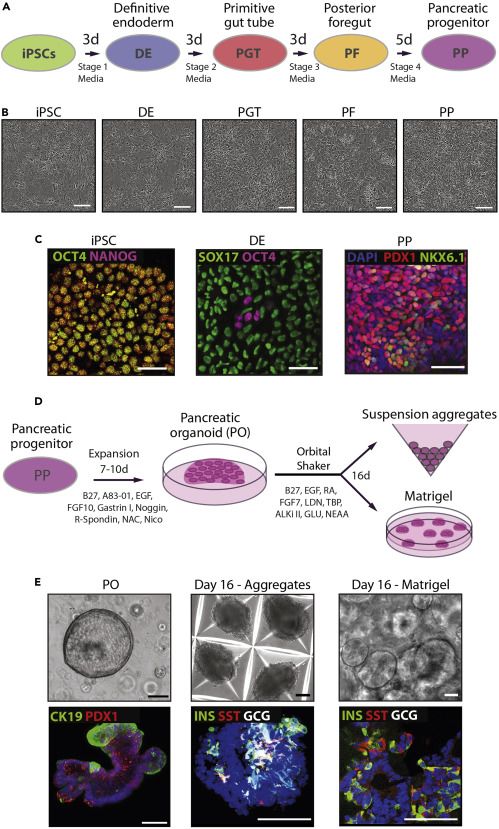 Fig. 2 A method to differentiate beta-like cells from hiPSCs through an intermediary step of pancreas progenitor expansion as 3D organoids.2,3
What Our Clients Say
"We needed a customized intestinal epithelial model derived from disease-specific iPSCs, and the differentiation requirements were more complex than a standard protocol. Creative Biolabs worked closely with our team to refine the induction strategy, optimize the culture format, and provide clear QC data. The final cells showed the epithelial characteristics and barrier-related readouts we needed for our downstream assays."
— Principal Investigator, Academic Gastrointestinal Disease Research Laboratory
"Our team was looking for hepatocyte-like cells generated from selected iPSC lines for early-stage compound evaluation. Creative Biolabs helped us define the most relevant marker panel and functional assays before the project started. The documentation, morphology images, and functional readouts made it easier for our internal team to integrate the cells into our screening workflow."
— Senior Scientist, Pharmaceutical Discovery Group
"What impressed us most was the scientific communication during the pancreatic lineage differentiation project. Instead of simply delivering a cell batch, Creative Biolabs provided milestone updates, explained key differentiation checkpoints, and helped us interpret the marker expression results. This was particularly useful for our disease-modeling program."
— Research Manager, Diabetes and Metabolic Disease Program
"Our project involved patient-derived iPSC lines with variable growth characteristics, so we needed a team experienced in handling line-to-line differences. Creative Biolabs provided thoughtful troubleshooting and adjusted the workflow based on each line's behavior. Their support helped us obtain usable digestive lineage cells for comparative disease studies."
— Stem Cell Core Facility Scientist
FAQs
Q: What types of iPSC-derived digestive system cells can Creative Biolabs generate?
A: Creative Biolabs can support differentiation toward a wide range of digestive system lineages, including intestinal epithelial cells, colon epithelial cells, gastric epithelial cells, hepatocyte-like cells, cholangiocyte-like cells, pancreatic progenitor-like cells, endocrine progenitor-like cells, beta-like cells, and digestive organoid models. If your target cell type is not listed, our team can evaluate feasibility and design a customized differentiation strategy.
Q: Can I provide my own iPSC line?
A: Yes. Clients can provide their own iPSC lines for digestive system differentiation. Before starting differentiation, we can perform quality assessment such as morphology review, viability testing, mycoplasma testing, pluripotency marker analysis, and genomic stability assessment if requested. If needed, Creative Biolabs can also support upstream iPSC generation, gene editing, reporter line construction, or isogenic control development.
Q: How do you confirm that the differentiated cells have the correct identity?
A: We use project-specific marker panels and functional assays. For intestinal epithelial cells, validation may include epithelial markers, tight junction markers, goblet cell markers, TEER, and permeability testing. For hepatocyte-like cells, we may evaluate hepatic markers, albumin secretion, urea production, glycogen storage, and metabolic enzyme activity. For pancreatic endocrine cells, we may assess pancreatic progenitor markers, endocrine markers, insulin expression, and glucose response depending on project scope.
Q: Do you provide both 2D and 3D digestive models?
A: Yes. Depending on the research goal, we can generate 2D differentiated cells, 3D organoids, spheroids, Transwell monolayers, air-liquid interface models, or assay-ready plate formats. For example, 2D intestinal epithelial monolayers may be preferred for permeability testing, while 3D intestinal or gastric organoids may be more appropriate for development, morphology, or tissue architecture studies.
Q: Can these cells be used for drug screening?
A: Yes. iPSC-derived digestive system cells are suitable for many screening applications, including toxicity testing, permeability assays, metabolic studies, inflammatory response assays, antiviral testing, barrier protection screening, and hormone secretion assays. Creative Biolabs can deliver cells in assay-ready formats or help establish customized readouts for your compound library.
Q: How long does an iPSC-derived digestive cell differentiation project take?
A: Timelines depend on the target lineage, iPSC line quality, required maturity, scale, and QC package. Some progenitor-stage differentiations may be completed faster, while mature organoids, hepatocyte-like cell models, or pancreatic endocrine maturation projects may require longer culture and validation periods. Creative Biolabs provides a project-specific timeline after consultation.
Q: Are these services suitable for clinical use?
A: These services are intended for research use only and are not for direct clinical use. However, the resulting cells and data can support early discovery, disease modeling, assay development, preclinical research, and translational feasibility studies.
Take the Next Step with Creative Biolabs







1. Contact Us
via the Inquiry Form or Email
2. Define Your Needs
Cell Type, Function, Quantity, Modifications
3. Kickstart the Project
Our Expert Team Guiding Every Step
Creative Biolabs helps researchers transform iPSC lines into customized digestive system cell models that reflect human biology, disease relevance, and experimental purpose. Whether your project focuses on intestinal barrier function, gastric infection, liver toxicity, biliary disease, pancreatic endocrine development, metabolic disorders, or organoid-based drug screening, our team can design a differentiation workflow that fits your scientific goals.
Contact Creative Biolabs today to develop customized iPSC-derived digestive system cell models for your next research program.
References
- Mithal, Aditya, et al. "Generation of mesenchyme free intestinal organoids from human induced pluripotent stem cells." Nature communications 11.1 (2020): 215. https://doi.org/10.1038/s41467-019-13916-6
- Pedraza-Arevalo, Sergio, et al. "Differentiation of beta-like cells from human induced pluripotent stem cell-derived pancreatic progenitor organoids." STAR protocols 3.3 (2022). https://doi.org/10.1016/j.xpro.2022.101656
- Distributed under Open Access license CC BY 4.0, without modification.