Endotoxin Standard Products
Introduction Standards The Roles Our Products Contact Us FAQs
Introduction
Historically, the Limulus Amebocyte Lysate (LAL) and Tachypleus Amebocyte Lysate (TAL) tests have served as the gold standard for detection. These assays utilize the coagulation cascade of horseshoe crab blood to identify LPS. Modern methodologies such as Recombinant Factor C (rFC) and the Monocyte Activation Test (MAT) are increasingly utilized to enhance specificity and sustainability. Regardless of the method, the accuracy of every test depends entirely on the quality of the endotoxin standards used to calibrate the instruments and validate the reagents. Our Endotoxin Standards help you ensure absolute product purity and streamline clinical trial processes through high-purity, RSE-traceable formulations and advanced recombinant enzyme technologies. We provide the critical benchmarks needed to validate your pyrogen detection and safeguard every batch.
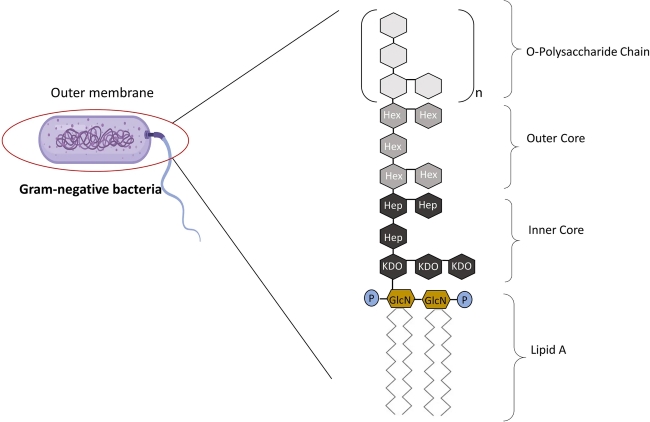 Fig.1 The LPS structure.1
International Standards
To ensure global consistency, endotoxin activity is quantified in Endotoxin Units (EU) or International Units (IU) rather than weight. This is because the biological activity of LPS varies significantly between bacterial strains, measuring by weight (nanograms) can lead to misleading results.
Reference Standard Endotoxin (RSE): The primary benchmark is highly characterized and serves as the ultimate point of traceability. These are used by regulatory bodies and lysate manufacturers to calibrate all other materials.
Control Standard Endotoxin (CSE): These are secondary standards calibrated specifically against the RSE. Because RSE is expensive and in limited supply, CSE is the practical choice for routine laboratory use.
The Roles of Endotoxin Standards
Endotoxin standards serve as the essential benchmarks for ensuring the safety and sterility of parenteral products. Without these precisely calibrated materials, it would be impossible to quantify bacterial contaminants or verify the reliability of detection assays. At Creative Biolabs, we utilize these standards to fulfill four critical roles in the testing workflow.
Standard Curve Generation
Standards are used to create the baseline for quantitative assays, including kinetic turbidimetric and chromogenic methods.
Reagent Sensitivity Verification
Before testing a product, laboratories must confirm the labeled sensitivity of their lysate using a standardized dilution series.
Inhibition/Enhancement Testing
Standards are spiked into drug products to determine if the formulation interferes with the assay's ability to detect endotoxins.
Hold-Time and Recovery Studies
Native endotoxin standards (NOEs) are used to validate that endotoxin remains "assayable" throughout a product's storage period, particularly in formulations prone to masking.
Our Endotoxin Standards Products
Creative Biolabs provides a comprehensive portfolio of standards tailored to diverse testing needs. The high-quality standards are calibrated against an RSE, provided with a lot-specific Certificate of Analysis (COA) that documents its potency in EU/vial. Our standards are optimized for a wide range of assays, from traditional Gel-Clot methods to high-throughput fluorimetric rFC systems.
Control Standard Endotoxins (CSE)
Derived from E. coli O113:H10 or O55:B5, these are available in multiple potencies ranging from 100 EU/vial to 10,000 EU/vial for routine screening.
Recombinant-Optimized Standards
Specifically formulated for use with animal-free rFC and rCR reagents to ensure peak fluorimetric or chromogenic sensitivity.
Naturally Occurring Endotoxins (NOE)
Non-purified standards that include cell wall fragments (vesicles), designed specifically for LER demasking and hold-time validation studies.
Endotoxin Challenge Vials
High-concentration vials (up to 10,000 EU) used to validate the effectiveness of depyrogenation ovens and tunnels.
Contact Us
Creative Biolabs' Endotoxin Standards are the foundation of a reliable, regulatory-compliant pyrogen testing program. By providing RSE-traceable materials, matched-lot certification, and specialized native endotoxins, we empower your laboratory to detect contaminants with unmatched precision. From early-stage drug discovery to final product release, we are committed to helping you maintain the highest standards of patient safety. Contact us for detailed information.
FAQs
Can I use the same potency for my CSE if I switch to a new lot of LAL reagent?
No. The potency of a CSE is specifically tied to the lot of lysates it was calibrated against. You should always consult the Certificate of Analysis (COA) for your specific CSE/Lysate combination to ensure accuracy.
Why should I choose NOE standards over purified CSE for hold-time studies?
Purified LPS (CSE) is highly susceptible to "masking" in certain buffers. Native standards (NOE) more closely mimic real-world contaminants, providing a more scientifically valid assessment of your product's endotoxin recovery.
Are your standards compatible with the Monocyte Activation Test (MAT)?
Yes, our high-purity standards are ideal for calibrating MAT assays, providing the "Endotoxin Equivalent" values required for human cell-based pyrogen detection.
Do you offer accessories that are certified endotoxin-free?
To ensure your standards aren't compromised, we provide a full range of glass tubes, pipette tips, and plates certified to <0.005 EU/mL.
Reference
-
Mohammad, Shireen, and Christoph Thiemermann. "Role of metabolic endotoxemia in systemic inflammation and potential interventions." Frontiers in immunology 11 (2021): 594150. Distributed under Open Access license CC BY 4.0, without modification. https://doi.org/10.3389/fimmu.2020.594150



 Add to Cart