
 Contact Us



The Monocyte Activation Test (MAT) represents the most significant advancement in pyrogenicity testing since the 1970s. As the biopharmaceutical industry moves toward a post-rabbit era, MAT has emerged as the gold-standard in vitro method for ensuring that parenteral medicines, medical devices, and cell therapies are free from fever-inducing contaminants. MAT is specifically designed to replicate the human innate immune response, providing a scientifically superior predictive model for patient safety.
In 2026, the regulatory landscape reached a turning point: the European Pharmacopoeia officially suppressed the Rabbit Pyrogen Test (RPT), establishing MAT as the reference method for pyrogen detection. Creative Biolabs provides a high-sensitivity MAT service that bridges the gap between ethical animal-free testing and rigorous scientific data required for submissions.
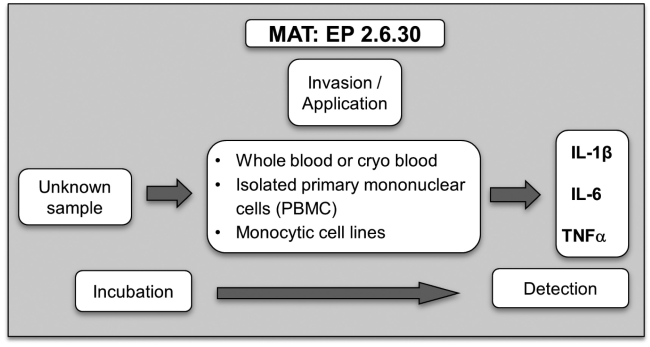 Fig.1 The biological principle of Monocyte Activation Test (MAT).1
The MAT functions by mimicking the human physiological fever response in a controlled laboratory environment. The mechanism centers on human monocytes which express a diverse array of pattern recognition receptors (PRRs) and most Toll-like receptors (TLRs).
MAT is a human cell-based in vitro assay designed to detect the full spectrum of pyrogens in parenteral medicines and medical devices. Its key features center on its ability to mimic human physiology, ensuring a safety profile that traditional animal-based tests cannot provide.
MAT detects the total pyrogens, including bacterial endotoxins and non-endotoxin pyrogens (NEPs).
Standard MAT services offer a limit of detection (LOD) as low as 0.05 EU/mL, even 0.001 EU/mL.
MAT is robust against the low endotoxin recovery phenomenon.
It is effective for testing products like human serum albumin, vaccines with aluminum adjuvants, and lipid-based parenterals.
Comparison of the MAT, RPT and LAL test
| Feature | RPT | LAL Test | MAT |
| Scientific Basis | Rabbit physiological response | Horseshoe crab hemolymph clotting | Human immune system activation |
| Detected Pyrogens | Endotoxin and NEP | Gram-negative endotoxin | Endotoxin and NEP |
| Relevance | Limited (species differences) | Low (non-mammalian) | Highest (human-specific) |
| Ethical Status | Animal intensive | Horseshoe crabs | Animal-free |
| Precision | Qualitative | Quantitative | Quantitative |
Creative Biolabs offers a suite of MAT services tailored to your specific product requirements. As the industry transitions away from animal-based models, our advanced platform offers a scientifically superior, human-relevant alternative for pyrogen detection in parenteral drugs, vaccines, and medical devices. Our MAT services are structured to ensure full compliance with Ph. Eur. 2.6.30 and USP <1225> standards, providing the critical data needed for global market approval.

Workflow of the Monocyte Activation Test (MAT) at Creative Biolabs
Creative Biolabs is your premier partner for Monocyte Activation Test (MAT) Services, offering scientifically superior and animal-free solutions for pyrogen detection. We provide the expertise and data packages necessary to ensure uncompromised patient safety and smooth regulatory approval in the modern biopharmaceutical landscape. Contact us for more information and to discuss your project.
MAT is more robust than LAL because it uses a biological cell-based system rather than a simplified enzyme cascade. We utilize specific protocols or product-specific dilutions to abrogate interference from surfactants or proteins like albumin.
Our MAT services typically reach a sensitivity of 0.05 EU/mL, which is well within the requirements for most parenteral products, and can be further optimized for high-sensitivity applications like dialysis fluids.
IL-6 is a stable, primary pro-inflammatory cytokine that provides a wide linear range for quantification. However, for products like HSA, we also offer IL-1β readouts, which can be even more representative of the rabbit-to-human fever correlation.
We use standardized cell lines to eliminate donor-to-donor variability. We ensure every test is performed with ready-to-use and pre-qualified cells.
Reference
 Contact Us