


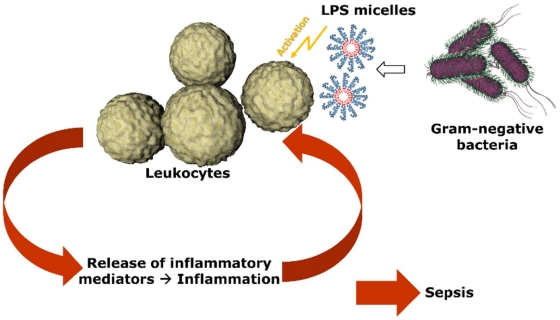
 Fig.1 The innate immunity is stimulated by bacterial endotoxins (LPS).1
Product List
Filter Product
Applications Endotoxin testing
Size 20 T
 Add to Cart
[Cat#: ES-0526-YC220]
Kinetic Turbidimetric Endotoxin Detection Kits, 0.01 - 100 EU/mL (ES-0526-YC220)
Applications Endotoxin testing
Assay Sensitivity 0.01 EU/mL
Detection Range 0.01 - 100 EU/mL
[Cat#: ES-0526-YC203]
Kinetic Turbidimetric Endotoxin Detection Kits (ES-0526-YC203)
Applications Endotoxin testing
Applications Endotoxin testing
[Cat#: ES-0526-YC218]
Kinetic Chromogenic Endotoxin Detection Kits, 0.005 - 50 EU/mL (ES-0526-YC218)
Applications Endotoxin testing
Assay Sensitivity 0.005 EU/mL
Detection Range 0.005 - 50 EU/mL
[Cat#: ES-0526-YC202]
Kinetic Chromogenic Endotoxin Detection Kits (ES-0526-YC202)
Applications Endotoxin testing
[Cat#: ES-0526-YC210]
Micro Kinetic Chromogenic Endotoxin Detection Kits (ES-0526-YC210)
Applications Endotoxin testing
Size 90 T
[Cat#: ES-0526-YC217]
Tube Quantitative Chromogenic Endotoxin Detection Kits (ES-0526-YC217)
Applications Endotoxin testing
Size 80 T
[Cat#: ES-0526-YC216]
Microplate Quantitative Chromogenic Endotoxin Detection Kits (ES-0526-YC216)
Applications Endotoxin testing
Size 64 T
[Cat#: ES-0526-YC215]
Rapid Gel Clot Endotoxin Detection Kit, 10 Sample Test (ES-0526-YC215)
Applications Endotoxin testing
Size 10 sample Kit
[Cat#: ES-0526-YC214]
Rapid Gel Clot Endotoxin Detection Kit, One Sample Test (ES-0526-YC214)
Applications Endotoxin testing
Size One sample Kit
[Cat#: ES-0526-YC209]
Gel Clot Endotoxin Detection Kits without Endotoxin (ES-0526-YC209)
Applications Endotoxin testing
[Cat#: ES-0526-YC208]
Gel Clot Endotoxin Detection Kits with Endotoxin (ES-0526-YC208)
Applications Endotoxin testing
[Cat#: ES-0526-YC207]
Gel Clot Endotoxin Detection Kit, 4500 Tests (ES-0526-YC207)
Applications Endotoxin testing
Size 4500 T
[Cat#: ES-0526-YC206]
Gel Clot Endotoxin Detection Kit, 1600 Tests (ES-0526-YC206)
Applications Endotoxin testing
Size 1600 T
[Cat#: ES-0526-YC205]
Gel Clot Endotoxin Detection Kit, 400 Tests (ES-0526-YC205)
Applications Endotoxin testing
Size 400 T
[Cat#: ES-0526-YC204]
Gel Clot Endotoxin Detection Kit, 128 Tests (ES-0526-YC204)
Applications Endotoxin testing
Size 128 T