
 Contact Us



The detection of bacterial endotoxins is a critical safety requirement for all injectable biopharmaceuticals and medical devices. Traditionally, this relies on Limulus Amebocyte Lysate (LAL), which is harvested from the blood of wild horseshoe crabs. However, as populations of these marine creatures become increasingly vulnerable and endangered, the industry is transitioning toward more sustainable, synthetic alternatives.
Recombinant Factor C (rFC) represents the next generation of Bacterial Endotoxin Testing (BET). By cloning the endotoxin-sensitive Factor C protein from the horseshoe crab and expressing it via recombinant DNA technology, we have created an animal-free reagent that offers the same, if not superior, sensitivity to traditional methods without the ecological impact. At Creative Biolabs, we specialize in helping biopharmaceutical manufacturers adopt this innovative technology to align with global 3Rs initiatives and modern pharmacopeial standards.
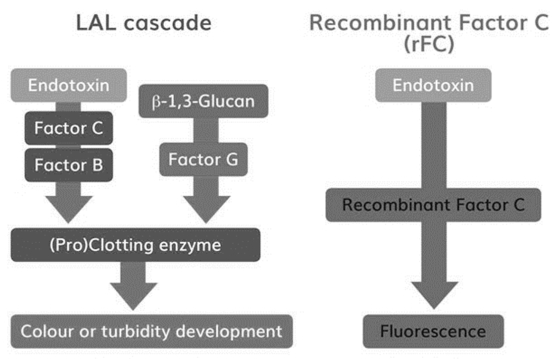 Fig.1 Reaction cascades in LAL and rFC assays.1
The rFC assay is a streamlined, single-enzyme biochemical reaction that mimics the initial step of the natural horseshoe crab coagulation cascade. Traditional LAL involves a multi-protease cascade (Factor C, Factor B, and the proclotting enzyme). The rFC assay focuses specifically on the primary biosensor. It lacks the Factor G enzyme found in LAL, rFC does not react with (1,3)-beta-D-glucans, thus eliminating the risk of false-positive results commonly caused by cellulose filters or fungal components.
The transition to rFC provides several technical and operational advantages over animal-derived methods:
Since rFC is exclusively activated by endotoxins, it provides a direct measurement free from interference by beta-glucans.
Synthetic production via genetic engineering ensures that every batch of reagent is identical, eliminating the biological variability inherent in animal-sourced amebocytes.
The assay maintains a wide detection range, typically from 0.005 to 5 EU/mL, ensuring it meets the most stringent purity requirements for biologics.
By removing the dependence on finite natural resources, rFC provides a reliable, year-round supply chain that is immune to seasonal harvesting fluctuations or ecological shocks.
Creative Biolabs provides a complete, outsourced solution for manufacturers ready to move to recombinant technology. Our services are designed for immediate regulatory submission and full compliance with international standards, including USP Chapter <86> and Ph. Eur. 2.6.32.
We offer comprehensive testing for a variety of products, from raw materials and water for injection (WFI) to complex finished biologics and autogenous vaccines. Our laboratory is equipped with high-performance fluorescence microplate readers and specialized software to ensure the highest data integrity and recovery accuracy. We also provide full documentation support to assist with your filing requirements, ensuring that your transition to an animal-free BET is seamless.

Workflow of Recombinant Factor C (rFC) Endotoxin Test Service at Creative Biolabs
Creative Biolabs helps you secure a stable supply chain and achieve unmatched specificity through genetically engineered recombinant DNA technology. We provide animal-free, compendial-aligned endotoxin detection to accelerate your product release and ensure superior patient safety. Contact us for your projects.
Yes. As of 2024, the USP has adopted Chapter <86>, which endorses recombinant reagents. Additionally, the European Pharmacopoeia has recognized rFC as a compendial method in Chapter 2.6.32 since 2020.
Traditional LAL contains Factor G, which can be triggered by beta-glucans. Recombinant Factor C eliminates this enzyme, making the assay 100% endotoxin-specific and reducing the need for costly Out-of-Specification (OOS) investigations.
rFC assay is equivalent and often superior to traditional Kinetic Chromogenic LAL for complex products, including autogenous vaccines, showing better endotoxin recovery and fewer interferences.
Our standard rFC assay is sensitive down to 0.005 EU/mL, making it suitable for even the most high-purity biopharmaceutical requirements.
Reference
 Contact Us