Fungal Glucan (G Test) Kits
Introduction Mechanism Our Products Contact Us FAQs
Introduction
(1→3)-β-D-Glucan (BDG) is a primary structural carbohydrate polymer found in the cell walls of most pathogenic fungi, including Candida, Aspergillus, and Pneumocystis jirovecii. Unlike bacteria or human cells, which lack this molecule, BDG serves as a highly specific pan-fungal biomarker. During an invasive infection, these glucan molecules are released into the bloodstream, making them detectable long before clinical symptoms or radiological signs appear.
The G test is a non-invasive, serum-based or BAL fluid-based diagnostic tool designed to address the diagnostic window where traditional cultures often yield false negatives. By quantifying BDG levels, clinicians can shift from blind empirical treatment to evidence-based preemptive therapy, significantly improving survival rates for immunocompromised patients. Our Fungal Glucan (G Test) Kit helps you obtain rapid, quantitative results and implement early preemptive therapy through advanced kinetic chromogenic and chemiluminescence technologies.
Action Mechanism of G Test
The fungal glucan (G test) is a sophisticated biochemical process that utilizes a natural enzymatic cascade to detect systemic fungal presence. The test specifically targets BDG, which is the primary structural component of the cell wall in most pathogenic fungi. The detection process mimics the natural immune response found in the limulus amebocyte lysate (LAL).
01. Factor G Activation
BDG present in the patient sample binds specifically to factor G, a natural serine protease zymogen.
02. The Cascade
This binding triggers an amplification cascade that converts a proclotting enzyme into an active clotting enzyme.
03. Signal Generation
The clotting enzyme then hydrolyzes a synthetic chromogenic substrate, releasing a detectable signal (PNA).
04. Quantification
The rate of change is measured. This rate is directly proportional to the concentration of fungal glucan in the sample.
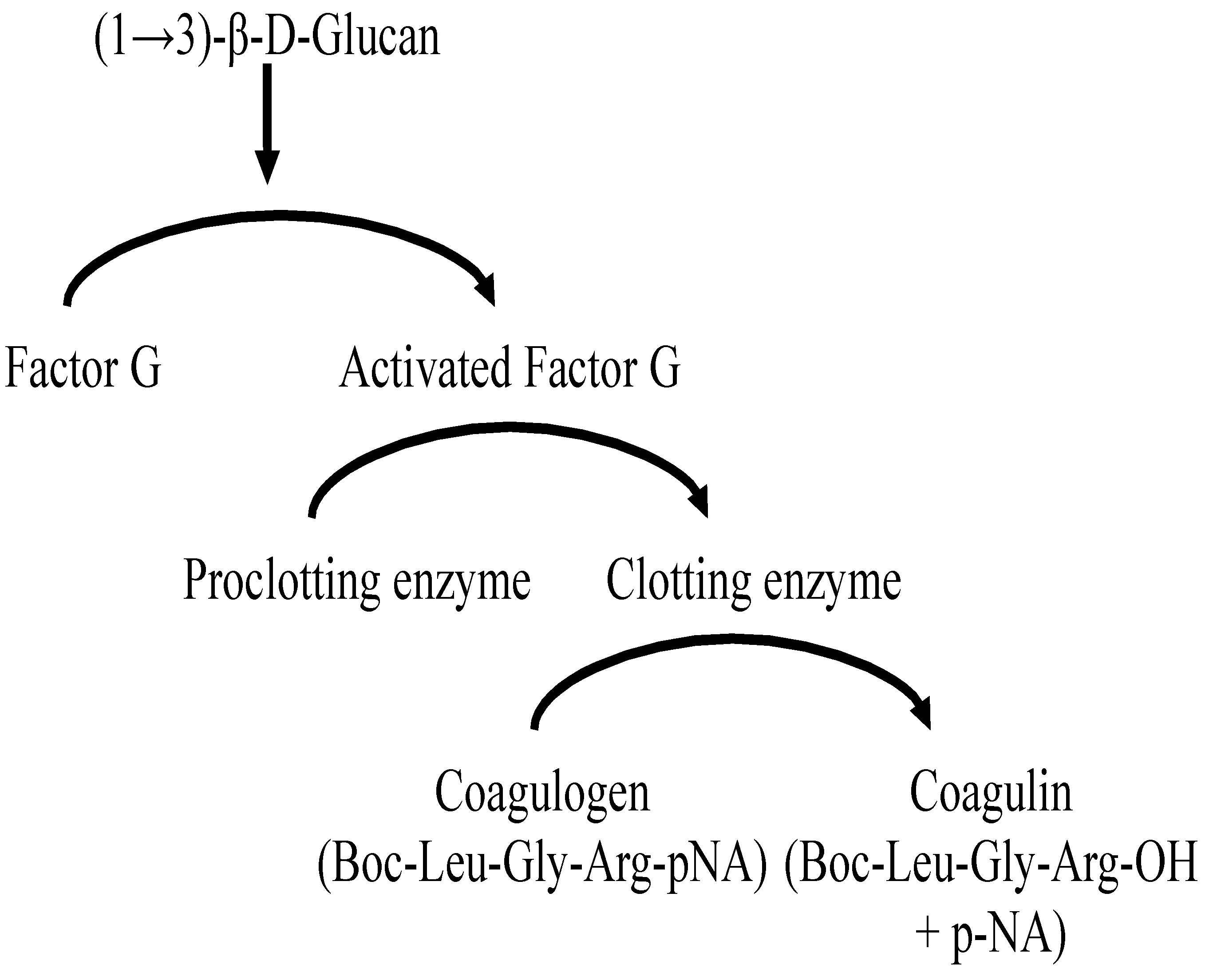 Fig.1 Principle of G test.1
Our Fungal Glucan Kit Products
The G test is a rapid, non-culture-based in vitro diagnostic tool designed for the quantitative detection of BDG in human serum. Creative Biolabs offers a range of configurations to suit various laboratory volumes and instrumentation.
Kinetic Chromogenic G Test Kit
Our classic microplate-based format, ideal for high-throughput screening and batch testing.
Automated G Test Kit
Utilizing chemiluminescence immunoassay technology, this format is optimized for our fully automatic systems.
Integrated Reagent Strips
All-in-one cartridges that combine reagents and consumables to minimize manual pipetting errors and contamination risks.
Specialized Pretreatment Solutions
Patented alkaline solutions that eliminate potential interference from serum proteins or lipids.
Contact Us
Creative Biolabs provides the global medical community with high-precision, rapid-response diagnostic tools. Our Fungal Glucan (G Test) Kit stands at the intersection of biochemical excellence and clinical necessity, offering the speed required to save lives and the accuracy required to manage antifungal resources effectively. Contact us for detailed technical specifications and products.
FAQs
Can the G Test distinguish between different fungal species?
The G test is a pan-fungal screening tool. While it identifies the presence of a fungal load, species identification should be confirmed through complementary methods like PCR or culture.
What causes a false positive result?
Common factors include hemodialysis with certain membranes, use of glucan-containing gauze, or recent treatment with certain blood products like albumin. Our detailed protocol provides clear guidelines to mitigate these risks.
Is the kit compatible with automated laboratory equipment?
Yes, our kits are designed for compatibility with standard microplate readers and our proprietary fully automated chemiluminescence systems.
Reference
-
Yoshida, Minoru. "Development of a method of measuring β-D-glucan and its use in preemptive therapy for invasive fungal infections." International Journal of Molecular Sciences 22.17 (2021): 9265. Distributed under Open Access license CC BY 4.0, without modification. https://doi.org/10.3390/ijms22179265



 Add to Cart