
 Contact Us



The Kinetic Turbidimetric Limulus Amebocyte Lysate (KT-LAL) assay represents the pinnacle of quantitative endotoxin detection. While the classical gel-clot method has served the industry for decades, the modern biopharmaceutical sector requires the granular data that only kinetic methods can provide. This assay is a photometric technique that measures the increase in turbidity resulting from the reaction between bacterial endotoxins and the LAL reagent. At Creative Biolabs, we implement this method to support clients who require high-sensitivity detection ensuring that even trace amounts of endotoxin are identified and quantified.
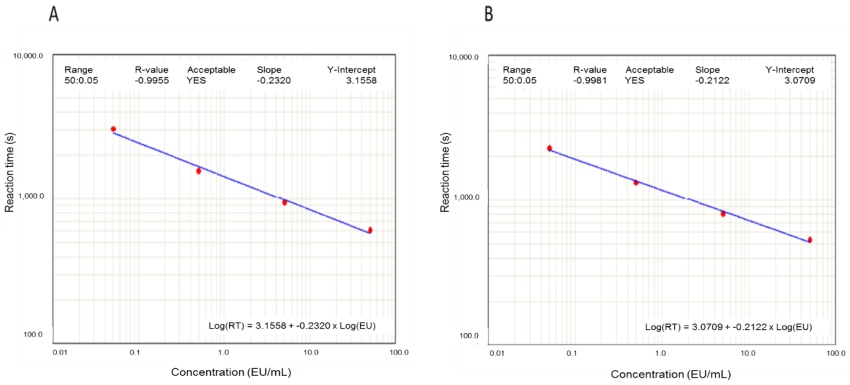 Fig.1 Calibration curves of a Kinetic Turbidimetric Assay.1
The underlying biochemistry of the turbidimetric assay mimics the primitive immune response of the horseshoe crab (Limulus polyphemus). When endotoxins are introduced into the LAL reagent, they trigger a proenzyme cascade.
The KT-LAL assay is a quantitative, photometric method that measures the increase in turbidity resulting from the reaction between bacterial endotoxins and the LAL reagent.
It often covers up to four orders of magnitude, minimizing the need for extensive sample dilutions.
The use of microplate readers allows for high-throughput screening of multiple batches simultaneously.
Because the results are electronic and software-driven, the risk of human error associated with the visual "gel-flip" test is eliminated.
Using specific buffers and optimized maximum valid dilution calculations, it effectively handles complex matrices like proteins, fats, and emulsions.
Creative Biolabs provides a turnkey solution for endotoxin quantification tailored to your specific regulatory path. Our service is designed to move beyond simple "pass/fail" results, offering a quantitative approach that provides absolute clarity on the endotoxin levels within your samples. Our services are structured to ensure that your products meet the most stringent safety and regulatory requirements.
Rapid testing for parenteral drugs, vaccines, and water for injection.
Custom protocols for difficult-to-test products, including those with significant inhibitory or enhancement properties.
Helping you identify contamination within your manufacturing line before they compromise a final lot.
Every test is performed in compliance with USP <85>, EP 2.6.14, and JP 4.01 standards.

Workflow of Kinetic Turbidimetric LAL Endotoxin Testing Service at Creative Biolabs
Creative Biolabs helps you streamline your quality control and achieve audit-ready compliance through our advanced kinetic turbidimetric LAL platforms. By utilizing real-time photometric monitoring and high-affinity limulus amebocyte reagents, we provide the definitive answer to endotoxin contamination in your parenteral drugs and medical devices. Contact us to assist with your validation and testing needs.
We utilize specific wavelengths that bypass many natural pigments. For highly opaque samples, we use PVDF filtration or optimized dilutions to ensure the photometric reader can accurately detect turbidity changes.
Yes. At Creative Biolabs, we use endotoxin-specific buffers that block the Factor G pathway, ensuring that (1,3)-β-D-glucan does not trigger a false positive result.
Generally, 2-5 mL is sufficient for routine testing, but this can vary based on the required sensitivity and MVD. We recommend a brief technical consultation to confirm requirements for your specific project.
Every run includes negative controls, positive product controls (spikes), and a multi-point standard curve. We only release results when all system suitability criteria are strictly met.
Reference
 Contact Us