Beta-Glucan Blocker Products
Introduction LAL Cascade Mechanism Our Products Contact Us FAQs
Introduction
(1→3)-beta-D-glucans are naturally occurring carbohydrate polymers found in the cell walls of fungi, yeast, and plants. Glucans are ubiquitous and often leach from cellulose-based filters, cotton plugs, and even laboratory paper products. While they are chemically distinct from bacterial endotoxins, their structural similarity allows them to inadvertently trigger the Limulus Amebocyte Lysate (LAL) cascade. This interference is a major hurdle in pharmaceutical environments.
A beta-glucan blocker is a specialized reagent designed to solve this specificity problem. By providing a targeted inhibitory environment, these blockers allow researchers and quality control specialists to isolate the measurement of bacterial endotoxins, ensuring that a positive result truly reflects the presence of gram-negative contaminants.
The LAL Cascade
The biochemical foundation of the LAL test involves two primary activation pathways. When both pathways are active, they converge on the same proclotting enzyme, leading to an overestimation of the endotoxin concentration, a phenomenon known as glucan noise.
The Factor C Pathway (Target)
This is the intended pathway for endotoxin detection. Bacterial endotoxins bind to and activate factor C, which then triggers Factor B, leading to the activation of the proclotting enzyme.
The Factor G Pathway (Interference)
This parallel system is sensitive to (1→3)-beta-D-glucans. When glucans are present, they activate factor G, which bypasses factors C and B to activate the proclotting enzyme directly.
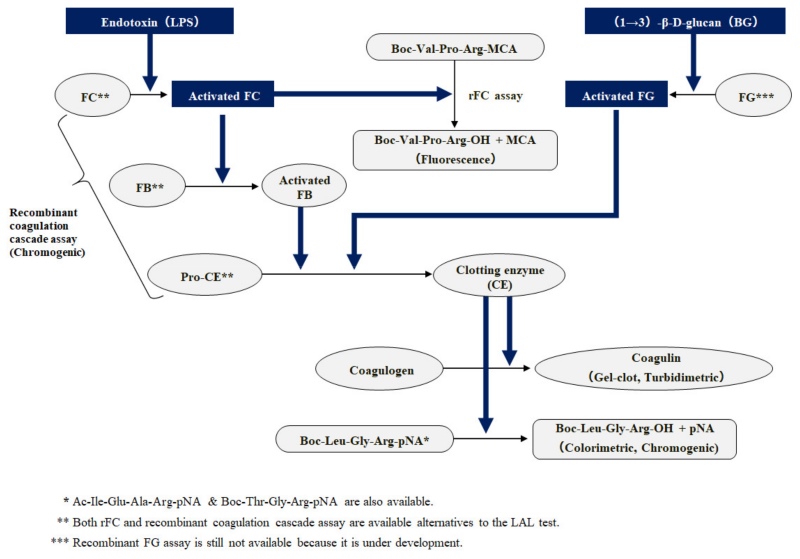 Fig.1 The LAL cascade pathways.1
How Beta-Glucan Blockers Work
Beta-glucan blockers function by specifically targeting and inhibiting the factor G zymogen.
-
Competitive Inhibition: The blocker contains a high concentration of non-reactive carbohydrate ligands. These ligands bind to the factor G recognition sites, saturating the pathway so it cannot react with (1→3)-beta-D-glucans.
-
Pathway Silencing: By turning off factor G, the blocker ensures that any activation of the proclotting enzyme is solely the result of bacterial endotoxin triggering the factor C pathway.
By implementing this targeted inhibition, Creative Biolabs ensures that your diagnostic results represent true microbial risk, free from the noise of environmental or manufacturing artifacts.
Our Beta-Glucan Blocker Products
Creative Biolabs' blockers utilize high-affinity ligands that bind to the Factor G recognition site, effectively rendering it unreactive to (1→3)-beta-D-glucans in the sample. This ensures that the enzymatic cascade is only initiated through the factor C pathway, providing a mathematically accurate and specific measurement of the actual endotoxin load. We offer a suite of high-purity blocking solutions tailored to different laboratory requirements and sample complexities.
Standard G-Blocking Reagent
Designed for routine Limulus Amebocyte Lysate (LAL) testing where moderate (1→3)-beta-D-glucan contamination is expected.
High-Potency Factor G Blocker
A concentrated formulation for samples with extreme glucan loads, such as those derived from high-density yeast cultures or crude cellulosic extracts.
Ready-to-Use Reconstitution Buffer
Formulated to replace LAL reagent water during the reconstitution of LAL reagents.
Multi-Vial Kits
Packaged in sterile 5 mL or 10 mL vials for maximum stability and convenience in high-volume production environments.
Contact Us
Creative Biolabs provides the critical tools needed to eliminate diagnostic noise and accelerate your path to regulatory approval. Our Beta-Glucan Blockers help you obtain high-fidelity endotoxin quantification and streamline your quality control processes through advanced competitive ligand technology that specifically silences non-endotoxin signals. Contact us for more information.
FAQs
Will using a blocker reduce the sensitivity of my endotoxin test?
No. Creative Biolabs' beta-glucan blockers are formulated to inhibit the factor G pathway without affecting the activation threshold of factor C.
Can I use this blocker with any brand of LAL reagent?
Yes, our blockers are compatible with major compendial amebocyte lysate reagents.
How long is the blocker stable once opened?
When stored at 2-8°C and handled aseptically, our blockers remain stable for up to four weeks after opening.
Reference
-
Tamura, Hiroshi, Johannes Reich, and Isao Nagaoka. "Outstanding contributions of LAL technology to pharmaceutical and medical science: review of methods, progress, challenges, and future perspectives in early detection and management of bacterial infections and invasive fungal diseases." Biomedicines 9.5 (2021): 536. Distributed under Open Access license CC BY 4.0, without modification. https://doi.org/10.3390/biomedicines9050536



 Add to Cart