
Applications
Online Inquiry
For research use only. Not intended for any clinical use.
This site is protected by reCAPTCHA and the Google Privacy Policy and Terms of Service apply.
Vector Biodistribution & Shedding Studies
Are you currently facing challenges in demonstrating comprehensive AAV vector biodistribution and shedding profiles to meet stringent regulatory requirements? Our NHP Vector Biodistribution & Shedding Studies help you reduce the risk of clinical hold and accelerate your gene therapy timeline through human-relevant AAV safety and biodistribution modeling.
NHPs Vector Biodistribution & Shedding Studies Secure Your IND Submission
NHP models provide essential translational data for AAV vector safety and biodistribution, addressing critical regulatory concerns about systemic exposure and patient safety.
Overview of NHP Applications
What Are Our Research Areas?
Vector biodistribution and shedding studies represent a critical stage in the preclinical development of gene therapies, particularly those utilizing Adeno-Associated Virus (AAV) vectors. While initial clinical success in conditions like Inherited Retinal Dystrophies has proven the therapeutic potential of AAV-mediated gene augmentation, a significant portion of genetic diseases, remains untreatable due to vector size limitations or the need for gene suppression rather than replacement. Preclinical research, therefore, must pivot toward novel delivery systems and therapeutic modalities (such as targeted RNA or protein approaches). However, regulatory bodies require robust data to assess the safety of any systemic exposure. This includes determining where the vector material travels within the treated subject (biodistribution) and if it is excreted into the environment (shedding), which must be confirmed as biologically inactive and non-propagating.
Why Choose Us?
NHPs are the mandatory translational model for gene therapy safety assessment due to their unparalleled physiological and immunological relevance to humans. Creative Biolabs leverages these advantages to generate data that satisfies the most rigorous regulatory scrutiny.
- Genetic and Immunological Similarities: NHPs possess a highly similar immune system to humans, enabling accurate modeling of Anti-Drug Antibody (ADA) and Neutralizing Antibody (NAb) responses against AAV capsids—a primary driver of vector clearance and efficacy loss.
- Clinical Translational Relevance: NHPs offer anatomical and physiological features (e.g., retinal structure, organ size, and metabolic rate) that accurately predict human PK/PD profiles, which is impossible with rodent models.
- Data Types Required for Regulatory Submissions: NHP biodistribution and toxicology data are specifically required for Investigational New Drug (IND) and Clinical Trial Application (CTA) submissions, serving as the bridge between proof-of-concept and first-in-human trials.
- Accurate Shedding Profile: Only NHPs allow for the collection of biologically relevant samples across all excretion routes, confirming that vector shedding occurs at the predicted very low, biologically inactive levels, mitigating safety concerns for non-treated individuals.
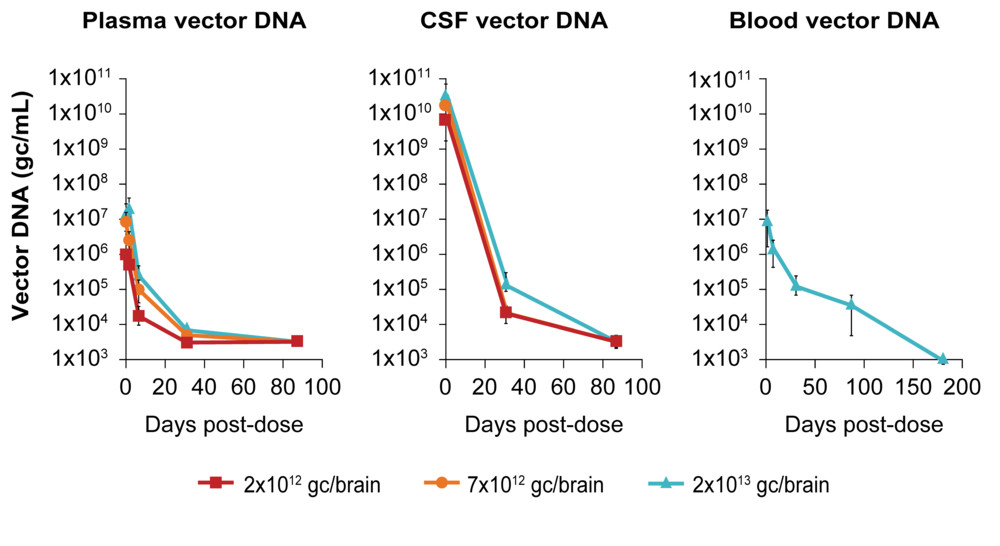 Fig.1 Shedding of vector DNA in body fluids in NHP after AAV5 injection.1
Key Applications
Creative Biolabs utilizes NHPs to provide high-quality data across the most challenging areas of gene therapy safety and regulatory compliance:
- Vector Biodistribution and Tissue Tropism Mapping: NHPs are used to precisely map the distribution of AAV vectors across major organs, including the central nervous system (CNS), gonads, and target tissues (e.g., retina). This is essential for establishing the dose and route of administration and confirming the intended target cell transduction efficiency.
- Quantification of Shedding Across Excreta (Safety Assessment): This critical study involves the systematic collection and analysis of excreta (feces, urine, semen, saliva, ocular fluid) post-dosing. We employ highly sensitive quantitative assays (qPCR/ddPCR) to determine the timeline and magnitude of vector material shedding, directly addressing regulatory non-proliferation concerns.
- Integrated PK/PD and Safety Correlation: NHPs enable the correlation of vector dose (PK) with the resulting safety profile (Toxicology) and the therapeutic response (PD). This allows for the establishment of a no-observed-adverse-effect level that is maximally predictive of the human clinical safety window.
- Immunogenicity and Pre-existing Immunity Evaluation: NHPs are used to screen for pre-existing anti-AAV antibodies and to monitor the development of de novo immune responses following vector administration, a key risk factor for both efficacy and acute toxicity.
How Do Creative Biolabs Support Your Projects?
Creative Biolabs provides end-to-end support for gene therapy programs by integrating our core NHP services, ensuring comprehensive data generation from collection to analysis.
| Service Capability | Corresponding Application Area |
| Vector Copy Number (qPCR, ddPCR) | The gold standard for highly sensitive and precise quantification of vector DNA in biodistribution and shedding samples. |
| Advanced Therapy Safety (Gene/Cell Therapy) | Essential for regulatory toxicology package submissions for all novel AAV and non-viral vectors. |
| ADA & Neutralizing Antibody (NAb) Assays | Critical for assessing immunogenicity and predicting vector clearance, particularly in systemic or high-dose applications. |
| Tissue Distribution & Mass Balance | Precise quantification of vector material in organ homogenates to determine off-target exposure and overall mass balance. |
Translational Impact
The strategic utilization of NHP vector studies is not just a regulatory checklist item; it is a fundamental de-risking strategy for gene therapy development. By providing data on biodistribution, tissue tropism, and the low magnitude of shedding, Creative Biolabs significantly impacts your translational timeline:
- Reduced Risk of IND Failure: NHP biodistribution data is often required for gene therapy IND submissions. Complete and human-relevant NHP data reduces the risk of IND failure or clinical hold related to systemic safety and environmental hazard concerns.
- Early Detection of Immune Responses/Toxicity: The strong immunological parallel between NHPs and humans allows for the early and accurate identification of severe immune or inflammatory responses to the vector, preventing catastrophic outcomes in Phase 1 trials.
- Optimized Dose Selection: PK/PD data generated in NHPs enables the selection of the lowest therapeutically effective dose with the safest biodistribution profile, directly supporting the clinical protocol design and maximizing the therapeutic index.
- Data-Driven Messaging: Our comprehensive reports allow clients to confidently establish the safety margin, emphasizing that even where vector DNA is detected (e.g., via highly sensitive qPCR), the vector material is biologically inactive and non-propagating, thus minimizing concern for potential horizontal transmission.
Frequently Asked Questions
Q: What is the required sensitivity for shedding assays, and can Creative Biolabs reliably measure these low levels?
A: Regulatory guidance requires high sensitivity, especially in demonstrating non-infectivity. Creative Biolabs routinely employs advanced digital droplet PCR (ddPCR) and highly optimized qPCR methods, which offer superior sensitivity and precision for quantifying vector copy number in trace samples (like feces, urine, or ocular fluid). We also offer challenging bio assays/infectivity assays to confirm the lack of biological activity, going beyond mere DNA detection.
Q: Which specific NHP bio-specimens are collected for a comprehensive shedding and biodistribution profile?
A: A complete profile requires analysis across all potential elimination routes. In addition to standard Blood, Serum & Plasma for PK/TK, our studies include tissues and body fluids such as CSF & Other Body Fluids, urine, feces, saliva, and sometimes semen/vaginal secretions, depending on the route of administration and target tissue. This broad collection scope ensures full mass balance and shedding assessment.
Q: How do NHP studies compare to rodent models for predicting human AAV toxicity and biodistribution?
A: While rodents offer initial screening, their small size and genetic distance from humans mean they fail to predict several critical human responses, particularly in terms of immunogenicity and accurate tissue tropism following systemic dosing. NHPs are essential because their immune responses and physiological barriers are highly translational, directly correlating to the data requested for IND submissions.
Q: What is the typical turnaround time for a full NHP biodistribution and shedding study, including final data reporting?
A: The timeline depends heavily on the study design, particularly the duration of follow-up required for late-stage shedding (which can be several weeks post-dosing). However, we commit to rapid, high-quality analysis. Our Multi-Omics & Data Reporting pipelines ensure efficient data processing post-sample collection, with final, integrated reports delivered according to agreed-upon project timelines.
Contact Us
Creative Biolabs is dedicated to providing the most robust, regulatory-compliant NHP models for your gene therapy journey. We specialize in navigating the complex safety landscape of AAV vectors, providing the high-resolution biodistribution and shedding data required to advance your novel treatments for conditions like Inherited Retinal Dystrophies and beyond. Contact us and leverage our NHP Vector Biodistribution & Shedding related services to accelerate your path to the clinic.
Reference
- Spronck, Elisabeth A., et al. "Intrastriatal administration of AAV5-miHTT in non-human primates and rats is well tolerated and results in miHTT transgene expression in key areas of Huntington disease pathology." Brain Sciences 11.2 (2021): 129. Distributed under Open Access license CC BY 4.0, without modification. DOI: https://doi.org/10.3390/brainsci11020129