
Introduction to iPSC-Derived Hematopoietic Cell Differentiation
Hematopoiesis is the developmental process through which multipotent progenitors give rise to the diverse cellular components of blood and immunity. In vivo, hematopoietic development involves a tightly regulated sequence of mesoderm specification, hemogenic endothelial emergence, endothelial-to-hematopoietic transition, progenitor expansion, and lineage maturation. These events are controlled by coordinated signaling pathways, transcriptional networks, extracellular matrix interactions, and microenvironmental cues.
In vitro differentiation of human iPSCs into hematopoietic lineages seeks to reconstruct key aspects of this developmental process under defined culture conditions. By modulating signaling pathways such as BMP, WNT, VEGF, FGF, Notch, cytokine-mediated hematopoietic expansion, and lineage-specific maturation signals, iPSCs can be directed toward hematopoietic progenitor-like populations and further differentiated into selected blood and immune cell types.
The resulting cells can be used in many research scenarios, including disease modeling, immune-cell functional studies, drug response profiling, toxicity assessment, host-pathogen interaction studies, inflammatory disease research, and exploratory cell therapy development. Because iPSCs can be generated from healthy donors, patients, or engineered isogenic lines, they are especially valuable for building genetically controlled experimental systems.
Creative Biolabs Hematopoietic Differentiation Platform
Creative Biolabs has established a versatile iPSC hematopoietic differentiation platform that can be adapted to multiple lineages and project goals. The platform integrates stem cell maintenance, mesoderm induction, hematopoietic specification, progenitor enrichment, lineage maturation, and downstream validation.
Our platform includes:
- Defined and feeder-free iPSC maintenance systems
- Mesoderm induction and hemogenic endothelial specification
- Hematopoietic progenitor cell generation
- Myeloid, erythroid, megakaryocytic, and lymphoid-oriented differentiation routes
- Cytokine-guided lineage maturation
- Flow cytometry-based phenotyping
- Gene expression and molecular profiling options
- Functional assay development
- Cryopreservation and recovery testing
- Custom reporting for publication, internal R&D, or preclinical research planning
We also provide protocol optimization for challenging iPSC lines, including lines with variable growth characteristics, disease-associated phenotypes, edited genotypes, or prior culture adaptation. Our team can assess whether a given iPSC line is differentiation-ready and recommend corrective steps if issues are detected.
Available iPSC-Derived Hematopoietic Cell Types
Creative Biolabs offers differentiation services for a broad range of hematopoietic and immune cell populations. Depending on the requested lineage, final products may be delivered as enriched progenitors, immature intermediates, or mature functional cells.
| Cell Types | Descriptions |
|---|---|
| iPSC-Derived Hematopoietic Progenitor Cells | Creative Biolabs can generate progenitor populations using stage-specific induction methods and provide phenotypic characterization based on markers such as CD34, CD43, CD45, CD41, CD235a, CD90, CD38, or other project-specific panels. Depending on client requirements, progenitor cells can be delivered fresh, cryopreserved, or used immediately for internal downstream differentiation. |
| iPSC-Derived Myeloid Cells | Myeloid cells play central roles in innate immunity, inflammation, tissue repair, antigen presentation, and host defense. Creative Biolabs supports differentiation of iPSCs toward several myeloid cell types, including macrophage-like cells, monocyte-like cells, dendritic cell-like populations, granulocyte-oriented populations, and customized myeloid disease models. |
| iPSC-Derived Erythroid Cells | Erythroid differentiation from iPSCs is valuable for studying erythropoiesis, hemoglobin switching, anemia, hemoglobinopathies, red blood cell disorders, oxygen transport biology, and drug response in erythroid systems. Creative Biolabs can develop erythroid differentiation workflows that guide iPSCs through hematopoietic progenitors toward erythroid progenitor and erythroblast-like stages. |
| iPSC-Derived Megakaryocytes | Creative Biolabs offers iPSC-derived megakaryocyte differentiation services using cytokine-supported maturation conditions. Cell characterization may include markers such as CD41, CD42a, CD42b, CD61, ploidy analysis, proplatelet-like structure evaluation, and lineage-specific gene expression profiling. Customized assay formats may be developed for thrombopoietic factor screening, disease modeling, or compound evaluation. |
| iPSC-Derived NK Cells | Creative Biolabs can support iPSC-derived NK cell differentiation workflows with emphasis on lineage specification, expansion, phenotypic maturation, and functional testing. Characterization options may include CD56, CD16, NKG2D, NKp30, NKp44, NKp46, KIR-related markers, granzyme B, perforin, and cytokine secretion assays. Cytotoxicity testing can be incorporated using tumor cell co-culture systems selected by the client. |
| iPSC-Derived Macrophages | Creative Biolabs can generate iPSC-derived macrophage-like cells and provide polarization or stimulation assays using client-specified conditions. Functional readouts may include phagocytosis, cytokine production, surface marker changes, inflammasome activation, pathogen response, lipid uptake, and transcriptomic profiling. |
| iPSC-Derived Dendritic Cells | Creative Biolabs can design differentiation and maturation strategies to support dendritic cell research, including cytokine stimulation, maturation factor exposure, and downstream immune co-culture assays. Phenotypic panels may include CD11c, HLA-DR, CD80, CD83, CD86, CD1c, CD141, or other markers selected according to the dendritic cell subset of interest. |
| Customized Hematopoietic Lineage Models | In addition to standard hematopoietic lineages, Creative Biolabs can support exploratory differentiation programs for rare or specialized blood-lineage populations. These projects may require feasibility testing, stepwise optimization, pilot-scale differentiation, and iterative assay development. Our team can help determine which differentiation route is most appropriate and what validation strategy is needed to define success. |
Applications of iPSC-Derived Hematopoietic Cells
iPSC-derived hematopoietic cell systems are powerful tools across basic, translational, and industrial research.
-
Disease Modeling
By differentiating patient iPSCs into hematopoietic lineages, researchers can model inherited blood disorders, immune deficiencies, inflammatory diseases, bone marrow failure syndromes, hemoglobinopathies, platelet disorders, macrophage-related diseases, and monogenic immune conditions.
Creative Biolabs can support disease modeling programs using patient-derived lines, healthy donor controls, and gene-corrected isogenic controls. -
Drug Discovery and Screening
iPSC-derived hematopoietic systems can be adapted for compound screening, toxicity testing, immune-modulatory drug evaluation, cytokine response profiling, and disease phenotype rescue assays. -
Immuno-Oncology Research
iPSC-derived immune cells, including NK cells, macrophages, and dendritic cell-like populations, can support immuno-oncology research. These systems can be used to evaluate tumor cell recognition, immune activation, antigen presentation, cytokine secretion, macrophage polarization, immune suppression, and cytotoxicity.
Creative Biolabs can help design co-culture systems, target-cell killing assays, immune checkpoint-related studies, and engineered immune cell research models. -
Hematologic Disease Research
iPSC-derived erythroid cells, megakaryocytes, and progenitor populations provide useful models for studying hematologic diseases. Applications include hemoglobinopathy research, anemia modeling, platelet disorder studies, marrow failure syndrome modeling, leukemia-associated differentiation studies, and evaluation of hematopoietic gene correction strategies. -
Gene Editing and Isogenic Model Development
Creative Biolabs can combine iPSC hematopoietic differentiation with genome editing to create isogenic disease models. Such platforms are particularly valuable when studying mutation-specific effects on hematopoietic development, immune cell behavior, erythroid maturation, megakaryocyte function, or drug response. -
Cell Therapy Development Support
Creative Biolabs can assist with exploratory differentiation workflows, engineered iPSC platforms, immune effector cell generation, and preclinical research assay design. -
Toxicology and Safety Assessment
iPSC-derived hematopoietic cells can be incorporated into in vitro toxicity models to evaluate effects on progenitor survival, myeloid activation, erythroid differentiation, megakaryocyte maturation, cytokine release, or immune effector function.
Customization Options
Creative Biolabs understands that hematopoietic differentiation projects vary widely. Our services can be customized at nearly every stage.
| Customization Options | Descriptions |
|---|---|
| Starting Material Options |
|
| Culture Format Options |
Depending on project needs, differentiation can be developed in:
|
| Target Cell Stage |
Clients may request cells at different stages, such as:
|
| Scale and Delivery Format |
|
| Assay Customization |
We can customize assays based on the intended endpoint, such as:
|
Published Data
Several protocols exist for generating megakaryocytes (MKs) and platelets from human induced pluripotent stem cells (hiPSCs) with limited efficiency. The researchers observed previously that mesoderm induction improved endothelial and stromal differentiation. They, therefore, hypothesized that a protocol modification prior to hemogenic endothelial cell (HEC) differentiation will improve MK progenitor (MKP) production and increase platelet output. In an iterative process, they first compared two HEC induction protocols. We found significantly more HECs using the modified protocol including activin A and CHIR99021, resulting in significantly increased MKs.
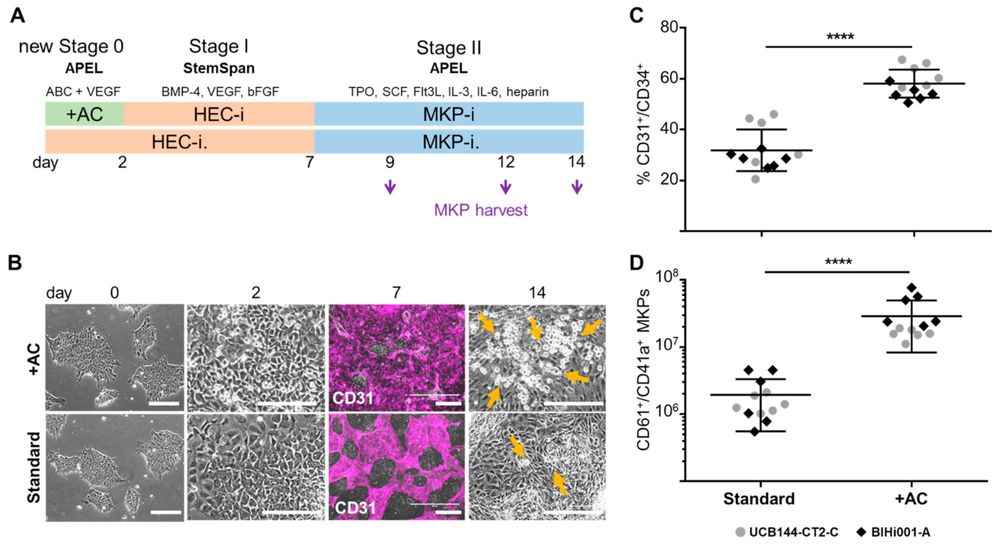 Fig. 1 Production of hemogenic endothelial cells (HECs) and megakaryocyte progenitors (MKPs) from hiPSCs.1,3
The researchers have developed a xeno-free and chemically defined intermediate-scale bioreactor platform, which allows for the generation of standardized human iPSC-derived hematopoietic organoids and subsequent continuous production of macrophages (iPSC-Mac). They described a novel method for intermediate-scale immune cell manufacturing, specifically the continuous production of functionally and phenotypically relevant macrophages that are harvested on weekly basis for multiple weeks.
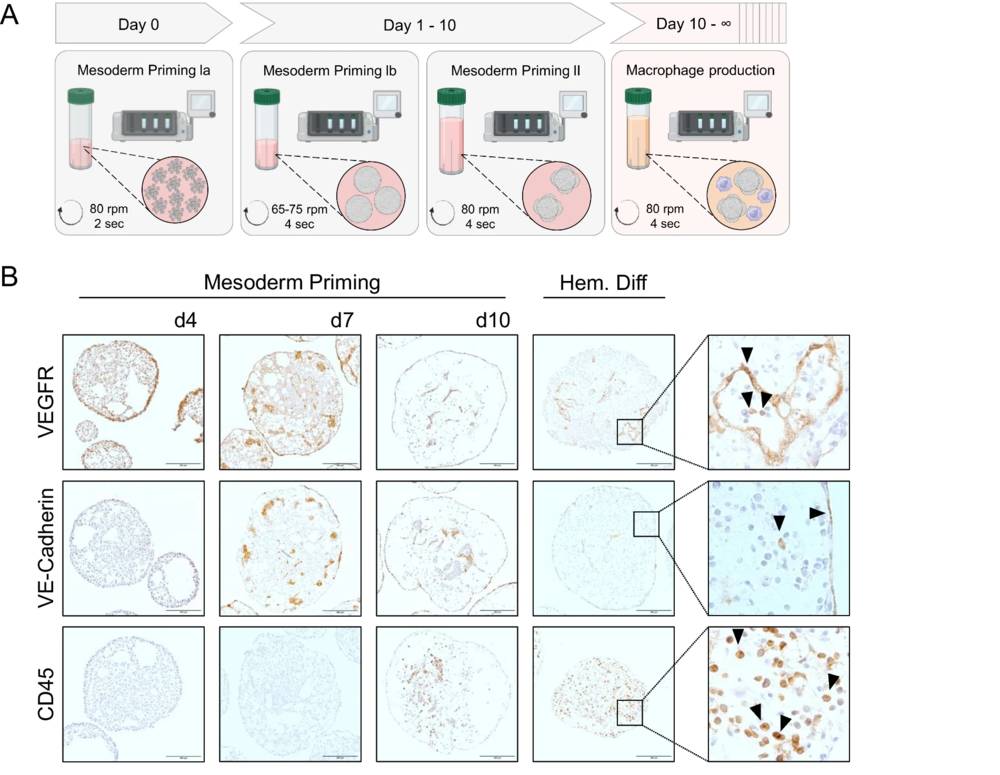 Fig. 2 Organoid-based production of iPSC-Mac in intermediate-scale bioreactors recapitulates embryonic hematopoietic development.2,3
What Our Clients Say
"Our project involved two patient-derived iPSC lines that behaved quite differently in early culture. What impressed us most was that Creative Biolabs did not simply apply a fixed differentiation protocol. Their team first evaluated the growth characteristics of each line, adjusted the induction schedule, and clearly explained how those changes could affect hematopoietic output."
— Principal Investigator, University Hematology Research Group
"We needed iPSC-derived macrophage-like cells for an inflammatory response assay, but our internal team had limited experience converting pluripotent cells into reproducible myeloid populations. Creative Biolabs helped us define a practical marker panel, recommended stimulation conditions, and delivered cells with a data package."
— Senior Scientist, Immunology-Focused Biotechnology Company
"For our disease modeling study, we were comparing a gene-edited iPSC clone with its parental control. We were concerned that clone-to-clone variation might complicate interpretation. The Creative Biolabs team designed the differentiation work in parallel, provided side-by-side characterization, and highlighted differences in progenitor emergence and erythroid marker expression."
— Research Lead, Rare Blood Disorder Program
"Our group requested iPSC-derived megakaryocyte-like cells for an early platelet biology project. This was not a routine order for us, and we had several questions about maturity markers, harvest timing, and whether the cells would be suitable for follow-up assays. Creative Biolabs helped us set realistic expectations, proposed CD41/CD42-based characterization."
— Translational Biology Manager, Pharmaceutical R&D Division
FAQs
Q: What iPSC lines can be used for hematopoietic differentiation?
A: Creative Biolabs can work with healthy donor-derived, patient-derived, disease-specific, genome-edited, reporter, and isogenic iPSC lines. Before differentiation, we recommend confirming that the lines show healthy morphology, robust growth, pluripotency marker expression, and acceptable genomic stability. If needed, our team can perform baseline QC and advise on line readiness.
Q: Can Creative Biolabs generate iPSCs first and then differentiate them into hematopoietic cells?
A: Yes. Creative Biolabs can support upstream iPSC reprogramming from somatic cells, iPSC clone selection, pluripotency validation, expansion, and subsequent hematopoietic differentiation. This integrated workflow is useful for patient-specific disease modeling and custom donor-line development.
Q: Which hematopoietic cell types can you provide?
A: We can support differentiation toward hematopoietic progenitor cells, macrophage-like cells, monocyte-like cells, dendritic cell-like populations, erythroid cells, megakaryocytes, NK-like cells, and customized hematopoietic lineages. Availability and final maturity depend on project design and starting line characteristics.
Q: Can you provide mature functional hematopoietic cells?
A: In many cases, yes. Mature or functionally responsive cells can be generated for selected lineages such as macrophages, dendritic cells, NK-like cells, erythroid cells, and megakaryocyte-like cells. The definition of maturity varies by lineage, so we recommend defining target markers and functional assays during project planning.
Q: How long does an iPSC-derived hematopoietic differentiation project take?
A: Project timelines vary depending on the starting iPSC line, target lineage, scale, assay requirements, and QC package. Pilot differentiation projects may be shorter, while multi-line, genome-edited, or functionally validated programs may require additional time. Creative Biolabs provides a project-specific timeline after feasibility assessment.
Q: Are the cells suitable for clinical use?
A: Creative Biolabs' iPSC-derived hematopoietic cell differentiation services are intended for research use only and not for direct clinical use, diagnostic use, or therapeutic administration.
Q: Can you generate iPSC-derived hematopoietic cells from client-provided iPSCs?
A: Yes. Clients may provide validated iPSC lines for differentiation. Our team will recover and expand the cells, assess culture quality, and proceed with the appropriate hematopoietic differentiation workflow. If the line shows poor growth or spontaneous differentiation, we will discuss optimization options before continuing.
Take the Next Step with Creative Biolabs







1. Contact Us
via the Inquiry Form or Email
2. Define Your Needs
Cell Type, Function, Quantity, Modifications
3. Kickstart the Project
Our Expert Team Guiding Every Step
iPSC-derived hematopoietic cells provide a powerful bridge between stem cell technology, immunology, hematology, disease modeling, and therapeutic discovery. However, successful differentiation requires careful planning, high-quality starting cells, lineage-specific optimization, and meaningful validation. Creative Biolabs brings these elements together through a flexible service platform designed to support both standard and highly customized projects.
Contact Creative Biolabs today to develop a customized iPSC-derived hematopoietic cell differentiation solution for your research program.
References
- Krisch, Linda, et al. "Improving human induced pluripotent stem cell-derived megakaryocyte differentiation and platelet production." International Journal of Molecular Sciences 22.15 (2021): 8224. https://doi.org/10.3390/ijms22158224
- Ackermann, Mania, et al. "Standardized generation of human iPSC-derived hematopoietic organoids and macrophages utilizing a benchtop bioreactor platform under fully defined conditions." Stem cell research & therapy 15.1 (2024): 171. https://doi.org/10.1186/s13287-024-03785-2
- Distributed under Open Access license CC BY 4.0, without modification.