DCAF based Protein Degrader Ligand Screening Service
BackgroundWhat We Can Offer?WorkflowWhy Us?FAQRelated Services
Pioneering alternative E3 ligase machinery demands access to versatile substrate adaptors that operate effectively across diverse cellular compartments. Creative Biolabs provides specialized ligand discovery, chemoproteomic mapping, and custom bifunctional molecule synthesis targeting DDB1- and CUL4-associated factors (DCAF proteins). Collaborate with our multidisciplinary TPD specialists to leverage the Cullin-4 ubiquitin transfer core, enabling the rational design of potent degraders capable of eliminating disease-driving targets.
Background of DCAF in Protein Degradation
While first-generation targeted protein degradation platforms relied heavily on CRBN and VHL, clinical development has highlighted the necessity of diversifying the E3 ligase toolbox to combat acquired resistance mutations and tissue limitations. The DCAF family comprises a broad class of WD40-repeat proteins that act as interchangeable substrate-recognition receptors for Cullin 4 (CUL4)–Ring Box Protein 1 (RBX1)–DDB1 ubiquitin ligase super-complexes.
In the protein degrader design, DCAF presents great advantages:
Modular Family Expansion: The DCAF gene family includes dozens of distinct members (such as DCAF1, DCAF11, DCAF15, and DCAF16), offering a wide array of structural surfaces and tissue-specific expression patterns.
Druggable WD40-Repeat Architecture: DCAF proteins characteristically feature 7-bladed β-propeller WD40 domains containing deep central clefts and surface grooves, providing exceptional structural pockets for high-affinity small-molecule interaction.
Dual Molecular Glue & Bifunctional Potential: DCAF family members are uniquely receptive to both heterobifunctional degradation architectures and monovalent molecular glue-type induced proximity mechanisms.
Covalent & Reversible Binding Modes: Specific DCAF members harbor accessible, nucleophilic cysteine residues within their substrate-binding domains, allowing the development of site-specific covalent recruiters via electrophilic warheads.
Circumventing CRBN Refractory Phenotypes: Although CRBN itself is technically a DCAF family member (DCAF5), utilizing non-CRBN DCAF adaptors completely restores target protein clearance in cancer models that have acquired CRBN loss-of-function mutations.
Fig.1 The DCAF-mediated protein degradation.
How Creative Biolabs' DCAF based Protein Degrader Ligand Screening Service Can Assist Your Project?
Exploiting non-canonical Cullin-4 adaptors requires precise navigation of WD40 propeller topologies, binder stoichiometry, and ternary complex kinetics. Creative Biolabs delivers an integrated technical workflow to take your project from initial screening to cellular proof-of-concept:
Navigating DCAF Family Selectivity: With dozens of homologous WD40-repeat adaptors expressed in human cells, our cross-screening counter-assays ensure identified hits selectively engage your chosen DCAF member (e.g., DCAF1 vs. DCAF15) without off-target ligase depletion.
Stabilizing Dynamic WD40 Propellers: To prevent conformational artifacts during screening, we co-express DCAF candidates with their obligate scaffold partner, DDB1, preserving the authentic substrate-binding cleft used in native cellular E3 assembly.
Bi-Functional vs. Molecular Glue Mechanics: Our analytical workflows differentiate between standard bifunctional recruitment and monovalent proximity-induced binding early in the discovery cycle, helping tailor your chemistry toward optimal degradation stoichiometries.
Rational Vector Mapping for Linker Attachment: Utilizing high-resolution structural modeling and biophysical mapping, we pinpoint exact linker exit sites on the DCAF surface to prevent steric clashes with the CUL4–DDB1 core.
Workflow of DCAF based Protein Degrader Ligand Screening Service
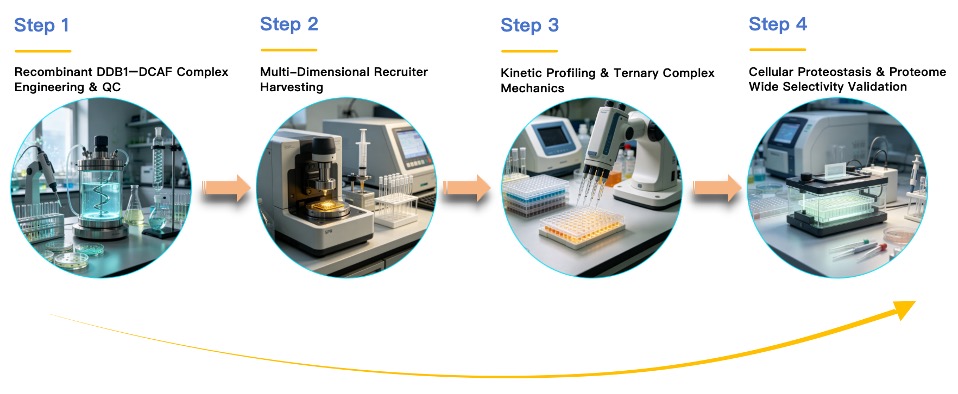
Our end-to-end DCAF discovery engine bridges recombinant protein engineering, chemoproteomics, biophysical kinetics, and cell-based degradation profiling into a fully integrated execution pipeline:
Stage 1
Recombinant DDB1–DCAF Complex Engineering & QC
Co-expression and purification of human DCAF adaptors bound to DDB1 domains across insect (Sf9) or mammalian host systems.
Stage 2
Multi-Dimensional Recruiter Harvesting
Parallel screening across multi-billion compound DNA-Encoded Libraries (DELs), target-focused fragment collections, and cysteine-reactive covalent probe matrices to isolate high-affinity ligands targeting the WD40 propeller cleft.
Stage 3
Kinetic Profiling & Ternary Complex Mechanics
Quantitative biophysical characterization via SPR, MST, and TR-FRET to determine association/dissociation parameters (KD, kon, koff) alongside ternary complex cooperativity factors (α) for POI–Degrader–DCAF assemblies.
Intracellular evaluation of conjugated degraders across disease-relevant cell models. Target clearance potency (DC50, Dmax) and proteome-wide selectivity are quantified using quantitative Western blotting and multiplexed TMT-MS proteomics.
Advantages of Our Services
Navigating the structural diversity of the Cullin-4/DCAF adaptor family requires an E3 ligase platform that seamlessly combines structural biology, chemical synthesis, and chemoproteomic mapping. Creative Biolabs provides a purpose-built R&D infrastructure optimized specifically for WD40-repeat E3 machinery. Partnering with our scientific team equips your targeted protein degradation initiative with clear biological and operational advantages:
WD40 Propeller Engineering Mastery
Deep scientific domain expertise in mapping the distinct central clefts of DCAF β-propellers, enabling the rational design of both non-covalent recruiters and site-specific covalent warheads.
Co-Expressed DDB1–DCAF Reagent Portfolio
Direct access to pre-formulated, structurally stable heterodimeric protein complexes (DCAF bound to DDB1), eliminating protein instability hurdles and reducing setup lead times.
Family-Wide Selectivity & Counter-Screening
Routine integration of paralogous DCAF panel screens to guarantee your recruiter selectively engages the intended DCAF subtype without off-target ligase competition.
Bi-Functional & Molecular Glue Discrimination
Early-stage biophysical assays designed to distinguish between traditional heterobifunctional recruitment and monovalent proximity-induced binding mechanisms.
Chemoproteomic Cysteine Site Mapping
Advanced LC-MS/MS activity-based protein profiling (ABPP) to confirm exact covalent modification sites within DCAF pockets while verifying proteome-wide safety.
Complete Client IP Ownership
Unconditional, exclusive assignment of all newly identified recruiter scaffolds, conjugated lead series, kinetic datasets, and resulting patent rights directly to the sponsor.
Frequently Asked Questions
Q: How does Creative Biolabs handle the expression of membrane-associated or unstable DCAF proteins?
A: DCAF adaptors often require their structural binding partner, DDB1, to maintain soluble, native folding. We routinely co-express target DCAF proteins with DDB1 subunits (or truncated DDB1 BPB domains), producing stable, biologically active heterodimeric complexes ideal for biophysical screening.
Q: Can your screening platform distinguish between bifunctional degraders and molecular glues that target DCAF adaptors?
A: Yes. We utilize comparative SPR and TR-FRET assay setups measuring binary versus ternary binding dynamics. Compounds that induce robust target-DCAF association only in the presence of the POI (without requiring a traditional linker) are categorized and advanced as potential molecular glue leads.
Q: Are covalent screening strategies applicable to all DCAF family members?
A: Covalent targeting depends on the presence of accessible, nucleophilic residues (such as cysteines or lysines) near the WD40 substrate pocket. We perform structural alignment and chemoproteomic mapping upfront to determine whether your specific DCAF target is suited for electrophilic fragment screens.
Q: What measures are taken to ensure degrader hits do not disrupt the interaction between DCAF and DDB1?
A: During primary biophysical screens, we monitor complex integrity using competitive TR-FRET and SEC-MALS. This ensures candidate recruiters bind the substrate-recognition face of the WD40 domain without perturbing the DCAF–DDB1 binding interface required for CUL4 E3 ligase assembly.
Creative Biolabs directly delivers the specialized structural biology, chemoproteomic mapping, and customized synthesis platforms required to deploy CUL4–DCAF E3 ligase engines for your drug discovery pipeline. If you have any problems, please do not hesitate to contact us for more details.
Contact Our Team for More Information and to Discuss Your Project →


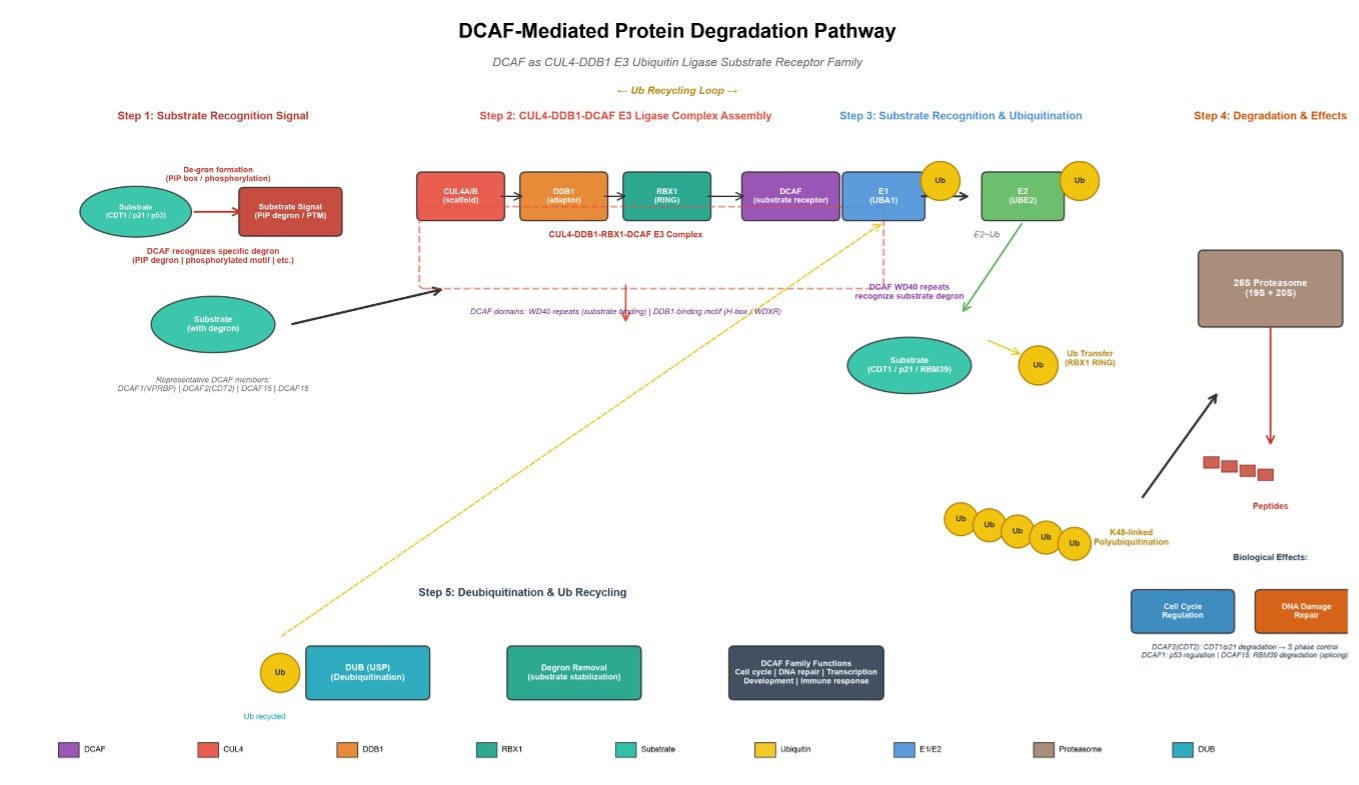 Fig.1 The DCAF-mediated protein degradation.