FBXO22 based Protein Degrader Ligand Screening Service
BackgroundWhat We Can Offer?WorkflowWhy Us?FAQRelated Services
Serving as a global pioneer in custom therapeutic discovery, Creative Biolabs delivers advanced targeted protein degradation (TPD) platforms to expand the functional scope of E3 ligase recruiting. As a specialized sub-module of our Novel E3 Ligase Ligand Screening Services, our FBXO22-based Protein Degrader Ligand Screening Service provides rigorous binder identification, biophysical profiling, and degrader assembly platforms focused on F-box protein 22 (FBXO22).
Background of FBXO22 in Protein Degradation
F-box protein 22 (FBXO22) acts as the interchangeable substrate-recognition subunit of the Cullin 1 (CUL1)–SKP1–RBX1 (SCF) RING-type E3 ubiquitin ligase super-complex. Functionally, FBXO22 serves as a pivotal regulator of nuclear homeostasis, cell cycle progression, and epigenetic remodeling by directing key substrates, such as p21 (CDKN1A), KDM4B (HDM), and methylated histone species, toward proteasomal destruction. Structurally, FBXO22 possesses distinct structural attributes:
The N-Terminal F-box Motif: Mediates direct interaction with SKP1 to anchor the subunit within the CUL1 core assembly.
The Specialized Substrate-Binding Domain: Features an adaptable, pocketed architecture (including specialized FBD/FWD domains) evolved to recognize nuclear and cytosolic protein-protein interaction (PPI) interfaces.
In the area of protein degrader design, FBXO22 presents great advantages:
Oncology-Enriched Expression Profile: FBXO22 exhibits marked upregulation across various aggressive malignancies (including breast, hepatocellular, lung, and colorectal carcinomas), allowing the development of tumor-selective degraders that minimize off-target toxicity in healthy cells.
Nuclear & Cytosolic Degradation Capacity: Unlike adaptors limited to specific cellular regions, FBXO22 functions dynamically across nuclear and cytoplasmic compartments, facilitating effective clearance of nuclear transcription factors and epigenetic regulators.
Drugable Binding Cavities: The structural pocket of FBXO22 provides favorable energetic characteristics for high-affinity reversible non-covalent molecules and targeted chemical fragment discovery.
Restoration of Sensitivity in CRBN/VHL Refractory Models: Recruiting SCF-FBXO22 machinery bypasses genetic alterations in CRBN or VHL, restoring robust degradation activity in therapy-resistant cell populations.
Clean Patent Landscape: Developing novel chemical entities that engage FBXO22 grants biopharmaceutical creators an unencumbered commercial trajectory and strong IP independence.
Fig.1 FEXO22-mediated protein degradation pathway.
How Creative Biolabs' FBXO22 based Protein Degrader Ligand Screening Service Can Assist Your Project?
Successfully recruiting a non-canonical SCF E3 adaptor requires careful coordination of protein engineering, biophysical kinetics, and cell-based degradation profiling. Creative Biolabs acts as a dedicated scientific extension to your team, steering your FBXO22 recruiter discovery program through every vital milestone:
De Novo Recruiter Discovery: Utilizing multi-billion compound DNA-encoded libraries (DELs), target-specific fragment collections, and structure-guided computational docking, we identify novel, high-affinity small-molecule ligands targeting FBXO22.
Bypassing Resistance & Securing Commercial FTO: We enable clients to construct distinct heterobifunctional degradation platforms that circumvent CRBN/VHL mutation patterns while building clear, proprietary intellectual property portfolios.
Cooperativity & Ternary Complex Optimization: Efficacy in bifunctional molecules relies heavily on positive binding cooperativity (α) rather than simple E3 binder affinity. We measure POI–Degrader–FBXO22 ternary complex stability to select optimal linker geometry and attachment positions.
Medicinal Chemistry & Conjugation Strategy: Our synthetic chemists build custom matrix libraries incorporating diverse linker compositions (rigid, flexible, amphiphilic) to achieve maximum spatial orientation and degradation efficiency.
Compressed Discovery Timelines: By unifying recombinant protein generation, biophysical affinity mapping, custom linker conjugation, and cellular target depletion assays under one roof, we significantly shorten your hit-to-lead lead-time.
Workflow of FBXO22 based Protein Degrader Ligand Screening Service
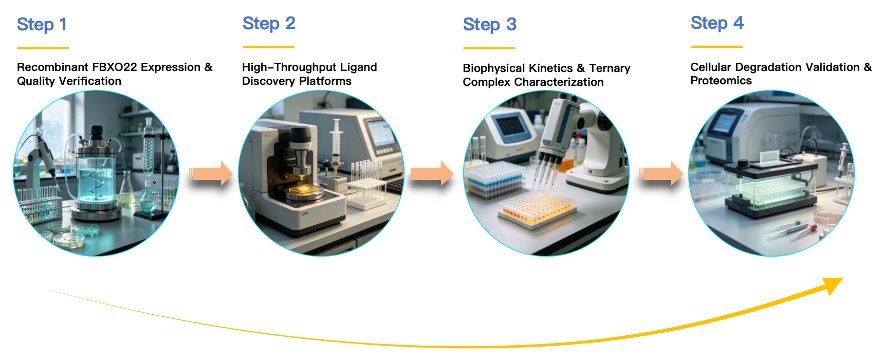
Creative Biolabs offers an end-to-end ligand discovery infrastructure specifically engineered around the structural traits of the SCF-FBXO22 architecture. Our capabilities span computational structure modeling, high-throughput biophysical assay suites, synthetic linker customization, and comprehensive cellular degradation profiling.
Affinity & Kinetic Profiling: Quantifying binding parameters (KD, Kon, Koff) using SPR, TR-FRET, Fluorescence Polarization (FP), and MicroScale Thermophoresis (MST).
Ternary Complex Cooperativity (α) Assessment: Evaluating the formation, stability, and kinetics of the POI–Degrader–FBXO22 complex in real time.
Structural Analysis: Utilizing X-ray crystallography and cryo-EM platforms to map binding interactions and direct rational linker attachment vectors.
Stage 4
Cellular Degradation Validation & Proteomics
Conjugation of lead FBXO22 recruiters to POI-targeting ligands using customized linker libraries.
Quantitative cellular evaluation (DC50, Dmax) via Western Blotting and multiplexed quantitative proteomics (TMT-MS) to confirm target depletion and global proteomic safety.
Advantages of Our Services
Selecting an expert Contract Research Organization (CRO) is vital when navigating alternative E3 ligases like FBXO22. Creative Biolabs combines deep domain knowledge in Cullin-RING ligase biology with state-of-the-art biophysical and chemical synthesis capabilities. Partnering with us offers your program strong technical and strategic backing:
Deep SCF Ligase Expertise
Specialized scientific focus on F-box adaptors, CUL1 structural dynamics, and nuclear target turnover.
Turnkey Reagent Access
Pre-validated SKP1–FBXO22 protein batches and optimized assay controls reduce upfront project setup timelines by weeks.
End-to-End Infrastructure
Screening, biophysical kinetics, custom medicinal chemistry, and cell biology executed under a unified quality management system.
Absolute IP Protection
All novel recruiters, bifunctional structures, and screening datasets remain 100% the exclusive property of the client.
Frequently Asked Questions
Q: What structural features make FBXO22 an attractive target for small-molecule recruiter discovery?
A: FBXO22 features a distinct substrate-binding domain with well-defined hydrophobic and polar pockets that naturally accommodate small-molecule interactions, making it highly druggable compared to flatter protein-protein interfaces.
Q: Why use the SKP1-FBXO22 heterodimer instead of isolated FBXO22 protein for screening?
A: FBXO22 relies on SKP1 interaction to maintain structural stability. Screening against the co-expressed SKP1-FBXO22 complex ensures the protein retains its physiological conformation, yielding hits that translate effectively into cell-based assays.
Q: Can clients supply their own target-binding ligands for degrader assembly?
A: Yes. Clients can provide their proprietary POI ligands. Our medicinal chemists will design and synthesize a matrix of bifunctional molecules combining your binder with newly identified FBXO22 recruiters across various linker configurations.
Creative Biolabs delivers customized screening strategies, advanced biophysical assay platforms, and dedicated scientific collaboration to accelerate your drug discovery goals. Contact us today to consult with our technical specialists or request a detailed project proposal.
Contact Our Team for More Information and to Discuss Your Project →


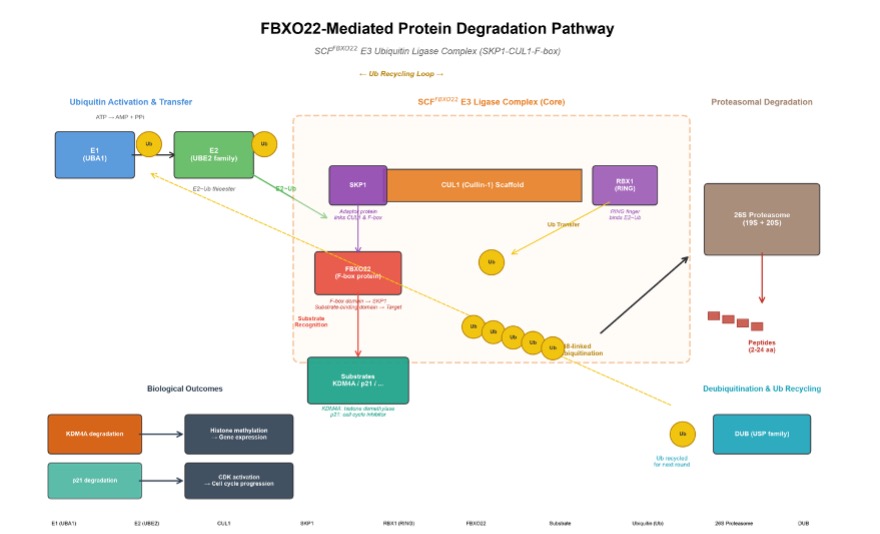 Fig.1 FEXO22-mediated protein degradation pathway.