FEM1B based Protein Degrader Ligand Screening Service
BackgroundWhat We Can Offer?WorkflowWhy Us?FAQRelated Services
Advancing targeted protein degradation requires recruiting alternative E3 ubiquitin ligases that operate independently of classical CRBN and VHL pathways. Creative Biolabs delivers customized ligand screening, chemoproteomic profiling, and bifunctional molecule synthesis targeting Fem-1 homolog B (FEM1B). Our dedicated TPD platform assists global biopharmaceutical teams in harnessing CUL2-driven degradation mechanisms to eliminate refractory disease targets with high precision.
Background of FEM1B in Protein Degradation
While Cullin-RING ligases represent a dominant class of ubiquitin engines in drug discovery, heavy clinical reliance on VHL recruiters has revealed distinct biological vulnerabilities—including acquired genomic loss, point mutations, and unintended interference with HIF-1α regulatory pathways. Fem-1 homolog B (FEM1B) provides a powerful, non-canonical alternative within the Cullin-2 (CUL2) family. As the substrate-recognition component of the CUL2–RBX1 ubiquitin ligase super-complex, FEM1B functions naturally as a cellular metabolic and redox sensor, mediating the destruction of specific protein targets under reductive stress conditions.
In the protein degrader design, FEM1B presents great advantages:
VHL-Independent CUL2 Engagement: Shares the highly efficient CUL2 ubiquitin transfer core with VHL, achieving rapid target turnover while completely bypassing VHL-refractory tumor phenotypes.
Redox & Metabolic Sensing Mechanics: Naturally evolved to recognize degraded protein motifs under cellular stress conditions, enabling degrader platforms tuned to specific metabolic and oxidative intracellular states.
Druggability of Ankyrin Repeat Domains (ARD): The extended, pocketed groove of the FEM1B ANK domain presents rich polar and hydrophobic contact points suited for non-covalent fragment binding.
Targeted Covalent Modification: Highly reactive nucleophilic residues (including C186) located near the substrate-recognition interface allow the design of site-specific, irreversible covalent recruiters.
Pancreatic & Stem-Cell Enrichment: Displays pronounced expression in metabolic tissues, stem cell environments, and specific solid tumor lineages, opening avenues for tissue-preferential target clearance.
Fig.1 The FEM1B-mediated protein degradation.
How Creative Biolabs' FEM1B based Protein Degrader Ligand Screening Service Can Assist Your Project?
Navigating an emerging Cullin-2 adaptor requires balancing structural fit, covalent reactivity, and ternary complex kinetics. Creative Biolabs provides a specialized technical environment to advance your degrader candidates from primary hits to cellular leads:
De Novo Recruiter Harvesting: We utilize multi-billion compound DNA-encoded libraries (DELs), activity-based chemoproteomic probes, and structure-guided virtual screens to identify selective FEM1B binders.
Proteome-Wide Cysteine Selectivity: Advanced LC-MS/MS chemoproteomics maps exact covalent modification sites on the FEM1B ANK domain while verifying minimal off-target reactivity across the cellular proteome.
Ternary Complex Engineering: Efficacy in bifunctional molecules relies heavily on positive binding cooperativity (α). We measure real-time ternary complex dynamics (POI–Degrader–FEM1B) to guide optimal linker exit vectors and length.
Custom Synthetic Conjugation: Our medicinal chemistry team prepares custom series of bifunctional molecules, varying linker rigidity, length, and composition to maximize intracellular degradation rates (DC50).
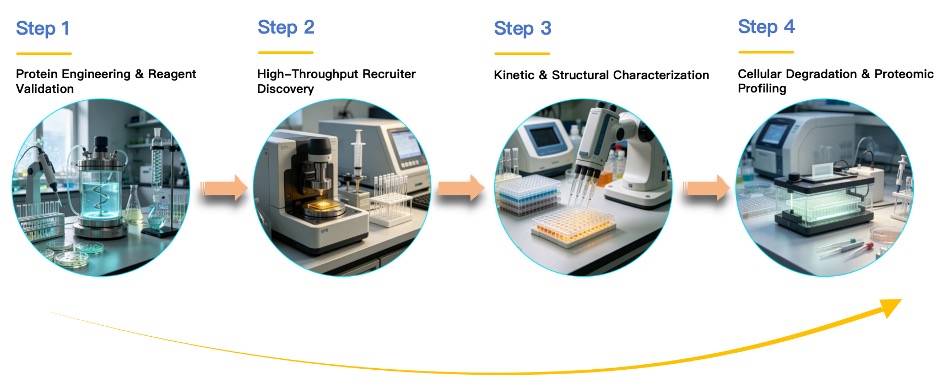
Workflow of FEM1B based Protein Degrader Ligand Screening Service
Our FEM1B discovery pipeline integrates molecular biology, biophysical kinetics, and cellular degradation benchmarking into a cohesive execution plan:
Stage 1
Protein Engineering & Reagent Validation
High-yield expression of human full-length FEM1B or isolated ANK domain constructs using insect or mammalian expression systems. Reagents undergo SEC-MALS and mass spectrometry analysis to guarantee native folding and active-site cysteine availability.
Stage 2
High-Throughput Recruiter Discovery
Multi-track screening using DNA-Encoded Libraries (DEL), SPR/NMR-based fragment platforms, or electrophilic chemical probes designed to react with functional ANK domain cysteines.
Stage 3
Kinetic & Structural Characterization
Quantification of binding parameters (KD, kon, koff) via SPR and MST. Structural biology services (X-ray/cryo-EM) delineate exact binding topologies within the PAS-B cavity to guide rational linker attachment.
Quantification of association (kon), dissociation (koff), and inactivation parameters (kinact/KI) via SPR, MST, and TR-FRET. X-ray crystallography and cryo-EM capabilities delineate exact binding topologies to direct rational linker attachment.
Stage 4
Cellular Degradation & Proteomic Profiling
Lead recruiters are conjugated with target POI binders. Intracellular degradation potency (DC50, Dmax) and proteome-wide selectivity are quantified in disease-relevant cell models using Western blotting, and quantitative proteomics (TMT-MS).
Advantages of Our Services
Converting novel Cullin-2 adaptors into functional degrader candidates demands deep proficiency in structural biology, chemoproteomics, and biophysical kinetics. Creative Biolabs operates a specialized discovery infrastructure designed to address the technical challenges of recruiting non-canonical E3 ligases. Partnering with our scientific team provides your TPD initiative with clear operational and technological edges:
Focused Ankyrin Domain Architecture Expertise
Deep scientific mastery in mapping the structural grooves of FEM1B's ANK domain, enabling the rational design of both non-covalent binders and cysteine-directed covalent warheads.
Direct Access to Pre-Engineered FEM1B Reagents
Immediate availability of structurally characterized, high-purity FEM1B protein batches and calibrated assay controls, significantly compressing upfront platform setup timelines.
Chemoproteomic-Guided Selectivity Profiling
Routine integration of activity-based protein profiling (ABPP) and intact mass spectrometry to verify site-specific modification and minimize proteome-wide off-target reactivity.
Thermodynamic Ternary Complex Prioritization
Early-stage quantitative assessment of binding cooperativity (α) ensures that only compounds capable of forming stable target–degrader–FEM1B complexes advance into lead optimization.
Unified Single-Site Execution
Seamless bridge connecting primary library screening, custom medicinal chemistry linker conjugation, and cell-based degradation benchmarking within a cohesive facility.
Unrestricted Intellectual Property Rights
Complete, exclusive ownership of all novel hit structures, synthetic lead series, kinetic datasets, and resulting intellectual property granted directly to the client.
Frequently Asked Questions
Q: What structural advantages does FEM1B offer over traditional E3 adaptors?
A: FEM1B utilizes an extensive Ankyrin Repeat Domain (ARD) that contains distinct hydrophobic grooves and reactive cysteines. This provides a versatile structural surface capable of accommodating both reversible non-covalent recruiters and irreversible covalent binders.
Q: Can Creative Biolabs perform covalent ligand screening for FEM1B?
A: Yes. We deploy chemoproteomic activity-based protein profiling (ABPP) and intact-protein LC-MS/MS to identify, map, and confirm cysteine-reactive electrophilic recruiters targeting functional residues within FEM1B.
Q: What protein constructs are used during the screening assays?
A: We express both full-length human FEM1B (to evaluate full CUL2 E3 complex incorporation) and isolated ANK domain constructs (optimized for high-throughput binding, fragment screening, and crystallographic studies).
Q: Can clients provide their own target-binding ligands for degrader assembly?
A: Yes. Clients can supply their proprietary POI-targeting small molecules or peptides. Our medicinal chemistry team will perform custom conjugation with identified FEM1B recruiters across various linker lengths and compositions.
Partner with Creative Biolabs to unlock the full therapeutic potential of the CUL2–FEM1B degradation axis. Our scientific team is ready to help you customize hit discovery protocols, profile ternary kinetics, and synthesize high-potency degrader candidates. Contact us today to discuss your project scope or obtain a detailed technical proposal.
Contact Our Team for More Information and to Discuss Your Project →


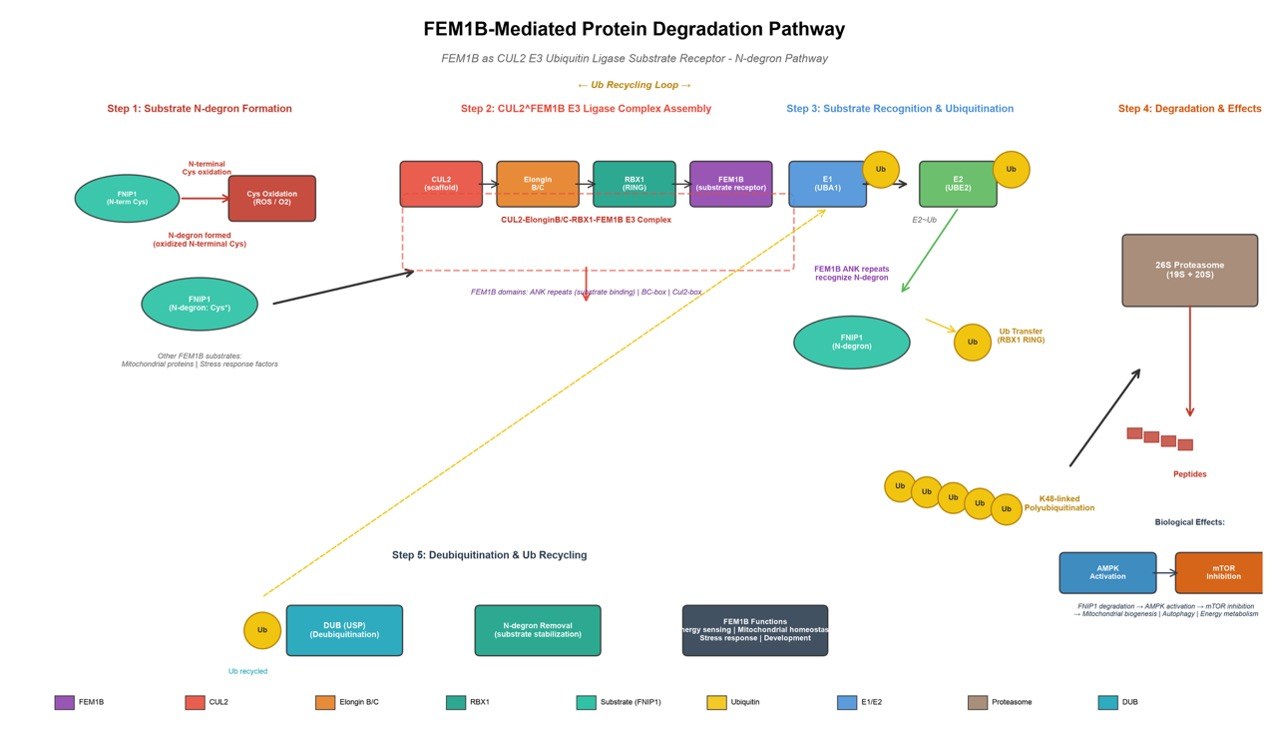 Fig.1 The FEM1B-mediated protein degradation.