KLHDC2 based Protein Degrader Ligand Screening Service
BackgroundWhat We Can Offer?WorkflowWhy Us?FAQRelated Services
As part of the expanding targeted protein degradation (TPD) discovery pipeline, Creative Biolabs offers a comprehensive KLHDC2-based Protein Degrader Ligand Screening Service. While conventional degradation strategies rely heavily on a small set of E3 ligases (such as CRBN and VHL), expanding the accessible E3 ligase repertoire is critical for overcoming acquired resistance, improving tissue selectivity, and degrading previously refractory targets.
Background of KLHDC2 in Protein Degradation
Kelch-like homology domain-containing protein 2 (KLHDC2) serves as a substrate recognition adaptor for the Cullin 2-RING E3 ubiquitin ligase complex (CRL2KLHDC2). Mechanistically, KLHDC2 plays a central role in the C-end degron pathway by recognizing exposed C-terminal diglycine (-Gly-Gly) motifs on aberrant, truncated, or proteolytic client proteins. Structural studies reveal that KLHDC2 employs a compact 6-blade β-propeller Kelch domain containing a deep surface pocket that binds these C-terminal degrons with exceptionally high affinity, often in the low nanomolar range (KD < 10 nM). Co-opting KLHDC2 for novel degrader design offers unique pharmacological advantages:
Overcoming Resistance: Bypasses loss-of-function mutations or downregulations associated with CRBN and VHL.
Potent Degradation: Unbiased proximity-based screens confirm KLHDC2 as one of the most efficient E3 ligases for inducing complete target clearance.
High-Affinity Pocket: Its distinct β-propeller binding pocket presents a well-defined structural framework ideal for high-throughput small-molecule and peptide ligand discovery.
Fig.1 The KLHDC2-mediated protein degradation.
How Creative Biolabs' KLHDC2 based Protein Degrader Ligand Screening Service Can Assist Your Project?
Our KLHDC2-based screening service is designed to overcome technical bottlenecks in targeted protein degradation by expanding chemical diversity beyond traditional E3 ligands. We help clients address specific challenges, including:
E3 Ligase Hooking & Chemical Expansion: Identifying novel, drug-like small-molecule or peptide ligands that bind KLHDC2 without disrupting core E3 complex assembly.
Paralog & Target Selectivity: Engineering cooperative ternary complexes (POI—Degrader—KLHDC2) to achieve paralog-specific degradation that cannot be accomplished through target-binding alone.
Hook-Effect Mitigation & Optimization: Evaluating binding kinetics (kon, koff) and stoichiometry to optimize linker length, attachments, and exit vectors for maximal degradation efficiency (DC50, Dmax).
Mitigating Resistance: Providing alternative E3 recruiting chemistries for cell lines refractory to CRBN/VHL-mediated degradation.
Workflow of KLHDC2 based Protein Degrader Ligand Screening Service
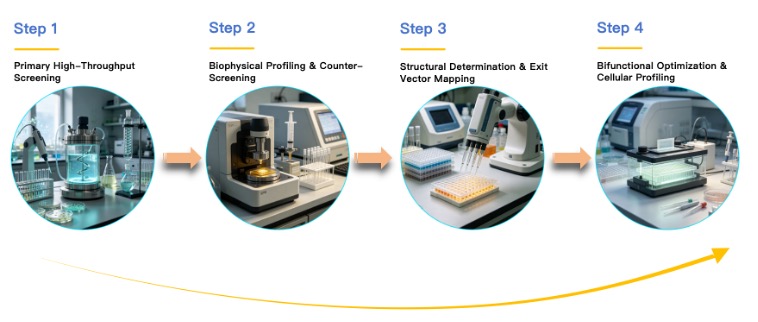
Creative Biolabs implements a rigorous, step-by-step workflow to ensure high-throughput efficiency, biophysical precision, and reliable cellular translation.
Stage 1
Primary High-Throughput Screening
Utilizing Fluorescence Polarization (FP), TR-FRET, or DNA-Encoded Libraries (DEL) to screen large chemical libraries for binding against recombinant KLHDC2.
Stage 2
Biophysical Profiling & Counter-Screening
Quantifying binding affinities (KD) and kinetics via SPR, ITC, or MST. Counter-screens against structurally related Kelch domain E3s (e.g., KEAP1, KLHDC1, KLHDC3) are performed to ensure strict target selectivity.
Stage 3
Structural Determination & Exit Vector Mapping
Determining co-crystal structures of KLHDC2-ligand complexes to delineate precise binding modes and identify ideal exit vectors for linker attachment.
Stage 4
Bifunctional Optimization & Cellular Profiling
Conjugating selected KLHDC2 ligands to target-protein ligands to build functional degraders. Degradation assays (Western blot, quantitative proteomics) confirm cellular target degradation, pathway dependency, and mechanism of action.
Advantages of Our Services
Proprietary Assay Technologies
Highly optimized FP, TR-FRET, and SPR platforms tailored specifically for C-degron and Kelch-domain interactions.
In-House Structural Biology Platform
Rapid co-crystallization and structure determination of KLHDC2 complexes to accelerate rational structure-based drug design (SBDD).
Comprehensive Chemical Library
Access to vast collections of small molecules, macrocycles, and synthetic peptide libraries targeting C-terminal diglycine mimics.
End-to-End Solutions
Integrated workflows spanning initial hit discovery, linker synthesis, ternary complex analysis, to cellular degradation kinetic studies.
Frequently Asked Questions
Q1: Why choose KLHDC2 over conventional E3 ligases like CRBN or VHL?
A: CRBN and VHL are prone to resistance via genomic alterations or downregulation in clinical settings. KLHDC2 offers a distinct, highly conserved C-degron binding pocket that provides a potent alternative degradation pathway, potential tissue specificity, and the ability to degrade targets refractory to conventional ligases.
Q2: What compound modalities can be screened for KLHDC2 recruitment?
A: We support both small-molecule screenings (via DEL, FP, and high-throughput biophysical assays) and peptide/peptidomimetic screening based on native C-terminal diglycine degron sequences.
Q3: How do you verify that cellular degradation is strictly KLHDC2-dependent?
A: We utilize genetic knockouts (CRISPR-Cas9), RNAi-mediated knockdowns, or competitive ligand pre-treatments to demonstrate that target clearance is abolished in the absence of functional KLHDC2.
Partner with Creative Biolabs to accelerate your protein degrader discovery. Contact our scientific team today to discuss your project or request a custom proposal for our KLHDC2-based Ligand Screening Service.
Contact Our Team for More Information and to Discuss Your Project →


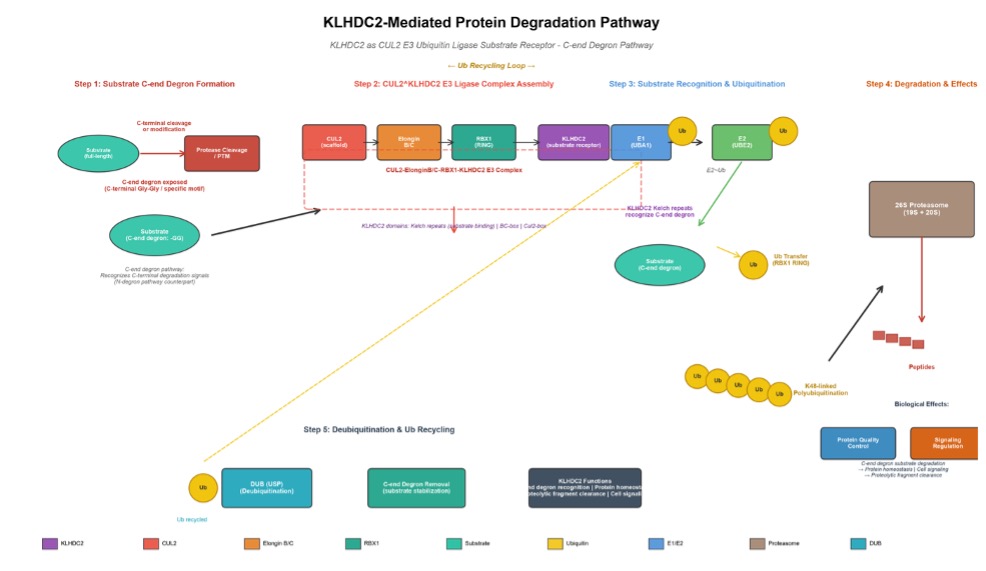 Fig.1 The KLHDC2-mediated protein degradation.