RNF4 based Protein Degrader Ligand Screening Service
BackgroundWhat We Can Offer?WorkflowWhy Us?FAQRelated Services
As a premier global CRO focused on targeted protein degradation, Creative Biolabs operates multifaceted E3 ligase exploitation systems geared toward accelerating modern drug discovery. Our RNF4-based ligand screening for protein degraders, a key component of our novel E3 ligase ligand services, features tailored workflows for small-molecule hit discovery, chemoproteomic analysis, and chemical assembly specifically for Ring Finger Protein 4. These capabilities allow drug development groups to capitalize on the SUMO-targeted ubiquitin ligase (STUbL) machinery, facilitating the strategic design of highly potent heterobifunctional degraders directed against nuclear and chromatin-associated disease drivers.
Background of RNF4 in Protein Degradation
Ring Finger Protein 4 (RNF4) is a prototypical SUMO-targeted ubiquitin ligase (STUbL) that plays a critical role in maintaining nuclear proteostasis, chromatin remodeling, and DNA damage response pathways. Structurally, RNF4 contains multiple N-terminal SUMO-interacting motifs (SIMs) that selectively recognize poly-SUMO chains, paired with a C-terminal RING finger domain that coordinates zinc ions to execute E2-dependent ubiquitin transfer. Biologically, RNF4 recognizes proteins that have undergone post-translational poly-SUMOylation (such as oncogenic fusion proteins like PML-RARα or altered transcription factors) and rapidly catalyzes their poly-ubiquitination for proteasomal elimination. Beyond its native SUMO-dependent pathways, RNF4 possesses druggable nucleophilic cysteines within its RING architecture, making it highly amenable to both non-covalent fragment recruitment and covalent electrophilic ligand targeting.
In the protein degrader design, RNF4 presents great advantages:
Specialized Nuclear & Chromatin Activity: RNF4 is heavily enriched in the cell nucleus and nucleolus, making it uniquely suited for designing degraders that target nuclear transcription factors, epigenetic modulators, and chromatin-bound oncogenes.
Dual Covalent and Non-Covalent Druggability: The RING domain and adjacent structural pockets of RNF4 contain nucleophilic residues suitable for targeted covalent modification (e.g., using electrophilic warheads), alongside hydrophobic grooves fit for high-affinity non-covalent recruiters.
Rapid Poly-Ubiquitination Kinetics: As a STUbL, RNF4 intrinsically processes poly-SUMOylated substrates with high turnover rates, translating into rapid target degradation kinetics (DC50) when recruited via bifunctional molecules.
Reversal of CRBN/VHL Refractory Phenotypes: Hijacking RNF4's distinct ubiquitin-conjugating machinery bypasses resistance mechanisms triggered by CRBN/VHL mutations in relapsed disease models.
Mitigation of Hook Effects via Covalent Engagement: Developing covalent RNF4 recruiters alters binary-versus-ternary binding equilibria, dampening non-productive binary saturation at elevated clinical doses.
Fresh Intellectual Property Landscape: Establishing novel chemical scaffolds that bind RNF4 grants biopharmaceutical sponsors an unencumbered commercial trajectory and strong patent independence.
Fig.1 The RNF4-mediated protein degradation.
How Creative Biolabs' RNF4 based Protein Degrader Ligand Screening Service Can Assist Your Project?
Harnessing a specialized STUbL E3 ligase such as RNF4 requires the seamless integration of chemoproteomic profiling, structural biology, and synthetic chemistry. Creative Biolabs serves as a committed scientific partner, steering your RNF4 recruiter discovery initiative through every critical stage:
De Novo Recruiter & Covalent Hit Discovery: Utilizing multi-billion compound DNA-encoded libraries (DELs), electrophilic fragment collections, and activity-based protein profiling (ABPP), we identify novel non-covalent and cysteine-reactive covalent RNF4 binders.
Overcoming Resistance & Securing Commercial FTO: We enable sponsors to rebuild therapeutic efficacy in CRBN/VHL-resistant cell models while establishing strong, proprietary intellectual property portfolios.
Proteome-Wide Selectivity & Site Mapping: Using advanced LC-MS/MS chemoproteomics, we map exact covalent modification sites on RNF4 and profile proteome-wide selectivity to eliminate off-target reactivity.
Ternary Complex Cooperativity (α) Optimization: Degradation potency relies heavily on stable ternary complex assembly rather than simple binary binding. We characterize POI-Degrader-RNF4 ternary dynamics in real time to guide optimal linker composition and conjugation vectors.
Compressed Discovery Timelines: By consolidating recombinant RNF4 domain production, high-throughput biophysical affinity mapping, custom synthetic conjugation, and cellular degradation validation under one roof, we significantly accelerate your hit-to-lead timeline.
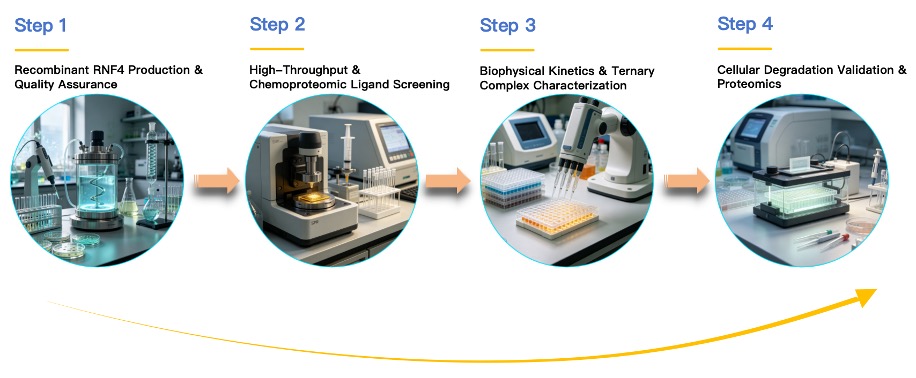
Workflow of RNF4 based Protein Degrader Ligand Screening Service
Stage 1
Recombinant RNF4 Production & Quality Assurance
Production of full-length RNF4 or isolated RING-domain constructs using specialized host systems to maintain native zinc-coordination and folding.
Quality verification via SEC-MALS, SDS-PAGE, and mass spectrometry to ensure structural integrity and active cysteine availability.
Activity-Based Protein Profiling (ABPP) & Covalent Profiling: Screening electrophilic fragment libraries to identify compounds that selectively modify functional cysteines on RNF4.
In Silico / Structure-Based Virtual Screening: Docking chemical collections into high-resolution structural models of the RNF4 RING domain.
Affinity & Kinetic Profiling: Quantifying binding parameters (KD, kon, koff) using SPR, TR-FRET, Fluorescence Polarization (FP), and MicroScale Thermophoresis (MST).
Ternary Complex Cooperativity (α) Assessment: Evaluating the formation, stability, and kinetics of the POI–Degrader–RNF4 complex in real time.
Structural Analysis: Utilizing X-ray crystallography and cryo-EM platforms to map binding interactions and direct rational linker attachment vectors.
Stage 4
Cellular Degradation Validation & Proteomics
Conjugation of lead RNF4 recruiters to POI-targeting ligands using customized linker libraries.
Quantitative cellular evaluation (DC50, Dmax) via Western Blotting and multiplexed quantitative proteomics (TMT-MS) to confirm rapid target depletion and global proteomic safety.
Advantages of Our Services
Engaging a seasoned CRO is a critical move when exploring alternative E3 ligases like RNF4. Creative Biolands fuses deep‑seated biological know‑how in nuclear E3 systems with state‑of‑the‑art biophysical and chemical synthesis resources. Teaming up with us gives your initiative solid technical foundations and robust strategic support:
Specialised STUbL & Nuclear E3 Insight
Comprehensive command of RNF4 biology, poly SUMO binding, and optimised degrader architecture.
Proven Biological Tools
Premade, high grade RNF4 protein reagents and standardised controls that dramatically cut down start up time.
Integrated Discovery Pipeline
Smooth handoffs from hit finding to linker customisation and cellular degradation assays, all under one roof.
Productive Ternary Focus
Early evaluation of binding cooperativity (α) filters in only high efficiency degraders, reducing late stage attrition.
Adaptable Project Frameworks
Customised to your goals, whether you aim for initial hit identification or comprehensive lead optimisation campaigns.
Guaranteed IP Protection
All resulting compounds, data, and IP stay 100% in your hands.
Frequently Asked Questions
Q: Why target a STUbL E3 ligase like RNF4 instead of standard Cullin-RING ligases?
A: RNF4 is specifically suited for clearing nuclear proteins, transcription factors, and chromatin-associated targets. Its dual ability to accept non-covalent and covalent recruiters offers flexible chemical options for overcoming CRBN/VHL resistance.
Q: What expression systems are used for generating RNF4 protein batches?
A: We utilize optimized insect cell (Sf9) and E. coli expression systems supplemented with zinc ions to preserve the structural integrity of the RING domain and ensure binding competence.
Q: Can Creative Biolabs handle covalent ligand screening for RNF4?
A: Yes. We deploy chemoproteomic ABPP assays and intact-protein LC-MS/MS to identify and confirm cysteine-reactive electrophilic recruiters targeting RNF4's functional residues.
Do you have any problems for your targeted protein degradation programs? Creative Biolabs delivers tailor-made screening solutions, biophysical validation, and synthetic expertise to accelerate your preclinical drug discovery. Please do not hesitate to contact us for more information.
Contact Our Team for More Information and to Discuss Your Project →


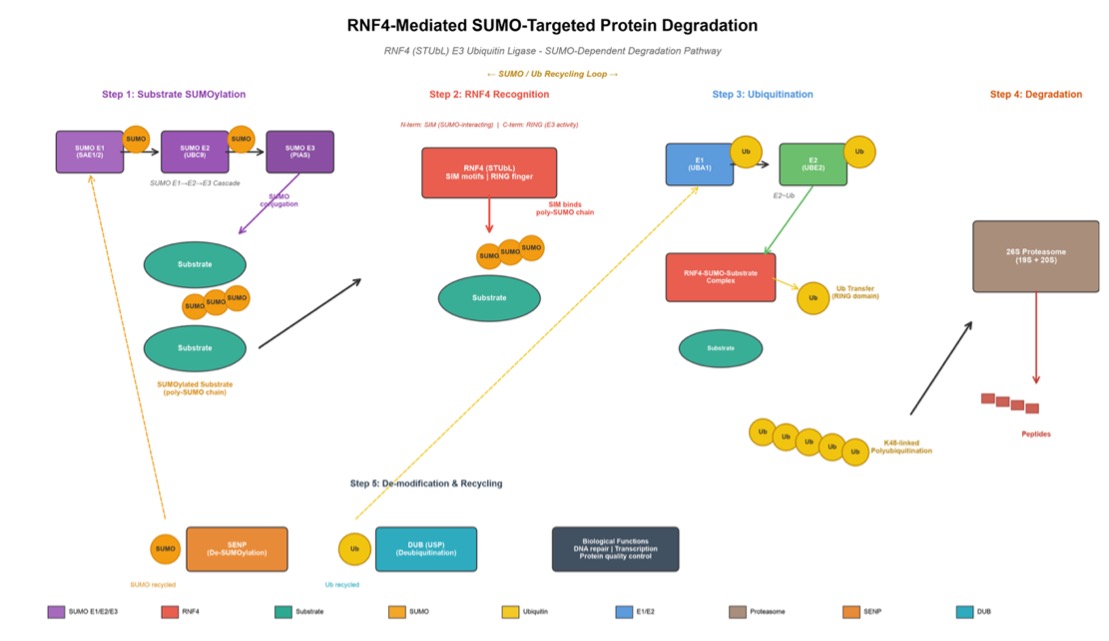 Fig.1 The RNF4-mediated protein degradation.