RNF114 based Protein Degrader Ligand Screening Service
BackgroundWhat We Can Offer?WorkflowWhy Us?FAQRelated Services
Creative Biolabs stands at the forefront of targeted protein degradation (TPD), offering sophisticated solutions to discover and deploy alternative E3 ligases. As an integral component of our Novel E3 Ligase Ligand Screening Services, our RNF114-based Protein Degrader Ligand Screening Service provides customized screening and chemical modification pipelines to identify high-affinity recruiters for RING finger protein 114 (RNF114). We empower biopharmaceutical innovators to harness covalent degradation machinery, facilitating the development of potent heterobifunctional degraders with distinctive pharmacological profiles.
Background of RNF114 in Protein Degradation
RING finger protein 114 (RNF114) is a zinc-binding RING-type E3 ubiquitin ligase that plays pivotal roles in cellular immune responses, cell cycle progression, and oncogenic signaling pathways. Recent chemical biology breakthroughs demonstrate that RNF114 possesses hyper-reactive, druggable cysteine residues within its zinc-coordinating RING finger domain, making it an exceptional target for covalent recruiter design (e.g., utilizing electrophilic scaffolds like nimbolide analogs). The strategic benefits of utilizing RNF114 in degrader development include:
Covalent Engagement Mechanism: RNF114 recruiters form irreversible or tunable covalent bonds with specific cysteine residues (such as C8/C10 motifs). This irreversible binding drives persistent recruitment of the E3 complex, often enhancing degradation kinetics (DC50) even at low binder occupancies.
Distinct Cancer & Immune Expression: RNF114 displays elevated expression in various solid tumors (such as breast and colorectal cancers) and specific immune cell populations, offering an opportunity to design cancer-preferential degraders that spare healthy peripheral tissues.
Mitigation of the Hook Effect: The covalent nature of RNF114 binding alters binary/ternary complex equilibrium, frequently dampening the classic hook effect and broadening the effective therapeutic window.
Alternative Degradation Pathways: Recruiting RNF114 engages distinct ubiquitin-conjugating (E2) enzyme cascades, enabling the turnover of complex disease targets that resist ubiquitination by CRBN or VHL.
Unexplored Patent Space: Novel chemical classes capable of binding RNF114 afford biopharmaceutical sponsors an unencumbered intellectual property trajectory.
Fig.1 RNF114-mediated protein degradation pathway.
How Creative Biolabs' RNF114 based Protein Degrader Ligand Screening Service Can Assist Your Project?
Navigating covalent E3 ligase discovery demands a specialized balance of reactivity profiling, biophysical assessment, and cellular validation. Creative Biolabs acts as a strategic technical engine, assisting your research team at every juncture of RNF114 ligand identification and bifunctional degrader construction:
Targeted Covalent Chemistry & Library Screening: We utilize tailored electrophile libraries, activity-based protein profiling (ABPP), and reactivity-guided fragment screening to pinpoint selective, non-cytotoxic covalent recruiters targeting RNF114.
Selectivity & Proteome-Wide Mapping: To prevent off-target toxicity, our advanced mass spectrometry capabilities map exact cysteine modification sites on RNF114 while profiling proteome-wide selectivity to ensure minimal reactivity against off-target cysteines.
Overcoming Resistance Profiles: We enable sponsors to rebuild efficacy against CRBN- or VHL-resistant cancer models by transitioning target-binding heads onto RNF114-recruiting backbones.
Structural Guidance & Linker Chemistry: Leveraging computational modeling and biophysical ternary complex characterization, we define ideal attachment vectors to synthesize bifunctional molecules with optimal spatial orientation and cooperativity (α).
Rapid Milestone Progression: By unifying target expression, covalent ligand profiling, medicinal chemistry conjugation, and cell-based degradation metrics, we streamline your trajectory from primary hit to qualified candidate.
Workflow of RNF114 based Protein Degrader Ligand Screening Service
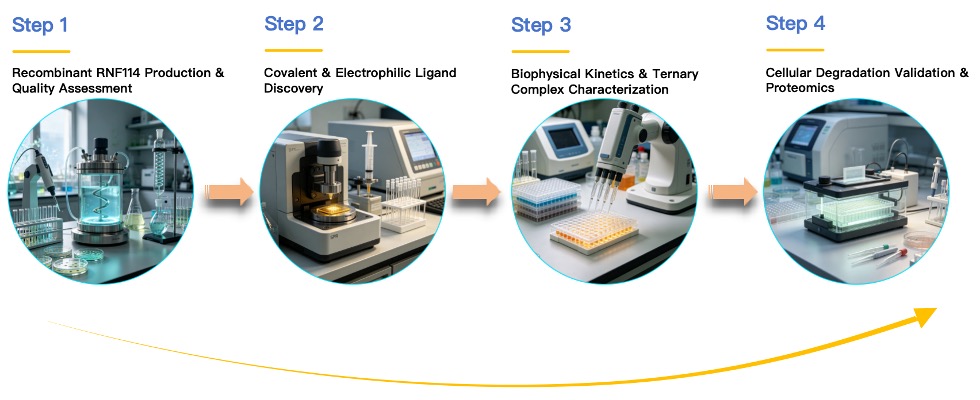
Stage 1
Recombinant RNF114 Production & Quality Assessment
Expression of full-length RNF114 or zinc-finger domain constructs utilizing specialized host systems to preserve native zinc-coordination and folding.
Quality validation via SEC-MALS and mass spectrometry to ensure structural integrity and active cysteine availability.
Stage 2
Covalent & Electrophilic Ligand Discovery
Chemoproteomic / ABPP Profiling: Screening electrophilic fragment libraries to identify compounds that selectively react with functional cysteines on RNF114.
DNA-Encoded Library (DEL) & Fragment Screening: Deployment of specialized libraries to discover both non-covalent starting points and covalent modifiers.
Mass Spectrometry (LC-MS/MS) Adduct Mapping: Verification of stoichiometric binding, reaction kinetics (kinact/Ki), and specific site modification.
Binding Kinetics & Thermodynamics: Characterization using SPR, MST, and nanoDSF to evaluate binding affinity and covalent reaction rates.
Ternary Complex Cooperativity (α): Assessing the formation and stability of the POI–Degrader–RNF114 complex in real time.
Structural Elucidation: High-resolution X-ray crystallography and cryo-EM studies to decipher binding modes and inform rational linker design.
Stage 4
Cellular Degradation Validation & Proteomics
Assembly of heterobifunctional molecules using diverse linker lengths and compositions.
Quantitative cellular evaluation (DC50, Dmax) via Western Blotting and global quantitative proteomics (TMT-MS) to confirm target selectivity and rule out off-target proteome depletion.
Advantages of Our Services
Navigating the nuances of covalent E3 recruitment requires deep expertise in chemoproteomics, structural biology, and synthetic conjugation. Creative Biolabs offers an end-to-end infrastructure engineered to minimize technical risk and accelerate the discovery of functional RNF114-recruiting degraders. Partnering with us provides your team with significant operational and strategic advantages:
Pioneering Covalent Degradation Expertise
Deep technical mastery in chemoproteomics, electrophilic ligand design, and site-specific cysteine mapping.
Ready-to-Use Biological Reagents
Access to pre-formulated, structurally verified RNF114 protein batches and established reference assays, cutting initial setup times dramatically.
End-to-End Synthetic & Biological Integration
Smooth transition from ligand screening to custom linker attachment, bifunctional degrader synthesis, and cell-based profiling within a unified facility.
Proteome-Wide Selectivity Focus
Early-stage proteomic profiling guarantees that candidate recruiters demonstrate targeted covalent engagement without broad, non-specific cellular reactivity.
Customizable Project Modules
Tailored service agreements ranging from discrete primary screening runs to comprehensive hit-to-lead optimization campaigns.
Complete Intellectual Property Protection
100% of the chemical structures, assay outputs, and intellectual property developed during the project belong exclusively to the client.
Frequently Asked Questions
Q: Why choose a covalent E3 ligase like RNF114 over traditional reversible E3 ligases?
A: Covalent engagement of RNF114 can drive prolonged target degradation with lower ligand occupancy, mitigating the hook effect and providing high potency even when target binder affinities are moderate. Furthermore, RNF114 offers a distinct tissue expression profile and fresh IP opportunities.
Q: How does Creative Biolabs ensure that covalent RNF114 ligands are not broadly toxic or non-selective?
A: We integrate activity-based protein profiling (ABPP) and global quantitative mass spectrometry early in the process. This allows us to confirm site-specific modification of target cysteines on RNF114 while screening out compounds that exhibit non-specific reactivity across the broader cellular proteome.
Q: Can Creative Biolabs assist with the synthetic conjugation of RNF114 recruiters to our target-binding ligands?
A: Yes. Our medicinal chemistry team specializes in custom linker design and synthesis. We construct matrix libraries of heterobifunctional molecules featuring varied linker lengths, rigidities, and exit vectors to optimize cellular degradation efficacy.
Q: What assay systems are used to verify target protein depletion in cells?
A: We employ quantitative Western Blotting and multiplexed TMT quantitative proteomics to determine DC50 values, maximum degradation depth Dmax, and global target selectivity in relevant disease cell lines.
Ready to harness RNF114 for your targeted protein degradation pipeline? Creative Biolabs offers specialized covalent screening platforms, biophysical assay suites, and dedicated scientific collaboration to bring your next-generation degrader candidates to fruition. Contact us to consult with our scientific team or request a detailed service proposal.
Contact Our Team for More Information and to Discuss Your Project →

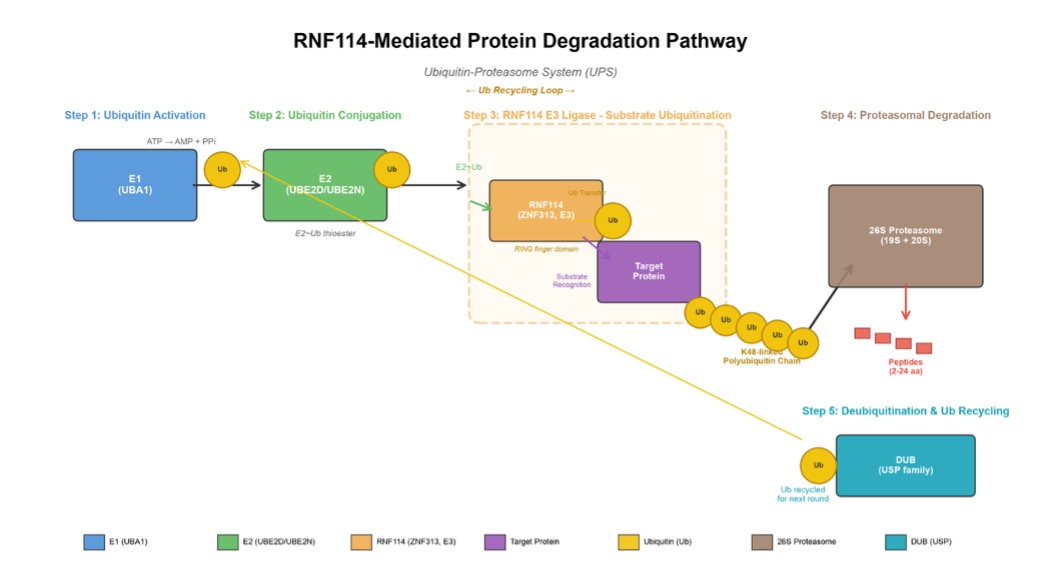 Fig.1 RNF114-mediated protein degradation pathway.