KEAP1 based Protein Degrader Ligand Screening Service
BackgroundWhat We Can Offer?WorkflowWhy Us?FAQRelated Services
As a global leader in targeted protein degradation (TPD), Creative Biolabs offers comprehensive E3 ligase exploitation platforms. As a core module of our novel E3 ligase ligand screening services, our KEAP1-based protein degrader ligand screening service delivers custom discovery and optimization of high-affinity KEAP1 recruiters. We empower biopharmaceutical partners to build next-generation heterobifunctional degraders with enhanced target specificity and novel tissue distribution profiles.
Background of KEAP1 in Protein Degradation
Kelch-like ECH-associated protein 1 (KEAP1) serves as the substrate-recognition subunit of the Cullin 3 (CUL3)–Ring Box Protein 1 (RBX1) E3 ubiquitin ligase complex. Under physiological conditions, KEAP1 regulates cellular redox homeostasis by targeting the transcription factor NRF2 for continuous ubiquitination and degradation via a two-site "hinge-and-latch" mechanism. Structurally, KEAP1 functions as a homodimer comprising three major functional domains:
The N-terminal BTB Domain: Responsible for homodimerization and assembly with the CUL3 scaffold.
The Central IVR / BACK Domain: Contains reactive cysteine residues (such as C151, C273, and C288) that act as sensors for oxidative stress and electrophilic molecules.
The C-terminal Kelch / DGR Domain: A six-bladed β-propeller structure that mediates direct protein-protein interactions (PPI) with substrate motifs (e.g., the ETGE and DLG motifs of NRF2).
In the protein degrader design, KEAP1 presents great advantages:
Favorable Tissue Expression Profiles: High cellular expression of KEAP1 in key organs, including the central nervous system (CNS), lung, liver, and kidney, enables tissue-preferential protein degradation complementary to CRBN/VHL.
Dual Covalent and Non-Covalent Druggability: The Kelch domain provides a deep, polar binding pocket ideal for high-affinity reversible non-covalent recruiters. Concurrently, reactive cysteines in the IVR/BTB domains allow the development of selective covalent recruiters.
Reduced Hook Effect Sensitivity: Unique dimerization kinetics and cooperativity mechanisms within the CUL3-KEAP1 complex can mitigate non-productive binary binding at therapeutic doses.
Therapeutic Crosstalk Modulation: Depending on the recruitment strategy, KEAP1 binders can be engineered either to maintain baseline redox sensing or intentionally trigger NRF2 pathway activation for dual therapeutic benefits in cytoprotection and target clearance.
Fig.1 KEAP1-mediated protein degradation pathway.
How Creative Biolabs' KEAP1 based Protein Degrader Ligand Screening Service Can Assist Your Project?
At Creative Biolabs, our service goes beyond routine high-throughput screening. We provide an end-to-end, milestone-driven discovery engine designed to overcome the structural and chemical challenges of hijacking the CUL3-KEAP1 machinery. By partnering with us, clients can seamlessly advance their degrader pipeline across key project stages:
De Novo Recruiter Discovery: Whether you are starting from scratch or optimizing existing chemical leads, we utilize multi-billion compound DNA-encoded libraries (DEL), targeted fragment screening, and virtual docking to identify novel non-covalent and cysteine-reactive covalent KEAP1 binders.
Overcoming Resistance & Intellectual Property Barriers: We help clients establish strong Freedom-to-Operate (FTO) positions by discovering proprietary, highly selective KEAP1 ligand scaffolds that bypass CRBN/VHL-associated mutation profiles and crowded patent spaces.
Unlocking Tissue-Preferential Degradation: By tapping into KEAP1's abundant expression in respiratory, renal, hepatic, and CNS tissues, our service helps transform non-selective target protein binders into organ-targeted therapeutic candidates with reduced systemic side effects.
Rational Linker & Ternary Complex Engineering: Bifunctional degrader activity relies heavily on binding cooperativity (α) rather than binary affinity alone. We assist your team in evaluating POI–Degrader–KEAP1 ternary complex dynamics and structural attachment vector geometry to rapidly identify optimal linker compositions.
Accelerating Hit-to-Lead Transitions: Integrating hit identification, biophysical validation, custom synthetic chemistry, and functional cell-based degradation profiling under one roof dramatically compresses your preclinical lead optimization timelines.
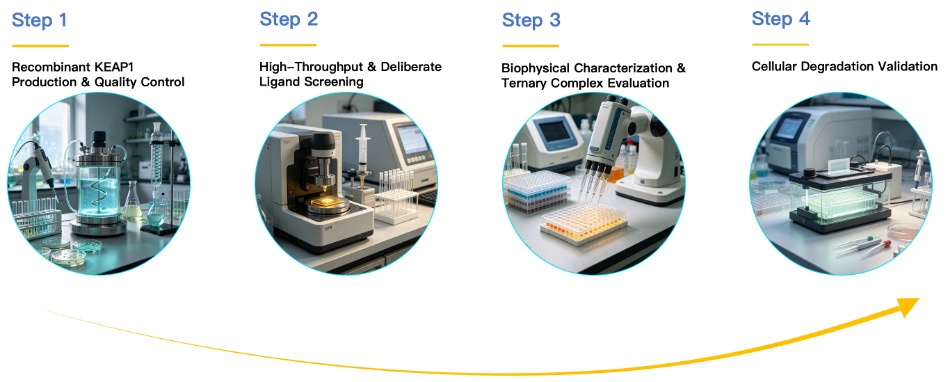
Workflow of KEAP1 based Protein Degrader Ligand Screening Service
Stage 1
Recombinant KEAP1 Production & Quality Control
High-yield expression of full-length KEAP1, BTB domain, or Kelch domain across E. coli, insect, and mammalian systems.
Rigorous purity (SDS-PAGE/SEC-MALS) and structural integrity testing to guarantee native folding and binding competency.
Affinity & Kinetics: FP, TR-FRET, MST, and SPR assays quantifying binding affinities (Kd) and dissociation kinetics.
Cooperativity Factor (α) Measurement: Quantitative assessment of ternary complex formation (POI-Degrader-KEAP1) to predict cellular degradation efficiency.
Structural Biology: Co-crystallography and cryo-EM capabilities to reveal exact binding modes and guide rational linker attachment.
Stage 4
Cellular Degradation Validation
Conjugation of lead KEAP1 recruiters to target POI binders via customized chemistry linkers.
High-throughput cellular degradation kinetics (DC50, Dmax) evaluated via Western Blot, and quantitative proteomics.
Advantages of Our Services
Selecting the right Contract Research Organization (CRO) is critical for translating early-stage E3 recruiter discovery into viable therapeutic leads. Creative Biolabs combines decades of specialized experience in targeted protein degradation with state-of-the-art biophysical and medicinal chemistry infrastructures. Our team works as a seamless extension of your internal R&D unit, offering customizable milestone-based workflows that mitigate technical risks, optimize capital efficiency, and accelerate your timeline to candidate selection.
Extensive TPD Expertise
Decades of collective experience in E3 ligase biology, linker chemistry, and bifunctional degrader structural optimization.
Pre-Validated Reagents
Ready-to-use recombinant KEAP1 protein constructs and established assay controls significantly reduce project lead times.
Integrated Chemistry & Biology
Seamless bridge from initial recruiter screening to custom linker synthesis and full degrader candidate profiling under one roof.
Multi-Modal Binding Screening
Fully flexible assay setups designed to discover both reversible non-covalent recruiters and selective covalent binders.
Rigorous Ternary Complex Focus
Early-stage evaluation of binding cooperativity (α) ensures only functional, high-efficiency degraders progress down the pipeline.
Frequently Asked Questions
Q: Can Creative Biolabs screen for both covalent and non-covalent KEAP1 recruiters?
A: Yes. We offer specialized assay platforms for both mechanisms. For non-covalent binders, we utilize high-throughput TR-FRET, FP, and SPR kinetic assays. For covalent binders, we employ LC-MS/MS mapping and intact-protein mass spectrometry to verify site-specific cysteine modification.
Q: Which KEAP1 domains can be targeted in your screening assays?
A: We construct and express full-length KEAP1 as well as isolated functional domains, specifically the Kelch domain (which binds NRF2) and the BTB domain. This allows targeted screening based on your specific therapeutic strategy.
Q: How do you validate that identified KEAP1 ligands effectively promote target degradation?
A: Lead recruiters are conjugated to known ligands for your protein of interest (POI) via customized linkers to generate bifunctional degrader molecules. We then measure cellular degradation efficiency (DC50, Dmax) in disease-relevant cell lines using Western Blotting, or quantitative proteomics.
Q: What compound sources can be used for the screening process?
A: Clients are welcome to provide their own proprietary chemical libraries, leverage Creative Biolabs' proprietary DNA-Encoded Libraries (DELs), or utilize our target-focused fragment collections.
Ready to advance your TPD pipeline with novel KEAP1 recruiters? Creative Biolabs delivers tailor-made screening strategies, robust biophysical assay platforms, and dedicated scientific support to accelerate your degrader discovery programs. Please do not hesitate to contact us for more details.
Contact Our Team for More Information and to Discuss Your Project →


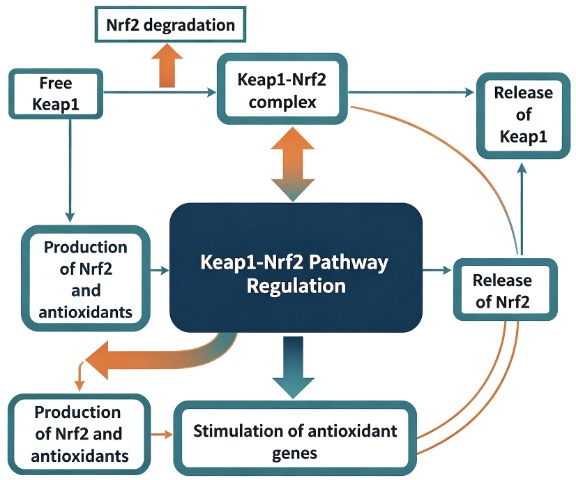 Fig.1 KEAP1-mediated protein degradation pathway.