KLHL22 based Protein Degrader Ligand Screening Service
BackgroundWhat We Can Offer?WorkflowWhy Us?FAQRelated Services
As an established global innovator in targeted protein degradation (TPD), Creative Biolabs provides versatile E3 ligase exploitation platforms to advance next-generation therapeutic discovery. As a specialized sub-module of our Novel E3 Ligase Ligand Screening Services, our KLHL22-based Protein Degrader Ligand Screening Service offers client-tailored ligand identification, biophysical profiling, and degrader conjugation pipelines targeting Kelch-like protein 22 (KLHL22). We partner with biopharmaceutical sponsors to expand their E3 recruiter arsenal, enabling the development of tissue-selective heterobifunctional degraders with exceptional target-clearing efficiency.
Background of KLHL22 in Protein Degradation
Kelch-like protein 22 (KLHL22) functions as a specialized substrate-recognition adaptor within the Cullin 3 (CUL3)-Ring Box Protein 1 (RBX1) RING-type E3 ubiquitin ligase super-complex. Biologically, KLHL22 plays a pivotal role in metabolic sensing and cell growth by mediating the ubiquitination and degradation of key regulatory proteins (such as DEPDC5 within the GATOR1 complex), thereby directly modulating mTORC1 pathway activity. Structurally, KLHL22 exhibits a modular multi-domain architecture:
The N-Terminal BTB / BACK Domain: Facilitates obligate dimerization and direct assembly with the CUL3/RBX1 core machinery.
The C-Terminal Kelch Domain: Features a symmetrical six-bladed β-propeller fold that forms a well-defined, druggable binding pocket optimized for protein-protein interactions (PPI) and peptide-motif recognition.
In the protein degrader design, KLHL22 presents great advantages:
Specialized Tissue & Pathway Enrichment: KLHL22 shows pronounced functional involvement in oncology (e.g., breast cancer progression) and metabolic signaling networks, enabling targeted protein clearance tailored to specific disease contexts.
Druggable Kelch β-Propeller Architecture: The deep, structured binding cavity of the KLHL22 Kelch domain accommodates both high-affinity non-covalent small molecules and targeted peptide-mimetic recruiters.
Distinct Ubiquitination Kinetics: Engaging CUL3–KLHL22 complexes allows alternative spatial positioning of ubiquitin transfer, enabling the turnover of target proteins that are topologically resistant to CRBN- or VHL-mediated ubiquitination.
Bypassing Classical Resistance Profiles: Utilizing KLHL22 recruiters maintains degrader efficacy in cell lines that have lost sensitivity to CRBN- or VHL-binding drugs due to target-gene mutations.
Proprietary Patent Opportunities: Exploring KLHL22 recruiters allows biopharmaceutical companies to secure novel chemical space and avoid crowded competitive patent domains.
Fig.1 KLHL22-mediated protein degradation pathway.
How Creative Biolabs' KLHL22 based Protein Degrader Ligand Screening Service Can Assist Your Project?
Unlocking a non-canonical E3 ligase like KLHL22 requires dedicated expertise in structural biology, biophysical assay design, and synthetic chemistry. Creative Biolabs acts as an integrated R&D partner, assisting your scientific team through every milestone of KLHL22 recruiter discovery and bifunctional degrader optimization:
High-throughput Hit Identification: We deploy proprietary DNA-encoded libraries (DELs), target-focused fragment collections, and structure-guided virtual screening to uncover high-affinity small-molecule starting points against the KLHL22 Kelch domain.
Addressing Resistance & Securing FTO: We help clients construct novel heterobifunctional degradation platforms that bypass CRBN/VHL mutation patterns while establishing strong, unencumbered intellectual property positions.
Ternary Complex & Cooperativity Optimization: Successful degradation depends on positive cooperativity (α) between the POI, degrader, and E3 ligase. We characterize ternary complex stability and kinetics in real time to guide rational linker composition and vector orientation.
Custom Chemistry & Linker Synthesis: Our experienced medicinal chemists synthesize matrix libraries of bifunctional molecules incorporating diverse linker chemistries (rigid, flexible, polyethylene glycol, or alkyl chains) to maximize cellular degradation efficiency.
Streamlined Milestone Delivery: By consolidating recombinant protein expression, biophysical affinity mapping, custom conjugation, and cellular assay validation, we accelerate your program's transition from initial hit to lead candidate.
Workflow of KLHL22 based Protein Degrader Ligand Screening Service
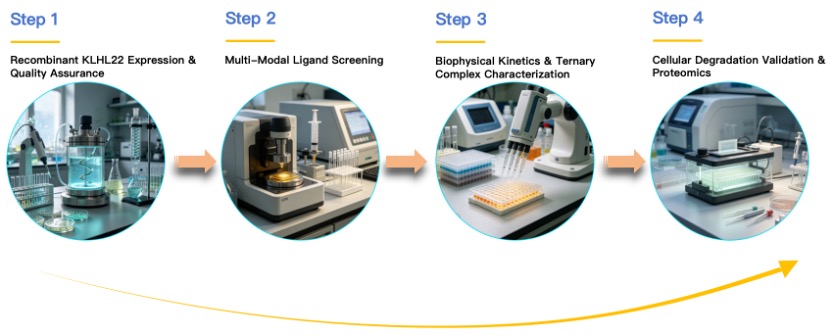
Creative Biolabs offers an end-to-end, multi-disciplinary platform tailored to the biophysical and structural properties of the KLHL22–CUL3 complex. Our service unifies in silico molecular modeling, high-throughput biophysical profiling, synthetic chemistry, and functional cellular validation into a cohesive discovery engine.
Stage 1
Recombinant KLHL22 Expression & Quality Assurance
Production of full-length KLHL22, BTB-BACK, or isolated Kelch domain constructs in mammalian, insect, or bacterial expression platforms.
Rigorous purity and structural validation via SEC-MALS, SDS-PAGE, and mass spectrometry to ensure active fold and native ligand-binding competence.
Stage 2
Multi-Modal Ligand Screening
DNA-Encoded Library (DEL) Selection: Rapid screening of multi-billion compound collections against functional KLHL22 constructs.
Fragment-Based Drug Discovery (FBDD): Screening fragment libraries via Surface Plasmon Resonance (SPR) and NMR to identify subtle chemical hits.
In Silico / Structure-Based Virtual Screening: Docking chemical collections into high-resolution KLHL22 Kelch domain pocket models.
Structural Elucidation: X-ray crystallography and cryo-EM platforms to solve co-crystal structures and define exact linker attachment vectors.
Stage 4
Cellular Degradation Validation & Proteomics
Conjugation of lead KLHL22 binders to POI-targeting ligands using customized linker libraries.
Quantitative cell-based evaluation (DC50, Dmax) using Western Blotting and multiplexed quantitative proteomics (TMT-MS) to confirm target selectivity and proteome-wide safety.
Advantages of Our Services
Selecting an experienced Contract Research Organization (CRO) is essential when exploring emerging E3 ligases like KLHL22. Creative Biolabs combines deep expertise in Cullin-RING ligase biology with state-of-the-art biophysical and medicinal chemistry facilities. Our integrated service model provides your team with substantial technical and strategic advantages:
Specialized E3 Ligase Expertise
Deep scientific insight into Cullin 3-based Kelch-repeat proteins and structural degrader optimization.
Pre-Formulated Biological Reagents
Access to pre-validated, recombinant KLHL22 protein batches and established reference assays to minimize project launch delays.
Integrated Chemistry & Biology Operations
Seamless transition from primary screening to linker chemistry modification, bifunctional degrader synthesis, and cellular validation under one roof.
Focus on Ternary Complex Dynamics
Early prioritization of binding cooperativity (α) ensures that only productive, highly efficient degraders are advanced into downstream testing.
Flexible Engagement Models
Modular service structures adaptable to specific project scopes, from standalone hit screening to comprehensive candidate optimization.
100% Intellectual Property Security
All screened hits, optimized chemical structures, and associated data remain entirely the property of the client.
Frequently Asked Questions
Q: What makes KLHL22 an attractive E3 ligase for targeted protein degradation?
A: KLHL22 offers a well-defined Kelch β-propeller domain ideal for high-affinity small-molecule binding. It operates as part of the CUL3 machinery, providing an alternative degradation pathway that can bypass CRBN/VHL resistance, target different subcellular pools, and open up fresh IP space.
Q: Which KLHL22 protein constructs do you use in your screening assays?
A: We produce both full-length KLHL22 (to evaluate complete E3 complex integration) and the isolated C-terminal Kelch domain (optimized for high-throughput binding and crystallography assays targeting the primary substrate-binding pocket).
Q: How do you evaluate whether a KLHL22 binder can successfully form a functional ternary complex?
A: We utilize biophysical techniques such as SPR, TR-FRET, and MST to measure the formation of the POI–Degrader–KLHL22 complex, allowing us to calculate the cooperativity factor (α) and select molecules that favor productive ternary assembly over binary competition.
Q: Can clients provide their own target-binding ligands for degrader assembly?
A: Yes. Clients can supply their proprietary POI-binding small molecules or peptides. Our synthetic chemistry team will handle the conjugation of these ligands with identified KLHL22 recruiters across various linker matrix variations.
Ready to explore KLHL22 as a novel E3 recruiter for your targeted protein degradation pipeline? Creative Biolabs delivers customized screening strategies, advanced biophysical assay platforms, and dedicated scientific collaboration to accelerate your drug discovery goals. Please do not hesitate to contact us for more details.
Contact Our Team for More Information and to Discuss Your Project →


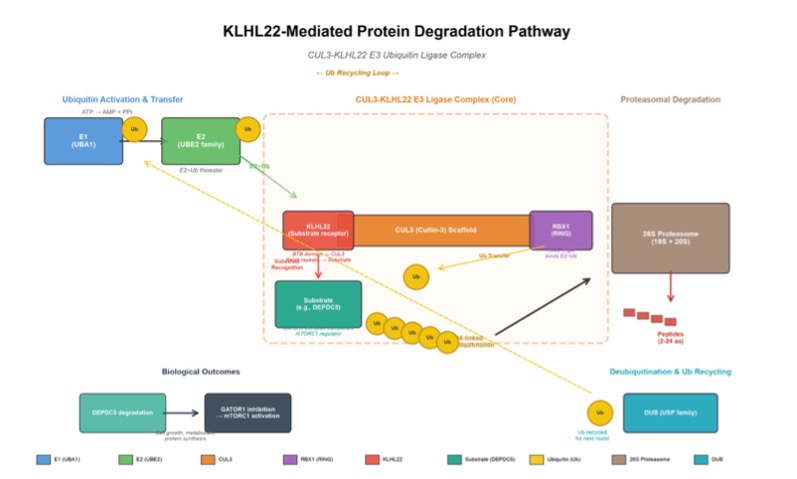 Fig.1 KLHL22-mediated protein degradation pathway.