IAP based Protein Degrader Ligand Screening Service
BackgroundWhat We Can Offer?WorkflowWhy Us?FAQRelated Services
Harnessing apoptotic regulators to clear pathogenic proteins requires recruiters optimized for BIR domain biophysics and RING-finger ubiquitin transfer dynamics. Creative Biolabs provides specialized ligand harvesting, chemoproteomic profiling, and bifunctional molecule synthesis targeting Cellular IAP1/2 (cIAP1/2) and X-linked IAP (XIAP).
Background of IAP in Protein Degradation
Inhibitor of Apoptosis Proteins (IAPs)—primarily cellular IAP1 (cIAP1), cellular IAP2 (cIAP2), and X-linked IAP (XIAP)—constitute a biologically distinct class of RING-type E3 ubiquitin ligases. Structurally defined by tandem N-terminal Baculovirus IAP Repeat (BIR) domains and a C-terminal RING catalytic domain, these proteins offer a highly versatile engine for targeted protein degradation. By utilizing synthetic SMAC (Second Mitochondria-derived Activator of Caspases) mimetics, bifunctional chemical probes can bridge target proteins directly to the BIR3 cavity of IAPs, driving robust polyubiquitination and proteasomal degradation.
The distinctive features of IAP-recruiting degraders:
Dual Degradation Modalities: Depending on the structural properties of the recruiter, bifunctional molecules can be engineered to trigger isolated target clearing or concurrent auto-ubiquitination and depletion of cIAP1/2.
Tumor-Preferential Abundance: Elevated expression of cIAP1 and XIAP in neoplastic tissue environments creates a natural window for localized target destruction while sparing normal tissue compartments.
Alternative Pathway Activation: Bypassing classical Cullin-RING adaptors restores effective target destruction in malignant cell lines containing loss-of-function mutations or epigenetic silencing of CRBN or VHL genes.
Structural Compatibility with Varied Linkers: The rigid spatial conformation of the BIR3 binding groove accommodates diverse chemical exit vectors, supporting both classic heterobifunctional molecules and monovalent proximity inductors.
Fig.1 The IAP-mediated protein degradation.
How Creative Biolabs' IAP based Protein Degrader Ligand Screening Service Can Assist Your Project?
Successfully recruiting IAPs requires solving precise biochemical trade-offs between ligase affinity, E3 self-depletion kinetics, and inflammatory pathway activation. Creative Biolabs applies targeted analytical platforms to resolve these critical parameters:
Controlling cIAP1 vs. XIAP Ligase Profiling: We utilize panel-based competitive binding assays across isolated BIR2 and BIR3 domains, allowing drug discovery teams to select recruiters that either drive cIAP1 self-depletion or preserve endogenous ligase levels via XIAP-sparing routes.
Optimizing Ternary Complex Stability (α): We measure real-time target–degrader–IAP assembly dynamics to select linker exit vectors that favor productive ubiquitin transfer rather than relying solely on binary binding affinities.
Matrix Synthetic Optimization: Our synthetic chemistry platform prepares systematically varied series of bifunctional molecules, optimizing linker length, composition, and rigidity to maximize intracellular clearing velocity (DC50).
Workflow of IAP based Protein Degrader Ligand Screening Service
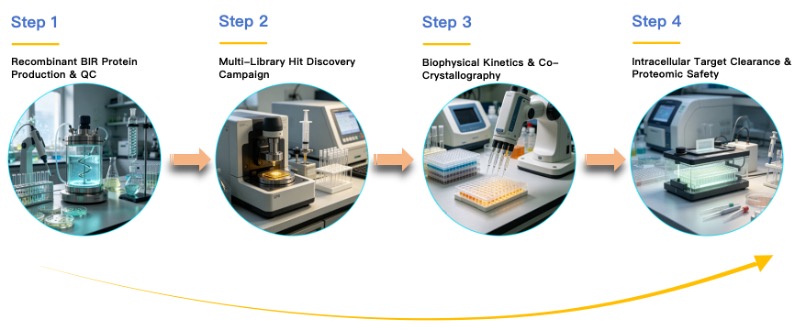
Our IAP discovery pipeline connects molecular engineering, high-throughput biophysics, and cellular degradation profiling into an aligned technical platform:
Stage 1
Recombinant BIR Protein Production & QC
High-yield expression of human cIAP1, cIAP2, and XIAP constructs (isolated BIR2/3 domains or full-length proteins) using insect or mammalian expression systems. Batches undergo rigorous SEC-MALS and mass spectrometry to verify native fold integrity and zinc ion coordination.
Stage 2
Multi-Library Hit Discovery Campaign
Parallel screening across multi-billion compound DNA-Encoded Libraries (DELs), SMAC-mimetic peptidomimetic arrays, and fragment collections using competitive TR-FRET and Fluorescence Polarization (FP) displacement platforms.
Stage 3
Biophysical Kinetics & Co-Crystallography
Real-time quantification of association (kon) and dissociation (koff) kinetics via Surface Plasmon Resonance (SPR) and MicroScale Thermophoresis (MST). High-resolution X-ray co-crystallography resolves atomic-level interactions inside the BIR3 pocket to direct rational linker attachment.
Stage 4
Intracellular Target Clearance & Proteomic Safety
Conjugated degraders are evaluated in disease-relevant cell models. Target depletion potency (DC50, Dmax), proteasomal dependence, and global proteomic selectivity are quantified using Western blotting and multiplexed TMT-MS proteomics.
Advantages of Our Services
Navigating the unique structural biology of RING-type E3 ligases requires a CRO partner with deep expertise in BIR domain mechanics and complex conjugation chemistry. Creative Biolabs provides a purpose-built technical framework designed to de-risk your IAP recruitment campaign:
Focused BIR Domain Structural Expertise
Extensive scientific knowledge in mapping the hydrophobic clefts of BIR2 and BIR3 domains, supporting the rational design of monovalent and bivalent recruiters.
Pre-Engineered Reagents & Assay Controls
Direct access to purified, structurally validated cIAP1, cIAP2, and XIAP protein constructs along with calibrated reference compounds, eliminating upfront preparation delays.
Dissection of E3 Auto-Degradation Kinetics
Specialized assay setups that differentiate target POI elimination from E3 ligase turnover, yielding clear insights into compound stoichiometry and mechanism of action.
Unified Single-Site Execution
Integrated workflow linking primary library screening, custom medicinal chemistry, structural modeling, and cell-based degradation profiling within a single facility.
Unconditional IP Ownership
All identified recruiter structures, conjugated lead series, kinetic datasets, and resulting patent rights remain 100% the exclusive property of the client.
Frequently Asked Questions
Q: Why is the BIR3 domain preferred over BIR1 or BIR2 for IAP recruiter screening?
A: The BIR3 domain contains the deep hydrophobic cleft evolved to bind the N-terminal AVPI peptide sequence of SMAC/DIABLO. This cleft provides a highly druggable pocket that accommodates small-molecule and peptidomimetic ligands far better than flatter protein surfaces.
Q: Can Creative Biolabs identify IAP recruiters that avoid triggering cIAP1 auto-degradation?
A: Yes. By fine-tuning binder orientation and chemical linker composition, we can identify "non-auto-degrading" IAP recruiters that direct polyubiquitination toward the target protein while preserving endogenous cIAP1 levels.
Q: How do you confirm that target depletion depends strictly on proteasomal activity?
A: We conduct cell-based degradation assays in the presence of selective pathway inhibitors (such as MG132 for proteasomal blockade or Bafilomycin A1 for lysosomal blockade) to confirm the exact catabolic route.
Q: Can clients supply proprietary target ligands for custom degrader conjugation?
A: Yes. Clients routinely provide their own POI-binding small molecules or peptides. Our medicinal chemistry team performs custom conjugation using identified IAP recruiters across varied linker lengths, compositions, and attachment vectors.
Direct your targeted protein degradation pipeline toward novel BIRC-recruiting mechanisms. Creative Biolabs combines recombinant protein production, biophysical ternary complex profiling, and custom conjugation chemistry into a unified discovery workflow. Contact our TPD research division today to submit your target requirements, discuss assay parameters, or obtain a comprehensive quote.
Contact Our Team for More Information and to Discuss Your Project →


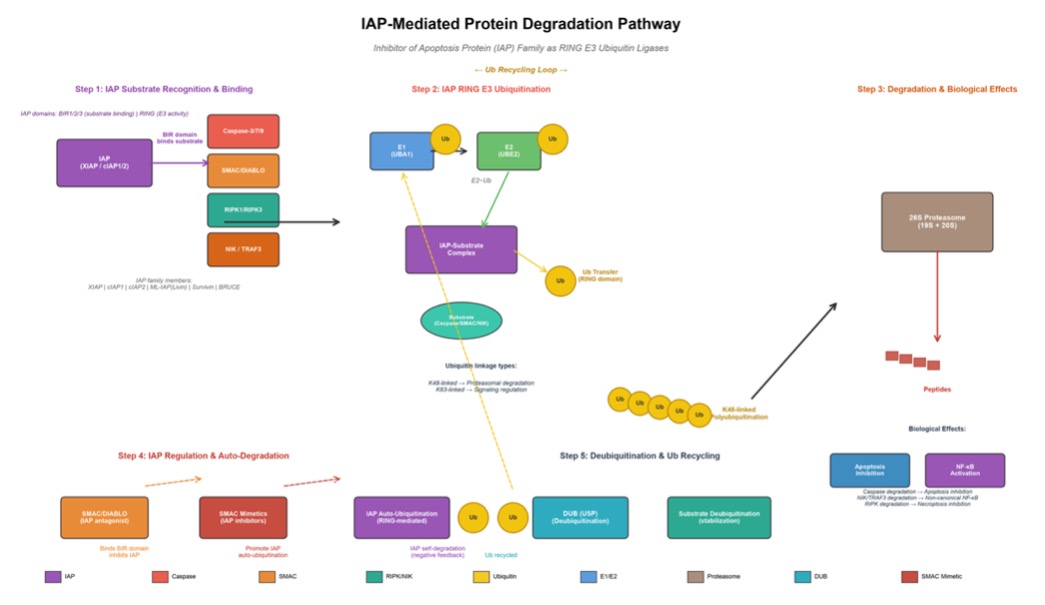 Fig.1 The IAP-mediated protein degradation.