GID4 based Protein Degrader Ligand Screening Service
BackgroundWhat We Can Offer?WorkflowWhy Us?FAQRelated Services
At Creative Biolabs, we specialize in pioneering next-generation targeted protein degradation technologies, proudly featuring our specialized GID4-based Protein Degrader Ligand Screening Service. Conventional degrader development frequently faces biological bottlenecks due to its overreliance on a small handful of traditional E3 ligases, which can lead to acquired resistance, off-target toxicities, or limited tissue distribution. To expand the functional E3 ligase repertoire, our platform delivers an integrated, custom-tailored solution for discovering, characterizing, and optimizing high-affinity small-molecule and peptide ligands that recruit GID4.
Background of GID4 in Protein Degradation
Glucose-induced degradation protein 4 homolog (GID4) operates as the dedicated substrate recognition subunit of the human CTLH (C-terminal to LisH) Cullin-RING E3 ubiquitin ligase complex. Mechanistically, GID4 drives targeted proteolysis by recognizing specific N-degrons—most notably N-terminal Proline (Pro/N-degrons) and related hydrophobic amino acid motifs. Structural characterization reveals that GID4 forms a compact eight-stranded β-barrel fold housing a deep, narrow, hydrophobic binding pocket that accommodates both native peptide degrons and synthetic small molecules with low-nanomolar binding affinities. In summary, GID4 presents great advantages:
Dual Cellular Distribution: GID4 is ubiquitously expressed and localizes to both the cytoplasm and the nucleus, allowing for targeted degradation across multiple cellular compartments.
Bypassing Resistance: Recruiting GID4 offers an orthogonal degradation route that circumvents genomic loss or down-regulation mutations commonly observed with CRBN or VHL.
Structural Plasticity: The flexible β-barrel binding cavity undergoes distinct conformational dynamics, making it an exceptional structural template for structure-based drug design (SBDD) and fragment expansion.
Fig.1 The GID4-mediated protein degradation.
How Creative Biolabs' GID4 based Protein Degrader Ligand Screening Service Can Assist Your Project?
Our GID4-based ligand screening platform directly resolves technical hurdles encountered during early-stage degrader discovery, providing actionable solutions for client projects:
Expanding E3 Chemical Space: We identify novel, drug-like non-covalent or covalent small-molecule ligands that bind GID4 without disrupting the structural assembly or enzymatic activity of the surrounding CTLH E3 complex.
Selective Ternary Complex Stabilization: We evaluate and optimize the cooperativity (α) of the target–degrader–GID4 complex, enabling paralog-selective target clearance that cannot be achieved by simple target inhibition.
Linker Vector Optimization: By determining precise exit vectors on GID4-bound ligands, we guide the synthesis of bifunctional molecules with optimal linker length, rigidity, and physicochemical properties to minimize the Hook effect (DC50, Dmax optimization).
Refractory Target Clearing: We enable the degradation of nuclear transcription factors, scaffold proteins, and previously "undruggable" drivers resistant to conventional degradation machinery.
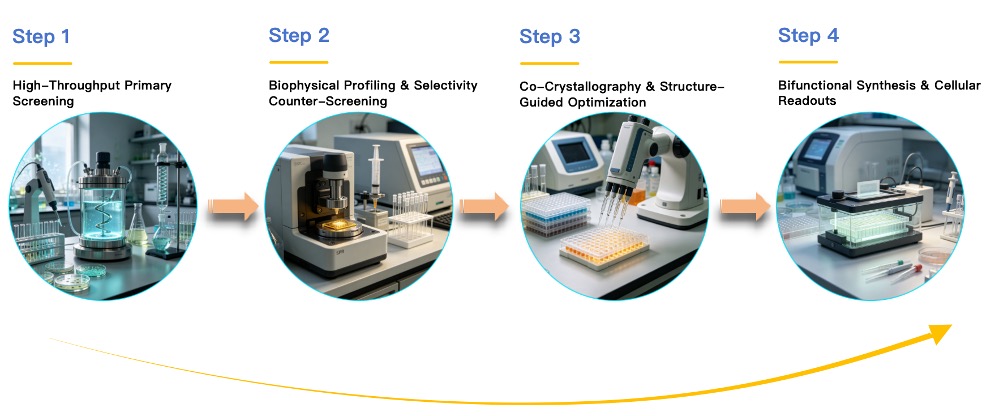
Workflow of GID4 based Protein Degrader Ligand Screening Service
Creative Biolabs employs a rigorous, modular workflow designed to transition smoothly from primary hit identification to complete cellular validation.
Stage 1
High-Throughput Primary Screening
We screen diverse chemical libraries, DNA-Encoded Libraries (DEL), or peptide/peptidomimetic collections against recombinant human GID4 using Fluorescence Polarization (FP), TR-FRET, and Surface Plasmon Resonance (SPR).
Hit compounds undergo orthogonal affinity and kinetic testing via Isothermal Titration Calorimetry (ITC) and MicroScale Thermophoresis (MST). Counter-screens against other Kelch/N-degron E3 adapters ensure strict target selectivity.
Direct access to custom DEL, macrocyclic, and synthetic N-degron mimic libraries engineered for deep hydrophobic pockets.
End-to-End Solutions
Fully integrated support bridging early ligand discovery, chemistry optimization, ternary complex characterization, and cellular degradation kinetics.
Frequently Asked Questions
Q1: What makes GID4 an attractive E3 ligase choice over conventional options?
A: Beyond offering an alternative pathway when CRBN or VHL exhibit resistance, GID4 possesses a unique, highly enclosed hydrophobic β-barrel pocket that is particularly amenable to high-affinity small-molecule binding and flexible ternary complex formation across both nuclear and cytoplasmic compartments.
Q2: Can Creative Biolabs screen both small-molecule and peptide-based ligands for GID4?
A: Yes. Our screening platforms support small-molecule library screens (DEL, fragment-based libraries) as well as peptidomimetic constructs designed around native N-terminal Proline degron motifs.
Q3: How do you confirm that target degradation is mediated specifically through GID4?
A: We validate mechanism-of-action via CRISPR/Cas9 knockout cell lines, GID4 RNAi knockdown, proteasome/cullin inhibition, and competitive ligand rescue assays to prove that clearance relies strictly on functional GID4 engagement.
Accelerate your targeted protein degradation pipeline with Creative Biolabs. Contact our scientific team today to discuss your project requirements or to request a customized proposal for our GID4-based Protein Degrader Ligand Screening Service.
Contact Our Team for More Information and to Discuss Your Project →

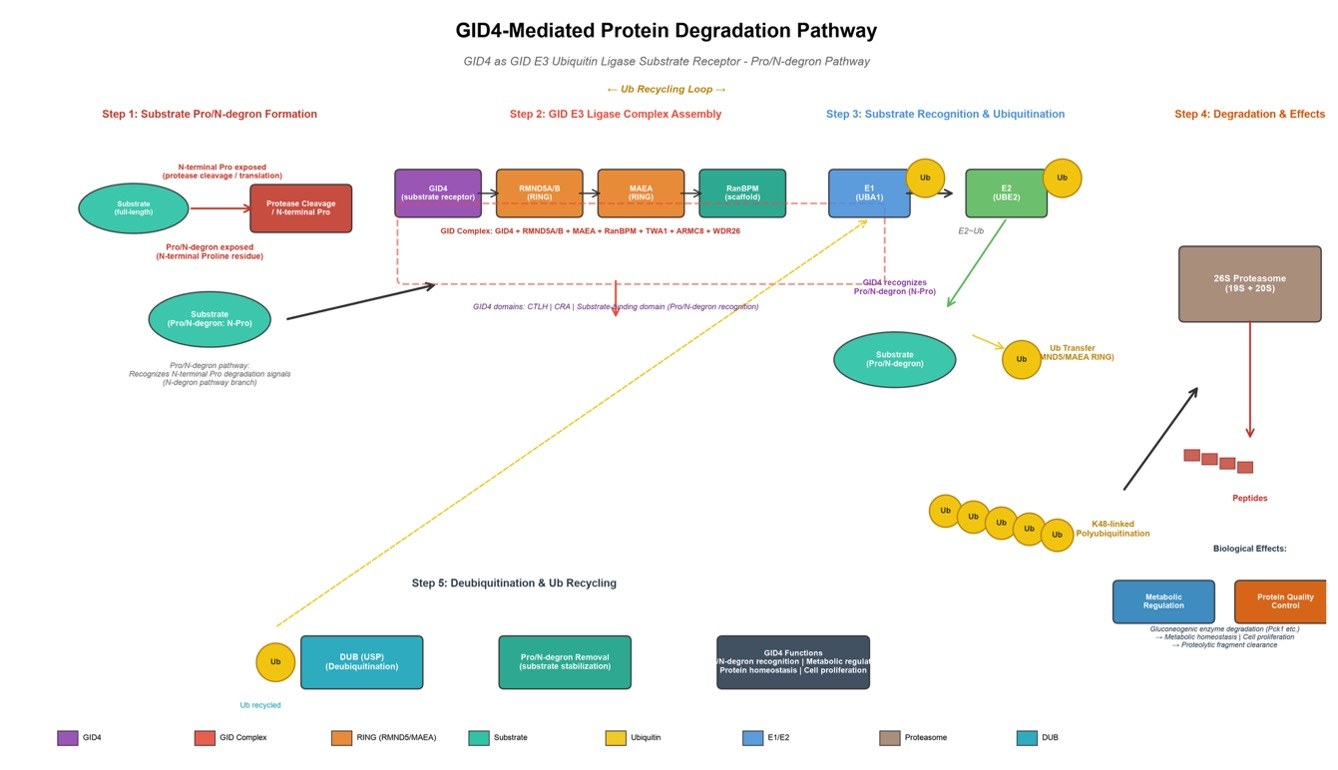 Fig.1 The GID4-mediated protein degradation.