KLHL41 based Protein Degrader Ligand Screening Service
BackgroundWhat We Can Offer?WorkflowWhy Us?FAQRelated Services
At Creative Biolabs, we pioneer specialized platforms for targeted protein degradation (TPD), leveraging underutilized E3 ubiquitin ligases to bypass conventional drug discovery limitations. Our KLHL41-Based Protein Degrader Ligand Screening Service provides an end-to-end framework designed to discover, validate, and optimize small-molecule and peptide-based recruiting elements for Kelch-like protein 41 (KLHL41). By integrating high-throughput biophysical screens with computational modeling and structural biology, we enable biopharmaceutical researchers to construct novel heterobifunctional degradation architectures capable of precise target clearance.
Background of KLHL41 in Protein Degradation
Kelch-like protein 41 (KLHL41), also known as KBTBD10, is a substrate-recognition adaptor for the Cullin 3 (CUL3)-RING ubiquitin ligase complex (CRL3KLHL41). Structurally characterized by its N-terminal BTB/POZ domain, a central BACK domain, and a C-terminal 6-blade β-propeller Kelch domain, KLHL41 utilizes its Kelch domain cavity to selectively bind client proteins. Exploiting KLHL41 as an E3 ligase engine offers crucial pharmacological benefits:
Skeletal Muscle-Enriched Expression: Unlike ubiquitously expressed E3 adaptors such as CRBN or VHL, KLHL41 expression is predominantly restricted to skeletal muscle tissue. This offers a pathway for tissue-selective protein degradation, mitigating systemic off-target toxicities in non-muscle tissues.
Resistance Bypass: Provides an alternative degradation mechanism in cellular environments where traditional E3 ligase pathways are mutated, downregulated, or pharmacologically desensitized.
Defined Ligandable Pocket: The deep, pocketed surface of the Kelch β-propeller architecture provides a structurally well-defined cavity suitable for high-affinity non-covalent or electrophilic covalent small-molecule ligands.
Fig.1 The KLHL41-mediated protein degradation.
How Creative Biolabs' KLHL41 based Protein Degrader Ligand Screening Service Can Assist Your Project?
Novel Chemical Space Identification: Discovering high-affinity small-molecule binders that engage KLHL41 without disrupting the core CUL3-RBX1-E3 complex assembly.
Ternary Complex Cooperativity (α): Profiling and optimizing the productive arrangement of the target protein, bifunctional degrader, and KLHL41 to ensure rapid ubiquitination kinetics (DC50) and maximum degradation depth (Dmax).
Exit Vector & Linker Geometry Mapping: Pinpointing accessible conjugation sites on KLHL41-binding recruits to guide the rational design of linkers with optimal length, flexibility, and physicochemical properties.
Tissue-Specific Degrader Profiling: Validating that target clearance remains confined to KLHL41-expressing cell lineages, safeguarding systemic safety profiles.
Workflow of KLHL41 based Protein Degrader Ligand Screening Service
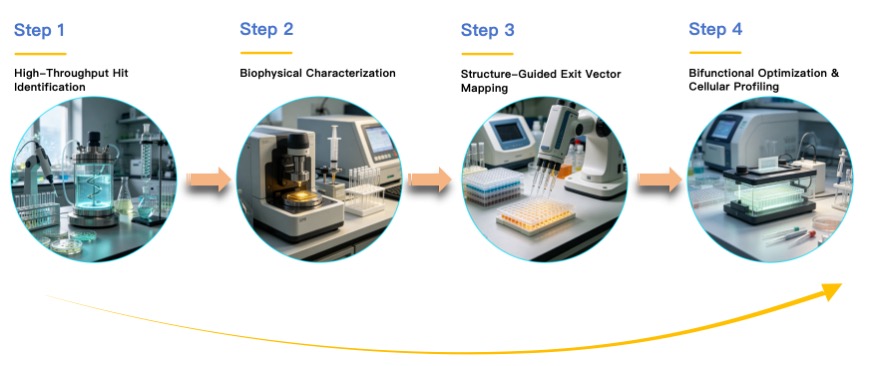
Creative Biolabs employs a step-by-step modular workflow to guide projects from initial hit discovery through cell-based degradation profiling.
Stage 1
High-Throughput Hit Identification
Screening diverse chemical collections, DNA-Encoded Libraries (DEL), or focused peptidomimetic libraries using Fluorescence Polarization (FP).
Stage 2
Biophysical Characterization
Determining precise binding affinities (KD) and kinetic parameters (Kon, Koff) via Surface Plasmon Resonance (SPR), Isothermal Titration Calorimetry (ITC), and MicroScale Thermophoresis (MST). Counter-screens against structurally adjacent Kelch adaptors (e.g., KEAP1, KLHDC2) ensure target specificity.
Stage 3
Structure-Guided Exit Vector Mapping
Utilizing X-ray crystallography or Cryo-EM to resolve atomic-level co-complex structures of KLHDC41 bound to candidate ligands, highlighting optimal points for linker attachment without sacrificing E3 binding capacity.
Stage 4
Bifunctional Optimization & Cellular Profiling
Assembling bifunctional degrader constructs and validating target clearance, proteasome dependence, and kinetic degradation profiles in relevant cell lines using Western Blotting and quantitative mass-spectrometry proteomics.
Advantages of Our Services
Optimized E3 Binding Assays
Tailored biophysical and biochemical platforms built specifically around the CUL3-KLHL41 interface.
In-House Structural Biology Engine
Rapid co-crystallization platforms that translate raw screening hits into actionable 3D structural data for structure-based drug design (SBDD).
Broad Library Diversity
Direct access to DEL technology, fragment libraries, and synthetic peptide/peptidomimetic collections.
End-to-End Execution
Seamless integration across computational screening, synthetic chemistry, biophysical kinetic evaluation, and cellular degradation assays.
Frequently Asked Questions
Q1: What distinct advantages does KLHL41 offer compared to ubiquitous E3 ligases like CRBN or VHL?
A: KLHL41 exhibits muscle-enriched tissue expression. Utilizing KLHL41 as a recruiting module allows researchers to restrict target protein degradation to skeletal muscle cells, mitigating potential toxicities caused by systemic target depletion in healthy non-muscle tissue.
Q2: Can Creative Biolabs identify covalent ligands for KLHL41?
A: Yes. We offer electrophilic library screening platforms aimed at identifying targeted covalent ligands that form irreversible bonds with reactive residues in the KLHL41 binding pocket, driving sub-nanomolar cellular degradation potencies.
Q3: How is cellular target clearance verified as KLHL41-dependent?
A: We validate mechanism-of-action using CRISPR/Cas9-mediated KLHL41 knockouts, RNAi knockdowns, ubiquitin-proteasome system inhibitors, and competitive E3 ligand pre-treatments to confirm that target depletion relies strictly on functional KLHL41 engagement.
Accelerate your tissue-selective targeted protein degradation programs with Creative Biolabs. Contact our scientific experts today to discuss your project specifications or to request a customized quote for our KLHL41-Based Protein Degrader Ligand Screening Service.
Contact Our Team for More Information and to Discuss Your Project →


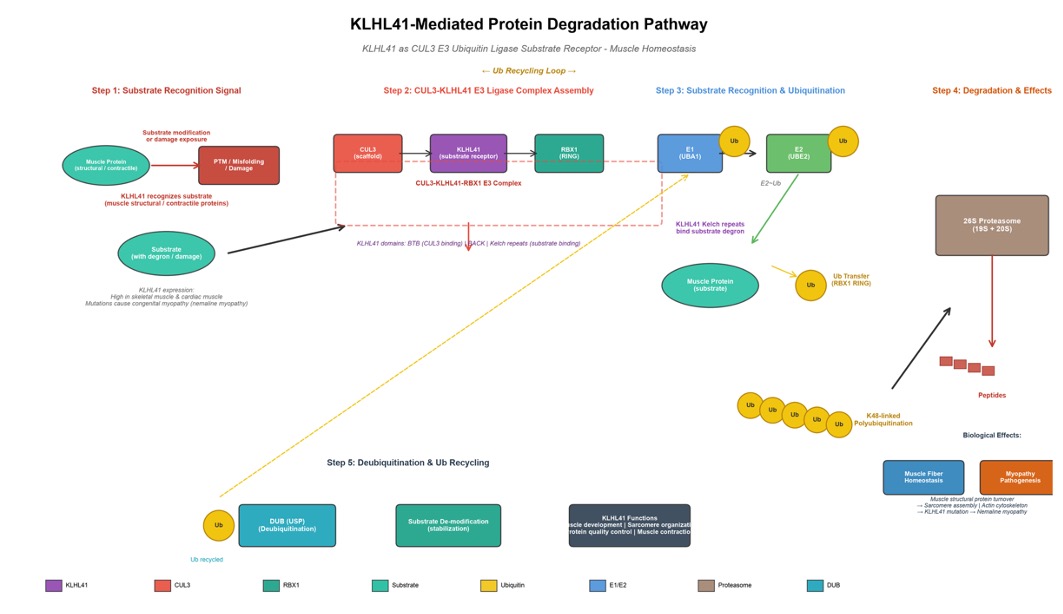 Fig.1 The KLHL41-mediated protein degradation.