TRIM21 based Protein Degrader Ligand Screening Service
BackgroundWhat We Can Offer?WorkflowWhy Us?FAQRelated Services
Standing at the forefront of bio-therapeutic innovations, Creative Biolabs delivers specialized targeted protein degradation (TPD) platforms engineered to exploit novel E3 ubiquitin ligases. As a core segment of our Novel E3 Ligase Ligand Screening Services, our TRIM21-based Protein Degrader Ligand Screening Service integrates advanced ligand discovery, antibody-based recruiter engineering, and biophysical profiling focused on Tripartite motif-containing protein 21 (TRIM21). We empower global biotechnology partners to leverage TRIM21's extraordinary cytosolic ubiquitinating power, facilitating the rapid development of next-generation heterobifunctional and antibody-guided degraders.
Background of TRIM21 in Protein Degradation
Tripartite motif-containing protein 21 (TRIM21) is a cytosolic RING-type E3 ubiquitin ligase that plays a fundamental role in intracellular innate immunity, protein quality control, and autoimmune regulation. Structurally, TRIM21 features an N-terminal RING domain responsible for E2-ubiquitin conjugation, a B-box domain, a coiled-coil dimerization domain, and a C-terminal PRYSPRY domain. In nature, TRIM21 acts as an extraordinarily potent cytosolic antibody receptor. The PRYSPRY domain binds to the Fc region of immunoglobulins (IgG) with nanomolar to picomolar affinity (KD ≈ 0.6 nM), making TRIM21 one of the highest-affinity monomeric antibody receptors in the human proteome. Upon binding an antibody-bound target protein, TRIM21 undergoes rapid auto-ubiquitination and recruits the proteasome, triggering swift, catalytic degradation of both the target protein and the bound antibody complex. This natural mechanism serves as the foundation for modern Trim-Away technology and customized antibody-based degrader architectures.
In the protein degrader design, TRIM21 presents great advantages:
Rapid Proteolytic Kinetics: TRIM21 operates with remarkable catalytic speed. Upon forming a productive ternary complex, target protein clearance frequently occurs within minutes, markedly outperforming the degradation velocity of CRBN- or VHL-based systems.
Broad Molecule Diversity: The PRYSPRY domain's distinct architecture accepts diverse recruiter formats-ranging from small synthetic molecules and Fc-mimetic peptides to full-length antibodies, Fab fragments, and single-domain antibodies.
Ubiquitous Cellular Presence: TRIM21 maintains high, functional expression across virtually all human cell lines and organ systems (including neural, pulmonary, hepatic, and hematological tissues), ensuring broad clinical applicability.
Bypassing Ligand Druggability Limits: Where conventional TPD requires high-affinity small-molecule binders for both the target and the ligase, TRIM21 platforms can utilize engineered protein domains or antibody fragments, drastically shortening early-stage discovery timelines.
Reversal of CRBN/VHL Refractory Phenotypes: Engaging TRIM21's distinct RING-mediated ubiquitin-conjugating (E2) cascade completely bypasses resistance mechanisms caused by CRBN or VHL loss-of-function mutations in relapsed disease models.
Reduced Susceptibility to Hook Effects: Owing to the ultra-high affinity and distinct stoichiometric assembly of the TRIM21 PRYSPRY domain with dimeric structures, TRIM21-mediated degradation frequently displays wider therapeutic windows with less pronounced binary hook effects.
Fig.1 The TRIM21-mediated protein degradation.
How Creative Biolabs' TRIM21 based Protein Degrader Ligand Screening Service Can Assist Your Project?
Unlocking a non-canonical E3 ligase like TRIM21 demands specialized proficiency in protein-protein interaction (PPI) analysis, chemoproteomics, and biophysical kinetics. Creative Biolabs functions as a seamless technical extension to your team, guiding your TRIM21 recruiter discovery campaign through every critical milestone:
De Novo Recruiter & Fc-Mimetic Discovery: Utilizing multi-billion compound DNA-encoded libraries (DELs), targeted peptide collections, and structure-guided computational docking, we identify novel non-antibody small-molecule and synthetic peptide recruiters that bind the TRIM21 PRYSPRY domain with high specificity.
Engineered Antibody & VHH Conjugation Platforms: For targets lacking small-molecule binders, we assist in converting existing antibodies, Fab fragments, or single-domain antibodies into potent TRIM21-recruiting degradation agents.
Overcoming Resistance & Securing Commercial FTO: We enable sponsors to rebuild therapeutic efficacy in CRBN/VHL-resistant cell models while establishing strong, proprietary intellectual property portfolios.
Ternary Complex Cooperativity (α) Optimization: Degradation potency relies heavily on stable ternary complex assembly rather than simple binary binding. We characterize POI–Degrader–TRIM21 ternary dynamics in real time to guide optimal linker composition and conjugation vectors.
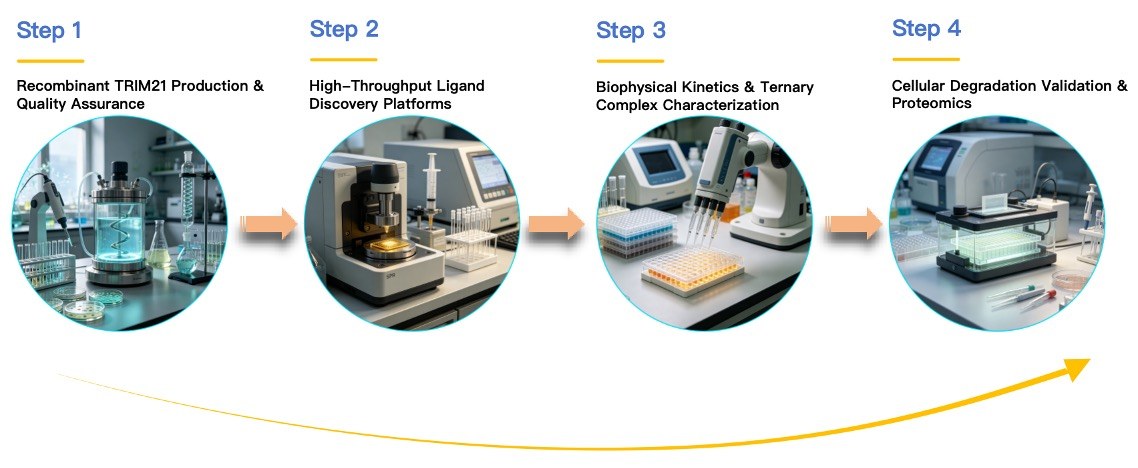
Compressed Discovery Timelines: By consolidating recombinant TRIM21 domain production, high-throughput biophysical affinity mapping, custom synthetic conjugation, and cellular degradation validation under one roof, we significantly accelerate your hit-to-lead timeline.
Workflow of TRIM21 based Protein Degrader Ligand Screening Service
Stage 1
Recombinant TRIM21 Production & Quality Assurance
Expression of full-length TRIM21, isolated PRYSPRY domain, or RING-finger constructs across mammalian, insect, and bacterial systems.
Rigorous purity, folding, and functional validation via SEC-MALS, SDS-PAGE, and mass spectrometry to ensure native ligand-binding competence.
Peptide & Fragment-Based Screening: Deploying specialized peptide libraries and fragment screens via Surface Plasmon Resonance (SPR) and NMR to identify subtle chemical hits.
In Silico / Structure-Based Virtual Screening: Docking chemical collections into high-resolution structural models of the TRIM21 PRYSPRY binding pocket.
Affinity & Kinetic Profiling: Quantifying binding parameters (KD, kon, koff) using SPR, TR-FRET, Fluorescence Polarization (FP), and MicroScale Thermophoresis (MST).
Ternary Complex Cooperativity (α) Assessment: Evaluating the formation, stability, and kinetics of the POI–Degrader–TRIM21 complex in real time.
Structural Analysis: Utilizing X-ray crystallography and cryo-EM platforms to map binding interactions and direct rational linker attachment vectors.
Stage 4
Cellular Degradation Validation & Proteomics
Conjugation of lead TRIM21 recruiters (small molecules, peptides, or VHHs) to POI-targeting ligands using customized linker libraries.
Quantitative cellular evaluation (DC50, Dmax) via Western Blotting and multiplexed quantitative proteomics (TMT-MS) to confirm rapid target depletion and global proteomic safety.
Advantages of Our Services
Exploring emerging E3 ligases like TRIM21 brings unique technical hurdles. Creative Biolabs blends deep expertise in cytosolic ubiquitin biology with high-caliber chemical synthesis and biophysical validation. Our services are designed to be supportive, not mechanical. Choose a team that truly understands your R&D pain points, and watch your program progress with greater ease.
Pioneering TRIM21 & Trim-Away Expertise
Deep technical command over PRYSPRY domain biophysics, cytosolic antibody-driven proteolysis, and non-small-molecule recruitment modalities.
Broad Recruiter Modality Coverage
Fully equipped to identify, characterize, and optimize diverse TRIM21-binding entities—spanning synthetic chemical fragments, Fc-mimetic peptides, single-domain antibodies, and full-length antibody constructs.
Streamlined Reagent Inventory
Direct access to purified, structurally validated TRIM21 PRYSPRY domain batches and established bio-layer interferometry (BLI)/SPR assay systems, minimizing upfront biological preparation phases.
Kinetically Driven Ternary Profiling
Early prioritization of real-time assembly dynamics and binding cooperativity (α) ensures only molecules capable of driving rapid target clearance progress into synthesis.
Fully Integrated Discovery Engine
Single-site execution spanning primary hit selection, custom linker conjugation, structural modeling, and cell-based degradation profiling to prevent inter-vendor delays.
Complete Intellectual Property Autonomy
Unconditional client ownership over all newly discovered recruiters, conjugated bifunctional structures, kinetic datasets, and screening outcomes.
Frequently Asked Questions
Q: How does the TRIM21 degradation mechanism differ from classical Cullin-RING ligase platforms?
A: Unlike membrane- or nuclear-bound Cullin complexes that require specific protein-subunit assemblies, TRIM21 acts as a standalone cytosolic receptor with extremely fast auto-ubiquitination kinetics. Recruiting TRIM21 often results in significantly faster target clearance (DC50 reached within minutes) and works effectively across nearly all cell types without relying on complex-specific co-factors.
Q: What types of recruiter formats can be screened using your TRIM21 platform?
A: Our platform evaluates both chemical and biological binders. This includes small-molecule hit discovery against the PRYSPRY domain, synthetic Fc-mimetic peptides, engineered antibody Fc variants, Fab fragments, and single-domain antibodies (VHH), allowing complete flexibility based on your target's druggability.
Q: Can Creative Biolabs validate TRIM21 degraders against targets that lack known small-molecule binders?
A: Absolutely. One of the primary strengths of our TRIM21 service is the ability to utilize antibody- or VHH-guided recruitment (Trim-Away approach). We can conjugate target-recognizing antibody fragments directly to TRIM21-recruiting moieties, bypassing the need for traditional small-molecule target ligands.
Q: Which analytical methods are employed to verify that a TRIM21 binder forms a stable, productive ternary complex?
A: We deploy real-time biophysical techniques, including Surface Plasmon Resonance (SPR) and MicroScale Thermophoresis (MST), to measure the thermodynamic stability, association/dissociation rates, and cooperativity factors (α) of the Target–Degrader–TRIM21 complex.
Creative Biolabs delivers customized screening strategies, advanced biophysical assay platforms, and dedicated scientific collaboration to accelerate your drug discovery goals. Please do not hesitate to contact us for more information.
Contact Our Team for More Information and to Discuss Your Project →


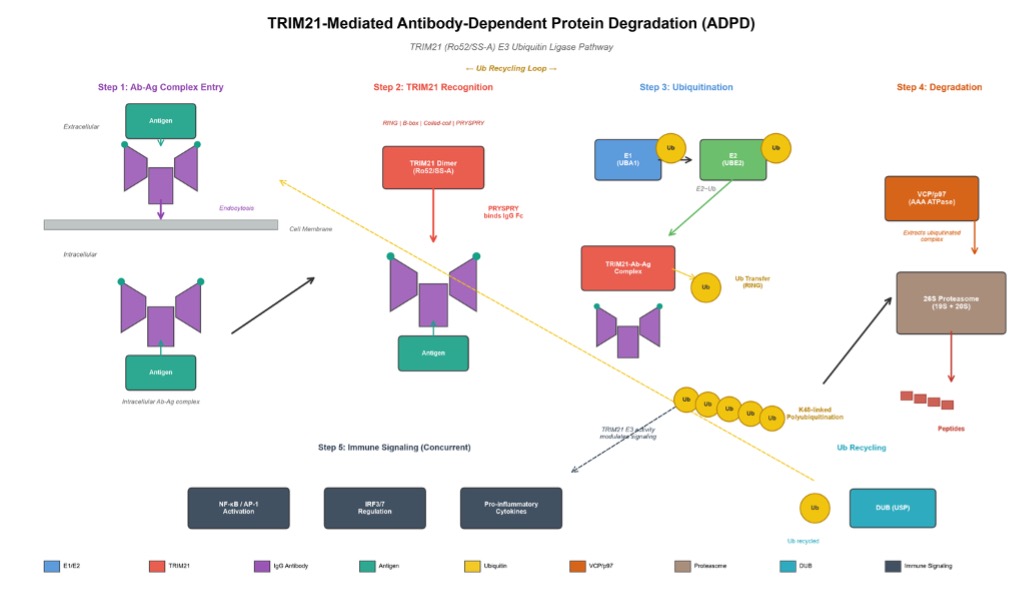 Fig.1 The TRIM21-mediated protein degradation.