Creative Biolabs is offering the most comprehensive services for antibody development projects. With strict regulation and effective execution, we are dedicated to providing the most valuable solutions to complete your projects.
HighlightsCreative Biolabs is offering the most comprehensive services for antibody development projects. With strict regulation and effective execution, we are dedicated to providing the most valuable solutions to complete your projects.
HighlightsCreative Biolabs has established a broad range of platforms for developing novel antibodies or equivalents. These cutting-edge technologies enable our scientists to meet your demands from different aspects and tailor the most appropriate solution that contributes to the success of your projects.
HighlightsWith deep understanding in antibody-related realms and extensive project experience, Creative Biolabs offers a variety of references to help you learn more about our capacities and achievements, including infographic, flyer, case study, peer-reviewed publications, and all kinds of knowledge that can assist your projects. You are also welcome to contact us directly for more specific solutions.
HighlightsGet a real taste of Creative Biolabs, one of the most professional custom service providers in the world. We are committed to providing highly customized comprehensive solutions with the best quality to advance your projects.
HighlightsAs a leading innovator in antibody development for over two decades, Creative Biolabs provides specialized anti-idiotypic antibody production services for detecting T cell receptors (TCRs). Our meticulously characterized antibodies offer exceptional specificity and binding affinity, empowering our clients with precise analytical tools. We help accelerate your research and development by providing bespoke reagents crucial for understanding T cell dynamics and immunotherapeutic efficacy.
Anti-idiotypic antibodies (anti-ID Abs) are a unique class of antibodies engineered to recognize the variable regions, or "idiotypes," of another antibody. These idiotypes represent the distinct antigen-binding sites, essentially serving as unique immunological fingerprints. Unlike typical antibodies that bind external antigens, Anti-ID Abs target these internal recognition elements, making them invaluable tools for studying complex immunological interactions and for drug monitoring.
TCRs typically consist of an αβ heterodimer in 95% of T cells, with the remaining 5% expressing a γδ heterodimer. This ratio fluctuates throughout ontogenesis and illness. For immunoglobulin molecules, the idiotype of each variable (V) region can comprise 15–20 idiotopes, distinguishable by anti-idiotypic monoclonal antibodies or unique amino acid sequences. If both heavy and light chain variable regions contribute to idiotypic determinants, the idiotype is likely conformational. Conversely, idiotypes located exclusively within either the heavy or light chain, and contained in their primary amino acid sequences, are more likely sequence-dependent, linear antigenic determinants. While hypervariable regions (CDRs) are considered the primary immunogenic sites within the variable region, any part of the immunoglobulin variable region can contribute to the idiotype structure.
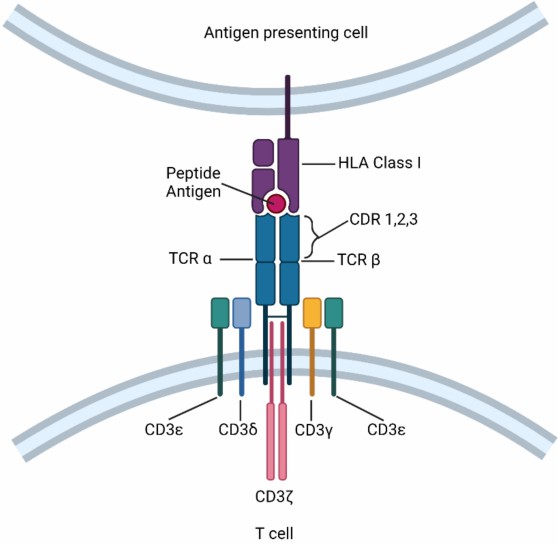 Fig.1 The structure of TCR.1, 3
By developing anti-ID Abs that bind directly to these TCR idiotypes, we can create powerful reagents capable of highly specific identification, quantification, or modulation of particular T cell clones. These reagents are instrumental in immunomonitoring, diagnostic development, and understanding the precise cellular mechanisms of action for novel immunotherapies.
Creative Biolabs offers a comprehensive TCR recognized anti-ID Ab discovery service tailored to your specific project needs. We initiate the discovery process by utilizing your target TCR in either scFv (single-chain variable fragment) form or by employing a carefully designed peptide that accurately represents the unique sequences of the variable domains of the TCR. Following immunization, our advanced strategy leverages robust immunized phage display libraries to isolate high-affinity anti-ID Abs. These meticulously selected anti-ID Abs are designed to bind specifically to the idiotypes, which are unique epitopes present in the variable regions of TCRs, ensuring the generation of reagents with unparalleled precision for your critical applications.
Please click here to see more custom Anti-Idiotypic Antibodies Production Services from Creative Biolabs to meet your specific requirements.
 Fig.2 Hypothesized idiotypic/anti-idiotypic interactions, T lymphocytes can be inhibited through anti-Id antibody binding to their T cell receptors.2, 3
The idiotypic network hypothesis suggests a regulatory function for the humoral immune response, where an 'idiotypic network' of interconnected lymphocytes and antibodies governs immune tolerance. The idiotope, an antibody's antigen-binding site, doubles as an epitope for other antibodies, thus giving rise to anti-Id antibodies that mediate peripheral tolerance. Emerging evidence suggests that anti-Id antibodies may target TCR in neonatal mice to modulate early T lymphocyte repertoire development. The potential involvement of maternally-derived idiotypic/anti-idiotypic interactions in neutralizing maternal autoantibodies and influencing neonatal lymphocyte profiles may elucidate why neonates, despite circulating high levels of maternal autoantibodies, do not exhibit increased autoimmune susceptibility. This maternal influence likely contributes to the reduced participation of these autoantibodies in triggering autoimmune conditions during early life, highlighting a crucial mechanism of immune tolerance and repertoire shaping in neonates.
Our stringent screening and selection protocols ensure the anti-ID Abs exhibit superb specificity for the target TCR idiotype and demonstrate high binding affinity, crucial for sensitive assays.
We accommodate diverse starting materials, whether it's a complete TCR scFv or a synthetic peptide representing key variable domains, optimizing the immunization strategy for optimal results.
Leveraging our extensive experience with immunized phage display libraries allows for the rapid and efficient isolation of diverse anti-ID Ab candidates with desired characteristics.
Our optimized workflow and dedicated project management ensure efficient progress from target preparation to antibody delivery, accelerating your research milestones.
Beyond discovery, we offer a range of antibody modification services, including labeling, conjugation, or format conversion, to precisely meet your downstream application requirements.
Our established track record in complex antibody discovery projects translates into a consistently high success rate for generating functional, high-quality anti-ID Abs recognizing TCRs.
Creative Biolabs provides you with high-level anti-idiotypic antibody production services for detecting T cell receptors. We have first-class technology and rich experience to help you develop antibody drugs.
All listed services and products are For Research Use Only. Do Not use in any diagnostic or therapeutic applications.