- Home
- ADC Development
- ADC In Vitro Analysis
- ADC In Vitro Efficacy Evaluation: Comprehensive Binding, Internalization & Cytotoxicity Assays
- ADC Fc Cytotoxicity Evaluation: Comprehensive ADCC, CDC & ADCP Assays
ADC Fc Cytotoxicity Evaluation: Comprehensive ADCC, CDC & ADCP Assays
Antibody-drug conjugates (ADCs) achieve targeted cancer cell killing primarily through payload cytotoxicity after internalization. However, the antibody Fc region also contributes significantly to anti-tumor efficacy through effector functions. Creative Biolabs provides comprehensive ADC Fc cytotoxicity evaluation services to characterize antibody-dependent cellular cytotoxicity (ADCC), complement-dependent cytotoxicity (CDC), and antibody-dependent cellular phagocytosis (ADCP). Our advanced platforms enable thorough assessment of Fc-mediated effector activities, supporting optimized ADC design for enhanced in vivo therapeutic efficacy in pre-clinical research.
Inquire About Fc Cytotoxicity AnalysisOverview: Fc-Mediated Effector Functions in ADC Efficacy
ADC efficacy is traditionally attributed to the cytotoxic payload delivered into target cells upon internalization. However, accumulating evidence demonstrates that the antibody Fc region plays a crucial role in anti-tumor activity through engagement with immune effector cells and complement systems. These Fc-mediated effector functions provide a "secondary" killing mechanism that complements direct payload cytotoxicity, particularly in solid tumors with heterogeneous antigen expression.
Three Primary Fc Effector Mechanisms
Understanding and optimizing Fc effector functions is increasingly recognized as essential for maximizing ADC therapeutic index in pre-clinical development:
- • Antibody-Dependent Cellular Cytotoxicity (ADCC): Fc region engages FcγRIIIa (CD16) on natural killer (NK) cells and macrophages, triggering release of perforin and granzymes to induce target cell apoptosis.
- • Complement-Dependent Cytotoxicity (CDC): Fc region recruits complement protein C1q, initiating the classical complement pathway and forming membrane attack complexes (MAC) that lyse target cells.
- • Antibody-Dependent Cellular Phagocytosis (ADCP): Fc region binds FcγRI (CD64) and FcγRIIa (CD32a) on macrophages and dendritic cells, promoting opsonization and phagocytic clearance of target cells.
Clinical Relevance of Fc Effector Functions
Multiple FDA-approved ADCs (e.g., trastuzumab deruxtecan, brentuximab vedotin) benefit from Fc effector activity. Our Fc cytotoxicity evaluation services enable pre-clinical assessment of how antibody engineering (Fc glycosylation, point mutations) and conjugation chemistries impact these critical immune-mediated killing mechanisms.
Overcoming Challenges in Fc Cytotoxicity Evaluation
Accurate assessment of Fc-mediated effector functions in ADCs is technically demanding due to the complex interplay between antibody engineering, conjugation chemistry, and immune cell activation. Common challenges in pre-clinical characterization include:
- ▶ Conjugation-Induced Fc Masking: Drug loading and linker-payload attachment can sterically hinder FcγR or C1q binding, reducing effector function without affecting antigen binding affinity.
- ▶ Assay Standardization: Variability in effector cell sources (PBMCs vs. isolated NK cells), target cell lines, and readout methods (LDH release vs. flow cytometry) complicates cross-study comparisons.
- ▶ Fc Glycosylation Impact: Heterogeneous N-glycan profiles at Asn297 significantly influence ADCC/ADCP activity, requiring analytical integration with binding assays for comprehensive characterization.
ADC Fc Cytotoxicity Evaluation Services
We provide comprehensive Fc-mediated effector function analysis services tailored to your ADC development needs. Our integrated assay platforms enable accurate evaluation of ADCC, CDC, and ADCP activities, delivering actionable data for pre-clinical ADC optimization.
Tailored Fc Effector Analysis for Your Research
Every ADC project has unique Fc engineering and conjugation requirements. Our services can be customized to match your specific antibody isotype, target antigen, and pre-clinical research objectives. Whether you need rapid screening of Fc point mutants or comprehensive multi-assay characterization of conjugation variants, we work with you to design the optimal evaluation strategy. Contact us to discuss your specific Fc cytotoxicity analysis needs.
| Service Name | Technical Specifications | Analysis Capabilities | Service Deliverables |
|---|---|---|---|
|
Primary Method ADCC Assay Service Comprehensive antibody-dependent cellular cytotoxicity evaluation using primary immune cells or engineered reporter systems. |
• Effector Cells: Primary NK cells, PBMCs, or engineered FcγR-expressing reporter cell lines. • Readout Methods: LDH release, Chromium-51 release, or Granzyme B ELISA. • Target Cells: Antigen-positive tumor cell lines or patient-derived cells. • Best For: FcγRIIIa affinity variants, NK cell activation assessment. |
• Dose-response curves with EC50 determination • FcγRIIIa V158/F158 allotype comparison • Correlation with Fc glycosylation profiles • High-content imaging option available |
• Cytotoxicity curves with EC50/Maximum Effect values • Effector-to-target (E:T) ratio optimization • Granzyme B/perforin release quantification • Comprehensive ADCC activity report |
|
Complement-Mediated CDC Assay Service Complement-dependent cytotoxicity evaluation via classical pathway activation and membrane attack complex formation. |
• Complement Source: Normal human serum (NHS) or purified C1q protein. • Detection Methods: Flow cytometry (C3b/iC3b deposition), LDH release, or propidium iodide (PI) uptake. • Target Cells: Complement-sensitive tumor cell lines with defined CD55/CD59 expression. • Best For: IgG isotype selection, C1q binding affinity assessment. |
• C3b/iC3b deposition quantification • Membrane attack complex (MAC) formation analysis • Complement resistance factor assessment • IgG subclass comparison (IgG1 vs. IgG3) |
• CDC dose-response curves with CDC50 values • Complement titer optimization report • C3b deposition flow cytometry data • Comprehensive CDC activity summary |
|
Phagocytosis-Focused ADCP Assay Service Antibody-dependent cellular phagocytosis evaluation using primary macrophages or macrophage-like cell lines. |
• Phagocyte Source: Primary human macrophages, THP-1 differentiated macrophages, or engineered FcγR-expressing cell lines. • Readout Methods: Flow cytometry (pHrodo-labeled target cells), high-content imaging, or phagocytic index calculation. • Target Cells: Antigen-positive tumor cells with or without opsonization tracking. • Best For: FcγRIIa/FcγRI affinity optimization, macrophage recruitment assessment. |
• Phagocytic index quantification • FcγRI/IIa/IIIa contribution analysis • Time-lapse phagocytosis kinetics • Macrophage activation marker assessment |
• Phagocytosis dose-response curves • High-content imaging videos/images • FcγR blocking antibody validation • Comprehensive ADCP activity report |
|
Advanced Characterization Fc Binding & Glycosylation Analysis Integrated FcγR/C1q binding affinity assessment coupled with Fc glycosylation profiling for structure-activity relationship studies. |
• Binding Assays: Surface plasmon resonance (SPR) or flow cytometry-based FcγR/C1q binding kinetics. • Glycosylation Analysis: LC-MS/MS N-glycan profiling at Asn297, including fucosylation and sialylation quantification. • Correlation Analysis: Integrated data analysis linking glycosylation patterns to effector function potency. • Best For: Fc engineering validation, biosimilar characterization. |
• FcγR/C1q binding affinity (KD) determination • N-glycan profile with % fucosylation • Structure-activity relationship analysis • Fc point mutation impact assessment |
• SPR sensorgrams with kinetic parameters • N-glycan chromatograms and quantification • Correlation matrix (glycan vs. effector function) • Comprehensive Fc characterization report |
Custom Fc Analysis Services
Fc Engineering Validation
Custom assay development for Fc point mutants (e.g., G236A/S239D, A330L/I332E) to validate enhanced effector function. Comparative analysis against wild-type IgG1 controls.
Conjugation Impact Assessment
Side-by-side comparison of Fc effector functions before and after conjugation to assess drug loading impact. Critical for optimizing DAR to preserve immune cell recruitment.
In Vivo Correlation Study
Integrated in vitro Fc effector data with in vivo efficacy in murine tumor models. Correlation analysis between ADCC/CDC activity and anti-tumor response.
Regulatory Package Support
Comprehensive Fc characterization reports formatted for regulatory submission, including assay validation data, system suitability records, and mechanism of action documentation.
Standardized Workflow for Fc Cytotoxicity Evaluation
Our streamlined pre-clinical workflow ensures data integrity, reproducibility, and comprehensive Fc effector function characterization from sample receipt to final reporting:
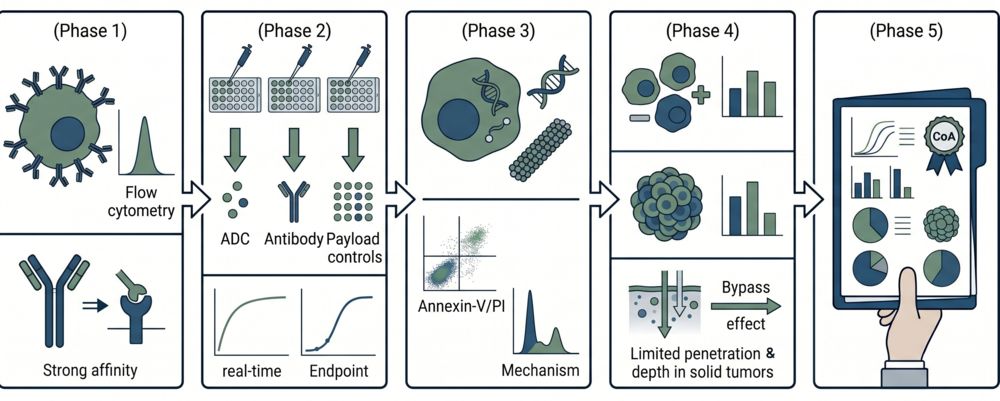
Phase 1: Sample Receipt & Quality Assessment
Upon sample receipt, we conduct initial quality checks including concentration determination (A280), purity assessment (SEC-HPLC), and Fc integrity verification. This ensures the ADC sample retains functional Fc region for downstream effector function analysis.
Phase 2: FcγR/C1q Binding Affinity Assessment
SPR-based kinetic analysis of FcγRI/IIa/IIIa and C1q binding to assess conjugation impact on Fc-mediated immune cell recruitment. Baseline binding parameters established before functional assays.
Phase 3: Multi-Assay Effector Function Profiling
Parallel evaluation using ADCC (LDH release or flow cytometry), CDC (C3b deposition), and ADCP (pHrodo labeling) assays. This comprehensive approach captures the full spectrum of Fc-mediated killing mechanisms.
Phase 4: Fc Glycosylation Correlation Analysis
LC-MS/MS N-glycan profiling at Asn297 to correlate specific glycoforms (e.g., afucosylation) with enhanced ADCC/ADCP activity. Critical for Fc engineering validation and biosimilar characterization.
Phase 5: Comprehensive Reporting & Data Integration
Delivery of a complete Fc cytotoxicity report including binding kinetics, effector function dose-response curves, glycosylation profiles, and integrated mechanism of action summary. Expert interpretation supporting your pre-clinical ADC development decisions.
Advanced Platforms for Fc Cytotoxicity Evaluation
Our multi-platform approach ensures comprehensive assessment of Fc-mediated effector functions across diverse ADC architectures and Fc engineering variants:
1. ADCC Assay Platform
A cornerstone platform for evaluating FcγRIIIa-dependent cellular cytotoxicity. Using primary NK cells or engineered reporter cell lines, this platform quantifies the ability of ADCs to recruit and activate immune effector cells for targeted tumor cell killing.
- • Primary NK Cell Co-culture: Autologous or allogeneic NK cells isolated from PBMCs for physiologically relevant ADCC assessment.
- • Engineered Reporter Systems: FcγRIIIa-expressing luciferase reporter cells for high-throughput screening of Fc variants.
- • Multiplex Readout: Simultaneous measurement of LDH release, Granzyme B secretion, and IFN-γ production for comprehensive immune activation profiling.
2. CDC Assay Platform
Employs classical complement pathway activation to assess C1q binding and membrane attack complex (MAC) formation. Essential for IgG isotype selection and complement-mediated killing mechanism validation.
- • Complement Source Optimization: Normal human serum (NHS) titration to determine optimal complement activity for target cell lysis.
- • Flow Cytometry Detection: C3b/iC3b deposition and C5b-9 (MAC) formation quantified by fluorescently labeled antibodies.
- • Complement Resistance Assessment: CD55/CD59 expression profiling on target cells to predict CDC sensitivity and resistance mechanisms.
3. ADCP Assay Platform
Specialized platform for evaluating FcγR-dependent phagocytosis using primary macrophages or macrophage-like cell lines. Critical for assessing ADC ability to promote opsonization and clearance of target cells.
- • pHrodo-Labeled Target Cells: pH-sensitive dye that fluoresces upon phagolysosome acidification, enabling real-time phagocytosis tracking.
- • High-Content Imaging: Automated microscopy for phagocytic index calculation and morphological assessment of macrophage activation.
- • FcγR Blocking Validation: FcγRI/IIa/IIIa-specific blocking antibodies to confirm receptor contribution to phagocytic clearance.
4. Fc Binding & Glycosylation Analysis Platform
Integrates biophysical characterization (SPR) with N-glycan profiling (LC-MS/MS) to establish structure-activity relationships between Fc modifications and effector function potency.
- • SPR-Based Kinetic Analysis: Real-time FcγR/C1q binding affinity (KD) and kinetics (kon/koff) determination.
- • N-Glycan Profiling: LC-MS/MS identification and quantification of Fc glycans, including fucosylation, sialylation, and high-mannose species.
- • Correlative Data Analysis: Statistical modeling linking specific glycoforms to enhanced ADCC/ADCP activity for Fc engineering guidance.
Why Choose Our ADC Fc Cytotoxicity Evaluation Services?
Comprehensive Fc Effector Profiling
We evaluate all three major Fc-mediated killing mechanisms (ADCC, CDC, ADCP) using orthogonal assay platforms, ensuring comprehensive characterization of antibody effector functions in your pre-clinical ADC candidates.
Integrated Glycosylation Analysis
Our unique platform combines functional effector assays with Fc N-glycan profiling, enabling structure-activity relationship studies and optimization of Fc engineering strategies for enhanced in vivo efficacy.
Conjugation Impact Assessment
We specialize in assessing how drug loading and linker-payload attachment affect Fc-mediated effector functions, enabling DAR optimization to balance direct cytotoxicity with immune cell recruitment.
Accelerated Turnaround for Pre-clinical Research
Our streamlined workflow and dedicated analytical team deliver comprehensive Fc cytotoxicity reports within 3-4 weeks, supporting fast-paced pre-clinical ADC development timelines and candidate selection decisions.
Research Insights: Evaluation of Fc-Mediated Effector Functions and Safety
According to Hoffmann et al. (2020), evaluating potential off-target or Fc-receptor-mediated cytotoxicity is a vital parameter in pre-clinical ADC characterization. Their research on a novel anti-CSPG4 ADC highlights the critical need to profile both target-specific efficacy and potential Fc-mediated safety liabilities.
Key Mechanistic Insights from CSPG4-PDD Research:
- • Fc-Receptor Binding Verification: Characterization of the anti-CSPG4-(PDD) ADC confirmed that stochastic conjugation to the mono-alkylating payload did not impair its binding affinity to Fc-receptor-expressing immune cells (using FcγR-high monocytic U937 and basophilic RBL-SX-38 models).
- • Absence of Fc-Mediated Off-Target Toxicity: Despite maintaining robust Fcγ-receptor binding, the ADC exhibited no cytotoxicity towards these non-target immune cells. This confirms that Fc-receptor-mediated engagement does not automatically trigger internalization or non-specific cell-killing, emphasizing the target selectivity of the construct.
- • Target-Dependent Internalization: In contrast to the safe immune-cell profile, the ADC demonstrated high potency (low nanomolar to picomolar range) specifically against CSPG4-expressing tumor cells, where Fab-mediated binding successfully induced receptor-mediated internalization and payload release.
These findings underscore the clinical importance of robust ADCC, CDC, and ADCP assays to ensure therapeutic candidates maximize tumor destruction while avoiding unintended immune system toxicity.
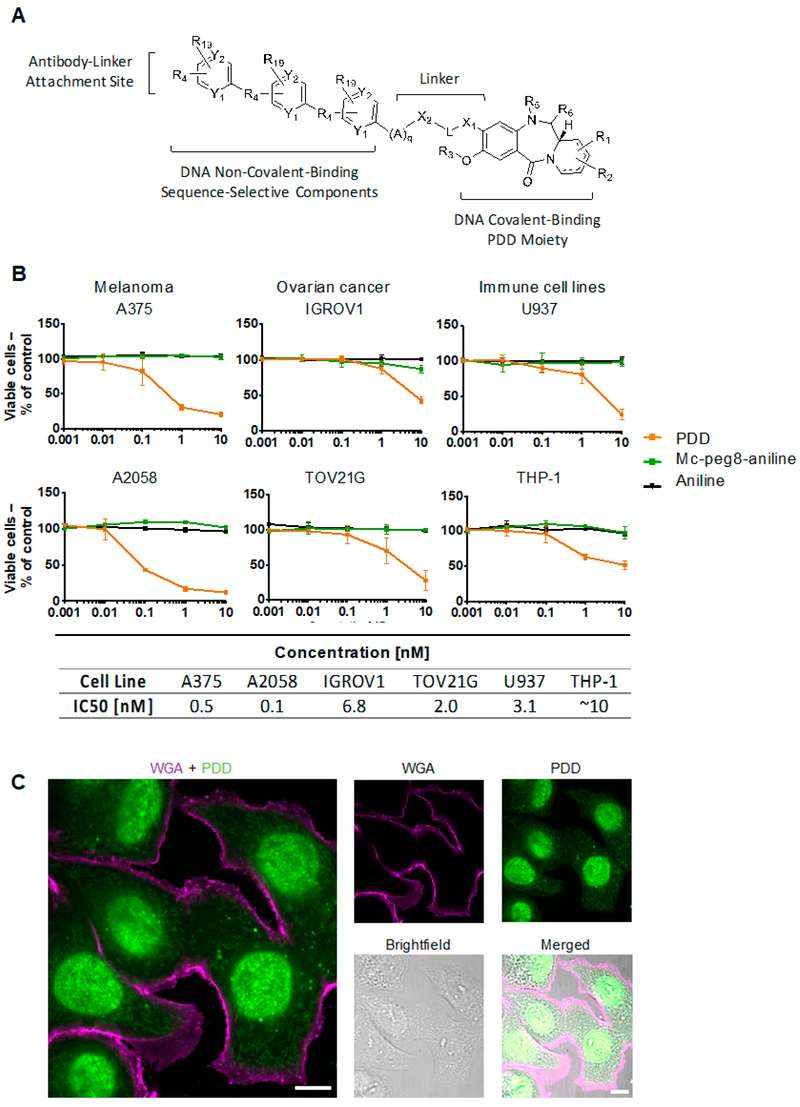
Fig.1 Structure, cytotoxicity profile and subcellular localization of the novel payload PDD.1,2
FAQs about ADC Fc Cytotoxicity Evaluation
Q: Why is Fc cytotoxicity evaluation important for ADC pre-clinical development?
A: Fc-mediated effector functions (ADCC, CDC, ADCP) provide a "secondary" killing mechanism that complements direct payload cytotoxicity. Optimizing Fc effector activity can enhance in vivo efficacy, particularly in tumors with heterogeneous antigen expression or limited internalization capacity.
Q: Can drug conjugation impact Fc-mediated effector functions?
A: Yes. High drug-to-antibody ratios (DAR > 6) or random conjugation can sterically hinder FcγR or C1q binding, reducing ADCC/CDC activity. Our conjugation impact assessment service evaluates how different DAR levels and conjugation site strategies affect Fc effector functions.
Q: What is the role of Fc glycosylation in ADC effector functions?
A: Fc N-glycans at Asn297 significantly influence ADCC/ADCP activity. Afucosylated glycans enhance FcγRIIIa binding affinity, augmenting NK cell-mediated killing. Our integrated glycosylation analysis platform correlates specific glycoforms with effector function potency for Fc engineering optimization.
Q: Do you provide Fc engineering validation services for ADCs?
A: Absolutely. We provide comprehensive Fc engineering validation, including point mutations (e.g., G236A/S239D, A330L/I332E) and glycoengineered variants. Our platform compares wild-type and engineered Fc variants across ADCC, CDC, and ADCP assays to confirm enhanced effector function.
Q: How much ADC sample is required for comprehensive Fc cytotoxicity evaluation?
A: For a complete Fc cytotoxicity package (ADCC + CDC + ADCP + Fc glycosylation), we typically require 1-2 mg of purified ADC. For individual assays, 200-500 µg is sufficient. Contact us if your sample is limited—we can optimize assays for low-input pre-clinical samples.
Other ADC In Vitro Evaluation Services
Related Products
Related Resources

References:
1. Hoffmann, Ricarda M., et al. "A Novel Antibody-Drug Conjugate (ADC) Delivering a DNA Mono-Alkylating Payload to Chondroitin Sulfate Proteoglycan (CSPG4)-Expressing Melanoma." Cancers. 12.4 (2020): 1029. https://doi.org/10.3390/cancers12041029
2. Distributed under Open Access License CC BY 4.0, without modification.
For Research Use Only. NOT FOR CLINICAL USE.
Online Inquiry
Welcome! For price inquiries, please feel free to contact us through the form on the left side. We will get back to you as soon as possible.
