Bacterial Antigen Design & Preparation
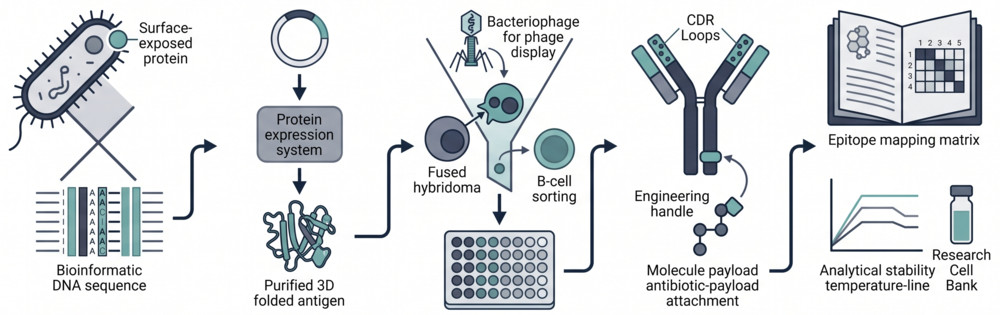
Successful antibody discovery begins with rational antigen selection. We identify and produce immunogenic bacterial targets that elicit therapeutically relevant antibody responses while avoiding tolerance mechanisms.
- • Cell Surface Proteins: Cell-wall anchored proteins, outer membrane proteins, and surface-exposed virulence factors from Gram-positive and Gram-negative pathogens.
- • Secreted Toxins: Alpha-hemolysin, Panton-Valentine leukocidin, and other exotoxins that contribute to pathogenesis.
- • Capsular Polysaccharides: Highly conserved serotype-independent epitopes suitable for broad-spectrum therapeutic applications.
Antibody Discovery & High-Throughput Screening
We deploy complementary discovery technologies to maximize the probability of identifying rare antibodies with optimal developability profiles for AAC applications.
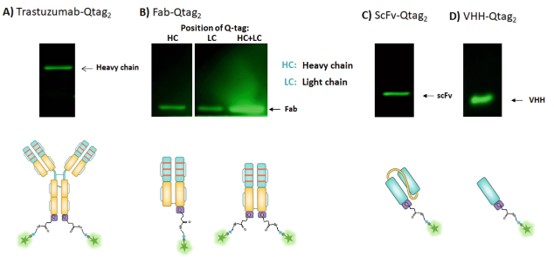
- • Phage Display: Naive and immune scFv/Fab libraries with diversities exceeding 1010 clones, enabling rapid isolation of fully human antibodies in vitro without immunization.
- • Hybridoma Technology: Classical mouse and rat hybridoma generation with optimized immunization protocols using live-attenuated bacteria, purified antigens, or DNA vaccination.
- • Single B Cell Screening: Microfluidics-enabled sorting of antigen-specific plasma cells directly from immunized donors, preserving native heavy-light chain pairing.
Antibody Engineering & Humanization
Raw discovery outputs require systematic optimization to ensure compatibility with human immune systems and AAC manufacturing requirements.
- • Complementarity-Determining Region Grafting: Preservation of antigen-binding affinity during conversion of murine antibodies to human frameworks.
- • Framework Selection: Human germline framework selection optimized for expression yield, stability, and reduced immunogenicity risk.
- • Developability Enhancement: Silencing of potential post-translational modification hotspots, removal of deamidation-prone sequences, and aggregation propensity reduction.
Pre-clinical Validation & Characterization
Comprehensive biophysical and functional characterization ensures that antibody candidates meet the stringent quality standards required for transition to conjugation and in vivo efficacy studies.
- • Surface Plasmon Resonance: Kinetic analysis of antigen binding with resolution of association and dissociation rate constants.
- • Epitope Mapping: Peptide tiling, hydrogen-deuterium exchange mass spectrometry, and competitive binding assays to define precise epitope location.
- • Cross-Reactivity Profiling: Testing against panels of clinical isolates, commensal strains, and human tissue samples.