- Home
- Resources
- Featured Solutions
- One-Stop ADC Development Solution
- Antibody Design and Conjugation Solution for ADC Development
- EnCys-mAb based Conjugation Strategy Solution
EnCys-mAb Based Conjugation Strategy Solution
Overcoming the inherent heterogeneity of traditional antibody-drug conjugates (ADCs) requires a fundamental shift in bioconjugation architecture. Creative Biolabs offers a cutting-edge EnCys-mAb based conjugation solution, leveraging precision antibody engineering to introduce reactive cysteine residues at optimized, non-interfering positions. By preserving native interchain disulfide bonds and targeting engineered "silent" thiols, we achieve near-perfect homogeneity (DAR 2.0 or 4.0) without compromising scaffold integrity. Our pre-clinical platform empowers researchers to develop site-selective conjugates with superior in vivo stability and predictable pharmacokinetics, setting a new benchmark for next-generation therapeutic candidates.
Inquire for Pre-clinical SupportOverview: Homogeneous ADCs via Engineered Cysteine Mutants
The EnCys-mAb (Engineered Cysteine Monoclonal Antibody) strategy represents a pinnacle in site-specific bioconjugation for pre-clinical discovery. Conventional cysteine conjugation relies on the partial reduction of interchain disulfide bonds, which can destabilize the antibody structure and produce a statistical mixture of species (DAR 0 to 8). In contrast, the EnCys-mAb approach utilizes site-directed mutagenesis to insert specific cysteine residues into the constant domains of the heavy or light chains. These engineered thiols provide precise "handles" for payload attachment while leaving the antibody's native structural disulfides intact.
Core Pillars of the EnCys-mAb Strategy
Our platform focuses on the "three-H" principle for pre-clinical success: Homogeneity, High-Stability, and Holistic-Integrity.
- • Precision Site Selection: We identify optimal residues where cysteine substitution does not interfere with antigen binding or Fc-mediated effector functions, often targeting positions like HC-A114C.
- • Superior Homogeneity: By controlling the number of engineered sites (typically 1 or 2 per chain), we produce conjugates with defined drug-to-antibody ratios, minimizing batch-to-batch variability.
- • Enhanced In Vivo Performance: Research indicates that conjugates with defined sites exhibit slower renal clearance and improved therapeutic indexes compared to their heterogeneous counterparts in in vivo models.
Comparative Analysis: EnCys-mAb vs. Traditional Cysteine Methods
| Feature | Random Interchain Cysteine | EnCys-mAb Strategy (Our Solution) |
|---|---|---|
| Scaffold Status | Native IgG (Reduced) | Engineered IgG (Site-Specific) |
| DAR Distribution | Heterogeneous (DAR 0-8) | Homogeneous (Defined 2 or 4) |
| Interchain Disulfides | Partially broken/re-bridged | Completely Intact (Native) |
| Stability (Maleimide Exchange) | Variable (High exchange risk) | Tunable (Optimized site-protection) |
| Analytical Complexity | High (Multi-species profiling) | Streamlined (Single-peak HIC) |
Solving the "Cysteine Bottleneck" in ADC Development
While thiol chemistry is highly efficient, its application in native antibodies often faces significant hurdles that impact the reliability of in vitro and in vivo data:
- ▶ Structural Weakening: Traditional reduction methods disrupt the covalent linkage between heavy and light chains, potentially leading to aggregation or half-antibody formation.
- ▶ Maleimide Instability: Payloads attached to highly solvent-accessible interchain cysteines can undergo thiol-exchange with serum albumin in vivo, leading to premature toxicity.
- ▶ Pharmacokinetic Variability: Heterogeneous mixtures produce unpredictable PK profiles, as differently loaded species clear at different rates in pre-clinical studies.
Comprehensive EnCys-mAb Conjugation Matrix
Our pre-clinical custom development services for ADCs and other bioconjugates provide a one-stop solution based on the EnCys-mAb platform. We ensure high homogeneity, stability, and controlled DAR through the following specialized modules:
Molecular Evaluation & Strategy Design
Critical assessment to identify the most effective engineering path for pre-clinical leads.
- • Feasibility analysis of antibody and protein scaffolds.
- • Identification of accessible cysteine sites via structural mapping.
- • Linker-payload compatibility and environment matching.
- • Route recommendation based on target DAR goals.
EnCys-mAb Engineering & Development
Precision site-directed mutagenesis and production of the high-fidelity antibody scaffold.
- • Design for single or dual cysteine mutation sites.
- • Vector construction and high-yield mammalian expression.
- • Pre-clinical developability and thermal stability assessment.
- • Screening for optimal expression and minimal aggregation risk.
Thiol Activation & Conjugation Screening
Robust chemical process establishment for quantitative and site-specific attachment.
- • Controlled reduction and "uncapping" of engineered thiols.
- • Selective re-oxidation to restore native interchain bridges.
- • Parallel screening of pH, temperature, and solvent conditions.
- • Optimization of molar ratios to minimize side products.
Targeted Purification & Recovery
High-resolution removal of impurities to deliver a pure research-grade candidate.
- • Removal of free payloads and multi-conjugated byproducts.
- • Implementation of specialized SEC, HIC, and IEX techniques.
- • Tailored ultrafiltration and buffer exchange protocols.
- • Optimization of batch recovery and reproducibility.
Orthogonal Analytical Characterization
Rigorous quality evaluation to confirm conjugate identity, purity, and site-occupancy.
- • DAR profiling and distribution analysis via LC-MS.
- • Site confirmation through LC-MS/MS peptide mapping.
- • Integrity and charge heterogeneity characterization.
- • In vitro serum stability and freeze-thaw monitoring.
Process Optimization & Technical Support
Detailed technical documentation to support transition through pre-clinical milestones.
- • Identification of Critical Quality Attributes (CQA).
- • Scale-up feasibility studies for research-level production.
- • IND-enabling data package preparation support.
- • Continuous technology transfer and technical assistance.
Standardized Pre-clinical EnCys-mAb Workflow
Our integrated process transitions from structural modeling to high-homogeneity conjugate delivery with rigorous QC at every milestone:
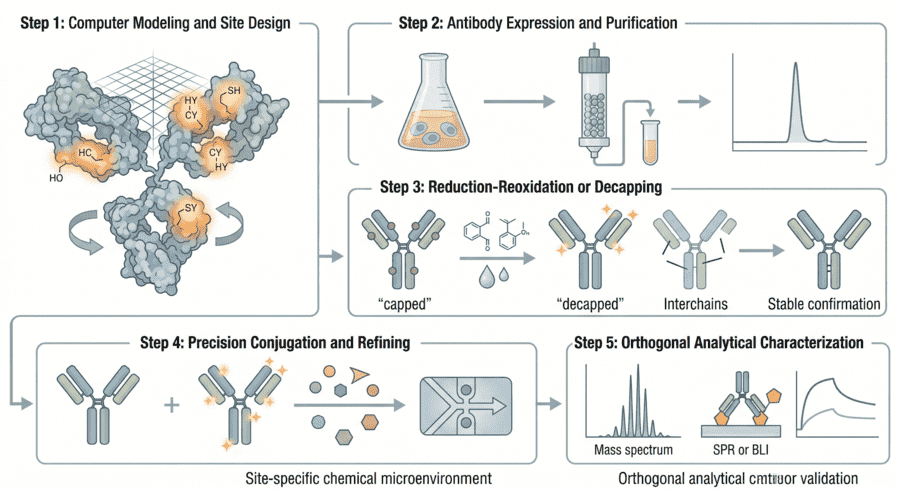
Step 1: In Silico Modeling & Site Design
We utilize computational SASA (Solvent Accessible Surface Area) analysis to select mutation sites that are partially buried or located in electrostatically favorable regions, preventing in vivo payload de-conjugation while maintaining linker accessibility.
Step 2: EnCys-mAb Expression & Purification
Generation of engineered antibody variants using transient mammalian expression systems. Post-Protein A purification, we perform rigorous characterization of monomeric purity and thermal stability.
Step 3: Reduction-Reoxidation (Uncapping)
Execution of a delicate "uncapping" process to remove cysteine or glutathione adducts from engineered sites. This ensures interchain disulfides are re-formed, restoring the antibody to its native structural state with free engineered thiols.
Step 4: Precision Conjugation & Refining
Site-specific coupling of the linker-payload. We optimize the molar ratio and reaction micro-environment to achieve near-quantitative conversion, followed by high-resolution purification (SEC/HIC/TFF) to remove trace impurities.
Step 5: Orthogonal Analytical Characterization
Final validation of the homogeneous ADC lead. We provide a complete "structural fingerprint" including intact mass spectroscopy, peptide mapping for site confirmation, and in vitro binding/stability profiling.
EnCys-mAb Technology Pillars
Our platforms are engineered to maximize pre-clinical success through unique technical differentiators:
1. Cysteine-Site Selectivity (CSS) Modeling Platform
Not all engineered sites are equal. Our CSS platform predicts the "functional impact" of a mutation, screening for residues that provide a "protective hydrophobic pocket" for the linker. This reduces maleimide exchange with albumin in in vivo circulation, significantly extending the therapeutic window of the candidate.
- • Electrostatic Environment Tuning: Selecting sites with positive local charges to stabilize the thioether bond.
- • Preserved Effector Function: Ensuring sites are distal from neonatal Fc receptor (FcRn) and FcγR binding regions.
2. High-Yield "Uncapping" & Re-activation Suite
A proprietary pre-treatment protocol that achieves high-efficiency activation of engineered thiols. By avoiding harsh, global reduction, we maintain the quaternary structure of the antibody, leading to superior batch-to-batch consistency and high monomer recovery (>98%).
- • Mild Re-oxidation: Utilizing specific redox pairs to specifically re-form native interchain bonds.
- • Automated TFF Integration: Streamlining buffer exchange to prevent oxidation of engineered thiols before conjugation.
3. Bio-orthogonal Site-Specific Acylation (BSSA)
Our BSSA platform optimizes the reaction kinetics for engineered cysteines, which can sometimes be "buried." We employ specialized catalysts and organic co-solvents to ensure 100% occupancy at the target site, eliminating "DAR 0" or "DAR 1" species from the final mixture.
- • Linker Compatibility: Optimized for both cleavable (peptide/disulfide) and stable linkers.
- • Payload Versatility: Expertise in handling ultra-hydrophobic toxins with proprietary solubility enhancers.
4. Deep-Characterization Analytical Unit
Deconvoluting the site-specific architecture requires sophisticated tools. We provide residue-level confirmation of attachment, ensuring that "site-specific" truly means the drug is where it’s supposed to be, with zero off-target modification.
- • Orbitrap Mass Spectrometry: Accurate drug-load distribution (DLD) analysis.
- • Hydrophobic Interaction Chromatography (HIC): High-resolution separation of different substitution levels.
Research Insights: Impact of Engineering on ADC Efficacy
According to Sochaj et al. (2015), the transition from conventional heterogeneous ADCs to site-specific conjugates is a critical frontier in modern oncology. Their research review highlights that the "THIOMAB" technology (engineered cysteine mutants) consistently improves the therapeutic index by minimizing non-specific toxicity.
Key Mechanistic Discoveries from Engineered Cysteine Research:
- • Solvent Accessibility Matters: Studies conducted by Shen et al. (cited in Sochaj et al.) showed that payloads conjugated to highly accessible sites were lost rapidly via maleimide exchange. In contrast, conjugation to partially buried sites in positively charged regions significantly enhanced in vivo stability.
- • PHESELECTOR Screening: The use of Phage ELISA (PHESELECTOR) identified over 10 reactive cysteine residues (e.g., HC-A114C) that do not interfere with antigen binding, proving that site-specific engineering can maintain 100% of the antibody's native affinity.
- • Optimized PK Profiles: Engineered conjugates (TDCs) exhibited slower renal clearance and less pronounced adverse effects on liver and white blood cell counts compared to traditional ADCs in cynomolgus monkey models, demonstrating the safety benefits of homogeneity.
These insights underscore why EnCys-mAb strategies are essential for developing safe, potent, and reproducible pre-clinical ADC candidates.
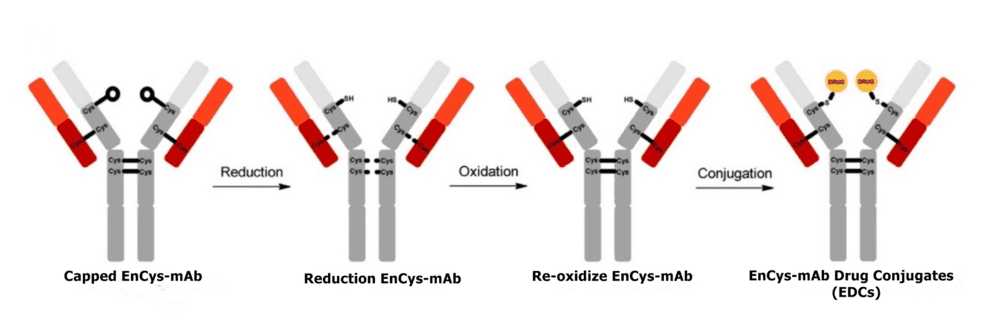
Fig.1 Generating EnCys-mAb Drug Conjugate..1,2
FAQs about EnCys-mAb Based Conjugation
Q: How does the EnCys-mAb strategy differ from traditional THIOMAB technology in pre-clinical research?
A: While the fundamental principle of engineering cysteines is similar, our EnCys-mAb platform offers an expanded library of mutation sites beyond standard positions, optimized for a wider range of antibody scaffolds (including bispecifics and fragments) and a broader variety of hydrophobic payloads used in pre-clinical discovery.
Q: Does the cysteine mutation affect the thermal stability (Tm) of the antibody?
A: We utilize computational pre-screening to avoid sites that are critical for structural folding. Every EnCys-mAb batch undergoes DSC or nanoDSF analysis to confirm that the mutation does not compromise the biophysical stability or shelf-life of the pre-clinical candidate.
Q: Why is "uncapping" necessary for engineered cysteines?
A: During expression in mammalian cells, free cysteine or glutathione in the media often reacts with the engineered thiols, forming a disulfide adduct (cap). We use a controlled reduction step to remove these caps and a precise re-oxidation step to ensure native interchain bonds are restored before conjugation.
Q: Can you achieve a DAR of 4.0 using engineered cysteines?
A: Yes. By engineering two specific cysteine residues per heavy/light chain pair (double-mutants), we can achieve a highly homogeneous DAR 4.0. This allows for higher payload delivery without the heterogeneity seen in traditional "DAR 4" interchain conjugates.
Q: Is site-specific occupancy confirmed for every project?
A: Absolutely. We provide peptide mapping via LC-MS/MS as a standard deliverable. This confirms that the drug is attached specifically to the engineered cysteine and ensures that no off-target conjugation has occurred on native residues.
Explore Related Conjugation Solutions
Related Research Products
Technical Resources
References:
1. Sochaj, Alicja M., Karolina W. Świderska, and Jacek Otlewski. "Current methods for the synthesis of homogeneous antibody-drug conjugates." Biotechnology Advances 33.6 (2015): 775-784. https://doi.org/10.1016/j.biotechadv.2015.05.001
2. Distributed under Open Access License CC BY 3.0, without modification.
For Research Use Only. NOT FOR CLINICAL USE.
Online Inquiry
Welcome! For price inquiries, please feel free to contact us through the form on the left side. We will get back to you as soon as possible.