- Home
- Resources
- Featured Solutions
- One-Stop ADC Development Solution
- Antibody Design and Conjugation Solution for ADC Development
- Enzyme-mediated Modification & Conjugation Strategy Solution
Enzyme-mediated Modification & Conjugation Strategy Solution
Leveraging the surgical precision of biocatalysts, Creative Biolabs provides state-of-the-art enzyme-mediated modification and conjugation solutions for next-generation ADC development. Unlike traditional chemical methods that often yield heterogeneous mixtures, our enzymatic platforms enable the synthesis of homogeneous conjugates with defined drug-to-antibody ratios (DAR). By targeting conserved sequence motifs or remodeling Fc glycans, we ensure the integrity of the native antibody scaffold while optimizing the therapeutic index for pre-clinical discovery. Our integrated analytical suite confirms site-occupancy and in vitro potency, empowering researchers to achieve unmatched reproducibility in in vivo pharmacokinetic models.
Overview: Redefining Homogeneity via Biocatalytic Precision
Enzyme-mediated bioconjugation represents the pinnacle of site-selective engineering in the antibody-drug conjugate (ADC) landscape. By exploiting the high substrate specificity of enzymes, researchers can introduce functional handles or directly attach payloads to specific amino acid residues or glycan structures. This strategy effectively bypasses the "random labeling" associated with traditional lysine or cysteine chemistry, resulting in a nearly uniform population of conjugates.
Key Characteristics of Enzymatic Conjugation Strategies
Our enzymatic solutions are designed to address the stringent requirements of modern pre-clinical ADC discovery, focusing on homogeneity, stability, and biological function:
- • Absolute Site-Specificity: Enzymes recognize specific peptide motifs ensuring the payload is attached precisely where intended, far from the antigen-binding regions.
- • Mild Physiological Conditions: Reactions typically occur at neutral pH and moderate temperatures, preserving the sensitive tertiary structure of antibodies and fragments.
- • Modular DAR Control: Enables the production of defined DAR 2 or DAR 4 species with minimal batch-to-batch variation, facilitating accurate SAR studies.
Comparative Analysis: Enzymatic vs. Chemical Conjugation
| Feature | Random Chemical (Lys/Cys) | Engineered Cysteine | Enzyme-Mediated (Our Solution) |
|---|---|---|---|
| Site Control | Statistical/Random | Genetic Site Control | Sequence/Glycan Specific |
| Product Homogeneity | Very Low (DAR 0-8) | High | Excellent (Uniform DAR) |
| Antibody Integrity | Risk of partial unfolding | Requires refolding/mutation | Native-like Preservation |
| Characterization | Complex (Mixtures) | Streamlined | Simplified (Single Species) |
| Ease of Scale-up | Moderate | Difficult (Expression) | Scalable & Robust |
Addressing the Bottlenecks in Native Antibody Modification
In the pre-clinical phase, the success of an ADC candidate often hinges on the quality of the initial conjugate. Traditional methods face significant hurdles that enzymatic strategies are uniquely equipped to solve:
- ▶ Substrate Incompatibility: Many native antibodies lack reactive handles for site-specific chemistry without extensive genetic engineering, which can delay discovery timelines.
- ▶ Conjugation-Induced Aggregation: High local concentrations of hydrophobic payloads can lead to antibody instability. Enzymatic control allows for better spacing and distribution of toxins.
- ▶ CDR Interference: Random modification of residues in the antigen-binding site often results in a total loss of in vitro potency, a risk mitigated by site-specific enzymatic targeting.
Comprehensive Enzymatic Conjugation Portfolio
Creative Biolabs offers a modular matrix of enzymatic services designed to transform native or engineered proteins into precision-guided therapeutic vehicles for pre-clinical evaluation:
Exploratory Pilot Suite
Foundational- Project Evaluation: Feasibility study of substrate/payload compatibility.
- Substrate Pre-processing: Purity testing, desalting, and buffer exchange.
- Pilot Modification: Single-route enzymatic screening.
- High-level feasibility report & recommended route.
- Small-scale pilot analysis.
- Intermediate stability data overview.
Standard Precision Development
Most Popular- Multi-Route Screening: 2-3 enzymatic strategies comparison.
- Enzymatic Site Activation: Tag engineering or Glycan activation.
- mg-Level Preparation: Purification of target DAR monomeric fractions.
- Full DAR/DOL distribution analysis via HIC-HPLC.
- Intact & Reduced Mass Spectrometry (LC-MS) verification.
- Batch-specific Certificate of Analysis (COA).
Advanced ADC Validation Suite
Premium Discovery- Payload-Linker Adaptation: Tailored chemical handle matching.
- Full Structural Validation: Peptide mapping for site confirmation.
- Pre-clinical Bioassays: SPR affinity & in vitro cell-killing assays.
- CMC Bridging: CPP/CQA mapping for technical transfer.
- Complete Pre-clinical SAR analysis dossier.
- Site-occupancy LC-MS/MS fingerprinting.
- Serum stability & long-term purity monitoring.
- Scalability & robustness roadmap for CMC.
Standardized Workflow for Enzymatic ADC Discovery
Our pre-clinical workflow integrates substrate assessment with precise enzymatic modification to ensure the highest quality conjugates:
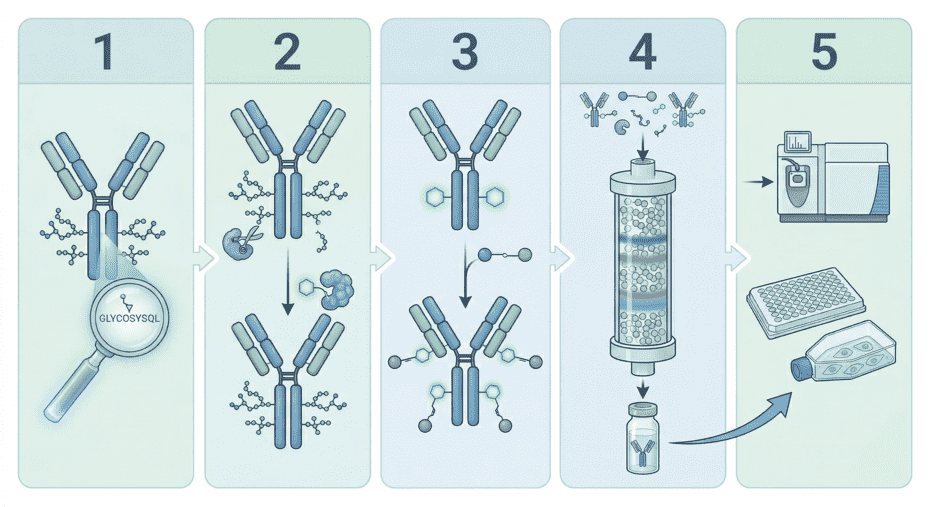
Phase 1: Substrate & Motif Assessment
We evaluate the antibody subtype, glycan profile, and sequence for conjugatability. For engineered routes, we design specific tags to ensure optimal spatial accessibility.
Phase 2: Enzymatic Site Activation
Introduction of the reactive handle. For glycan remodeling, this involves deglycosylation and controlled glycosyltransferase-mediated functionalization under mild conditions.
Phase 3: Payload-Linker Conjugation
Execution of the final coupling. This phase is optimized for stoichiometry and pH to minimize antibody aggregation.
Phase 4: High-Resolution Purification
Removal of residual enzymes, free payloads, and any trace amounts of DAR variants using FPLC. We target the most homogeneous monomeric fraction.
Phase 5: Pre-clinical Analytical Validation
Comprehensive characterization including intact mass spectrometry, peptide mapping, and in vitro cytotoxicity assays to confirm the pre-clinical efficacy.
Unique Technology Platforms for Enzymatic Conjugation
Our platforms are built upon proprietary biocatalytic engineering to solve the unique challenges of complex protein modification:
1. TGase Precision Engineering Platform
Utilizing microbial transglutaminase, we target native Gln295 or introduce hotspot glutamines in the constant regions. This platform is ideal for creating stable, amide-linked ADCs on wild-type antibodies.
- • Amide Stability: Produces one of the most stable covalent bonds for in vivo circulation.
- • Native IgG Compatibility: Often requires no genetic modification for standard IgG1 scaffolds.
- • Tunable Payload Loading: Allows for precise control of drug distribution via reaction stoichiometry.
2. Chemoenzymatic Glycan Remodeling Suite
A flagship platform for researchers working with delicate antibodies. By remodeling the N-linked glycans at Asn297, we create a conjugation site naturally distal from the CDRs, ensuring preservation of binding affinity.
- • Sequence-Independent: Works across various antibody species and subclasses.
- • Superior Homogeneity: Typically yields DAR 2.0 species with high purity.
- • Click-Ready Handles: Incorporates azide or DBCO handles for efficient, copper-free coupling.
3. Motif-Specific Transpeptidation Unit
Specifically designed for C-terminal or N-terminal modification. This platform leverages specialized enzymes to sew a payload onto a specific tag, creating a modular architecture for multifunctional conjugates.
- • High Site-Occupancy: Achieves near-quantitative conversion in pre-clinical batches.
- • Modular Design: Easy to swap linkers and payloads for screening various candidates.
- • Minimal Structural Impact: Small peptide tags do not interfere with FcRn or antigen binding.
4. Advanced Bio-Analytical Characterization Unit
A specialized unit for the fingerprinting of enzymatic conjugates. We provide the structural evidence required for pre-clinical SAR analysis, ensuring every drug molecule is exactly where it should be.
- • Sub-ppm Intact Mass: Precise DAR and glycoform determination.
- • Site-Occupancy Quantification: Peptide-level analysis of modification efficiency.
- • Biophysical Stability: SEC-MALS analysis of conjugate robustness.
Why Choose Our Enzymatic Modification Services?
Unmatched Pre-clinical Reproducibility
Our enzymatic strategies eliminate batch-to-batch variance of chemical labeling, providing a defined molecule that behaves consistently in in vitro and in vivo research models.
Absolute Preservation of Affinity
By targeting conserved motifs distal from the antigen-binding site, our conjugates maintain the full target specificity of your parental antibody during pre-clinical screening.
Superior Linkage Stability
Enzymatic amide or click linkages exhibit exceptional resistance to premature payload release in serum, ensuring that your in vivo efficacy data is accurate and reliable.
Fully Integrated Discovery Support
We handle everything from motif engineering and reagent synthesis to high-resolution MS characterization, providing a complete solution for your discovery program.
Research Insights: Tag-Free Specific Conjugation of Glycosylated IgG1
According to Hadjabdelhafid-Parisien et al. (2022), achieving site-specific conjugation on native, fully glycosylated antibodies is a major milestone for ADC engineering. Their research highlights the use of microbial transglutaminase for tag-free modification of IgG1.
Mechanistic Breakthroughs in Enzymatic Conjugation:
- • Targeting the I253Q Substitution: While native Q295 is masked by glycans, the introduction of a single I253Q mutation creates a highly reactive, surface-exposed handle that remains addressable even in fully glycosylated antibodies.
- • Glycosylation-Compatible Modification: This approach removes the need for deglycosylation, preserving the antibody's natural solubility and stability profiles for in vitro research.
- • High Degree of Conjugation: Mass spectrometry analysis confirmed the conjugation of one payload per heavy chain, demonstrating exceptional homogeneity without disrupting HER2 binding affinity.
These advancements provide a robust route to site-specific conjugates using minimal sequence alteration, ideal for pre-clinical evaluation of therapeutic candidates.
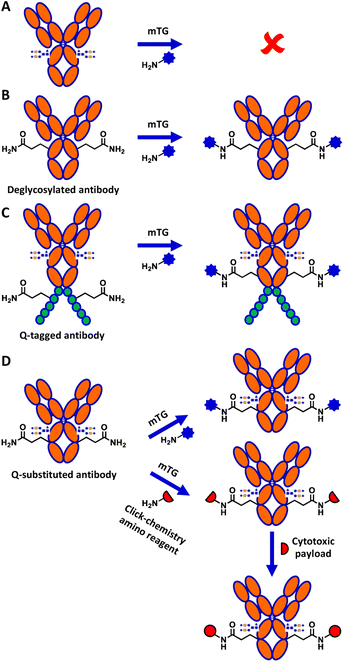
Fig.1 Overview of mTG-mediated glutamine conjugation strategies in glycosylated IgG.1,2
FAQs about Enzyme-Mediated Conjugation
Q: Why should I choose enzymatic conjugation over standard cysteine chemistry for my pre-clinical ADC?
A: Enzymatic conjugation provides absolute site-specificity and homogeneity, which is critical for accurate in vivo pharmacokinetic modeling and toxicity screening. Unlike standard cysteine chemistry, it avoids the formation of heterogeneous mixtures that can complicate discovery data.
Q: Does enzymatic modification require large-scale sequence engineering?
A: Not necessarily. While platforms like FGE require small peptide tags, our Fc Glycan Remodeling and certain TGase protocols work effectively on native antibody scaffolds. This allows for rapid pre-clinical evaluation of wild-type antibodies.
Q: How stable are the linkages formed by these enzymatic methods?
A: Our enzymatic platforms favor the formation of stable covalent bonds. These linkages are highly resistant to hydrolysis and premature payload release, ensuring maximum conjugate stability during long-term in vivo circulation studies.
Q: Can you perform enzymatic conjugation on antibody fragments like Fab or scFv?
A: Yes. Enzymatic motifs can be easily integrated into Fab or scFv sequences. Because these reactions occur under mild physiological conditions, they are ideal for maintaining the delicate folding of fragments compared to harsh chemical alternatives.
Q: What analytical documentation do you provide with the pre-clinical batches?
A: Every project includes a comprehensive Certificate of Analysis featuring intact mass spectrometry, analytical SEC, HIC, and in vitro binding assays to ensure project data integrity.
Related Products
Related Resources
References:
1. Hadjabdelhafid-Parisien, Adem, et al. "Tag-free, specific conjugation of glycosylated IgG1 antibodies using microbial transglutaminase." RSC Advances 12.51 (2022): 33510-33515. https://doi.org/10.1039/d2ra05630e
2. Distributed under Open Access License CC BY 3.0, without modification.
For Research Use Only. NOT FOR CLINICAL USE.
Online Inquiry
Welcome! For price inquiries, please feel free to contact us through the form on the left side. We will get back to you as soon as possible.
