- Home
- Resources
- Featured Solutions
- One-Stop ADC Development Solution
- Antibody Design and Conjugation Solution for ADC Development
- Tyrosine based Conjugation Strategy Solution
Tyrosine-Based Conjugation Strategy Solution
Tyrosine residues, although less abundant than lysines, offer a unique window for high-precision Antibody-Drug Conjugate (ADC) synthesis due to their specific surface distribution and distinct chemical reactivity. Creative Biolabs provides industry-leading tyrosine-based conjugation solutions, specifically designed for native antibody scaffolds. By targeting the phenol group of tyrosine, our proprietary platforms achieve superior site-selectivity and structural homogeneity in the pre-clinical stage. Leveraging advanced chemoenzymatic activation and photoredox chemistry, we deliver custom conjugates with enhanced in vivo stability and minimized drug-to-antibody ratio (DAR) distribution, empowering the discovery of next-generation biologics.
Inquire for Pre-clinical SupportOverview: Advanced Precision through Tyrosine Site-Selectivity
Tyrosine bioconjugation has emerged as a powerful alternative to cysteine and lysine-based methods, particularly when structural homogeneity is paramount for pre-clinical evaluation. Native antibodies typically contain a limited number of solvent-exposed tyrosine residues, which facilitates "natural site-selectivity" without the need for complex genetic engineering or antibody modification. Our strategy focuses on the nucleophilic phenol ring, employing innovative chemical handles like triazolinediones or enzymatic systems to create robust covalent linkages.
Key Characteristics of Tyrosine-Selective Strategies
Unlike standard bioconjugation, tyrosine-based approaches provide a "sweet spot" between the over-abundance of lysines and the potential disulfide instability of cysteines:
- • Natural Rarity & Selectivity: Solvent-accessible tyrosines are relatively scarce, allowing for lower drug loading with higher site-precision on native IgG scaffolds.
- • Robust Chemical Linkages: Utilizes C-C or C-O bond formations that offer superior resistance to enzymatic cleavage in in vitro and in vivo environments.
- • CDR-Safe Engineering: Advanced micro-environment mapping ensures modification occurs away from the complementarity-determining regions (CDRs) to preserve binding affinity.
Comparative Analysis: Tyrosine vs. Conventional Methods
| Feature | Lysine (NHS-Ester) | Cysteine (Maleimide) | Tyrosine (CBL Solution) |
|---|---|---|---|
| Site Abundance | High (~80-100 sites) | Limited (8 interchain) | Optimal (Low solvent-exposed) |
| DAR Control | Low (Statistical) | Moderate | High (Site-selective) |
| Linkage Stability | High | Risk of Retro-Michael | Exceptional (Stable Amide/C-C) |
| Antibody Engineering | Not Required | Required (for site-specific) | Not Required (Native precise) |
| Pre-clinical SAR | Complex | Defined | Highly Predictable |
Addressing the Challenges of Selective Phenol Modification
While tyrosine offers significant advantages, its modification requires sophisticated chemistry to overcome inherent bottlenecks in ADC discovery:
- ▶ Low Solvent Accessibility: Many tyrosine residues are buried within the protein core. Our computational mapping identifies only the reactive surface tyrosines for reliable in vitro performance.
- ▶ Side Reaction Interference: Conventional tyrosine reagents may cross-react with other nucleophiles. We employ proximity-guided chemistry to ensure 100% residue selectivity.
- ▶ Structural Homogeneity: Ensuring a tight DAR distribution (e.g., DAR 2.0) on native antibodies requires rigorous kinetic control and purification strategies.
Comprehensive Tyrosine-Based Conjugation Solutions
Creative Biolabs provides an integrated suite of tyrosine-specific chemical and enzymatic protocols to accelerate pre-clinical ADC development:
| Conjugation Strategy | Technical Difficulties Solved | Analytical & QC Platform |
|---|---|---|
|
Click Chemistry PTAD/TAD Tyrosine-Click Utilizes 4-phenyl-3H-1,2,4-triazole-3,5(4H)-dione (PTAD) derivatives for rapid, site-selective electrophilic aromatic substitution on tyrosine phenol groups. |
• Eliminates the need for genetic mutations. • Faster reaction kinetics than traditional NHS-esters. • Targets native surface tyrosines with minimal light-chain background. |
• High-Res LC-MS/MS: To verify PTAD-labeling site-occupancy. • Intact Mass Spectrometry: For precise DAR 2.0/4.0 confirmation. |
|
Enzymatic Platform Tyrosinase-Mediated Oxidation Employs tyrosinase to catalyze the oxidation of native tyrosines to o-quinones, which then react with nucleophilic payload handles via photoaddition or strain-promoted click. |
• Achieves site-selectivity at specific conserved Fc-region residues (e.g., Y296). • Operates under mild physiological conditions to preserve antibody stability. • Solves the "buried site" problem via glycan-dependent exposure control. |
• Surface Plasmon Resonance (SPR): Confirms antigen binding retention after enzymatic treatment. • Peptide Mapping: Identifying specifically oxidized tyrosine sites. |
|
Light-Activated Photoredox Site-Selective Modification Uses visible light photocatalysts (e.g., Ruthenium or Lumiflavin) to drive the site-specific labeling of native tyrosines with various bioorthogonal handles. |
• High functional group tolerance for delicate antibody-fragments. • Allows for "two-step" modular labeling for diverse payload types. • Minimal non-specific background modification. |
• SEC-MALS Characterization: Monitoring aggregation and molecular weight homogeneity. • DSF Analysis: Ensuring thermal stability of light-treated conjugates. |
Tailored Tyrosine Conjugation Service Modules
Building on our core chemical platforms, Creative Biolabs offers an end-to-end service package tailored to the unique molecular architecture of your antibody, protein, or peptide scaffold:
Project Assessment & Strategic Design
- Comprehensive evaluation of protein/antibody/peptide molecular types.
- Tyr-site Solvent Accessible Surface Area (SASA) and bioconjugation feasibility analysis.
- Custom route design: Native Tyr, Tag-assisted Tyr, or two-step Tyr-click.
- Compatibility assessment for various linkers, payloads, and labels.
- Definition of target Drug-to-Antibody Ratio (DAR) and homogeneity goals.
Pilot-Scale Conjugation Development
- Raw material intake and rigorous QC validation.
- Establishment of optimized reaction systems for tyrosine phenol targeting.
- Screening of tyrosine-selective reaction conditions and catalyst variations.
- Comparative study of diverse reagents and activation methods.
- Initial DAR assessment, recovery rate evaluation, and primary purification.
Process & Parameter Optimization
- Fine-tuning of pH, temperature, incubation time, and stoichiometry.
- Strict control of oxidative side reactions and over-modification artifacts.
- Fixing of the labeling/conjugation window for consistent pre-clinical batches.
- Optimization of purification workflows to maximize monomeric species.
- Reproducibility confirmation prior to pre-clinical scale-up.
Advanced Analytical & Validation Services
- Precise molecular weight confirmation via high-res Mass Spectrometry.
- Residue-level site identification and occupancy mapping.
- Purity analysis and trace byproduct profiling.
- Aggregation, thermal stability, and homogeneity characterization.
- In vitro binding activity and functional potency verification.
Strategic Extended Services
- Secondary Click Modification: Post-conjugation functionalization at tyrosine sites for dual-payload systems.
- Complex Bioconjugates: Development of protein–protein, protein–peptide, and protein–small molecule conjugates.
- Diverse Labeling: Integration of Fluorescent tags, PEGs, Oligonucleotides, Chelators, and novel drug payloads.
- Pilot Scale-up Support: Method transfer and scale-up assistance for discovery-stage research programs.
Optimized Pre-clinical Tyrosine Conjugation Workflow
Our tyrosine conjugation services are built on a modular and highly flexible framework. Whether you are at the initial design phase or require specialized purification of an existing conjugate, we provide tailored entry points to match your research needs:
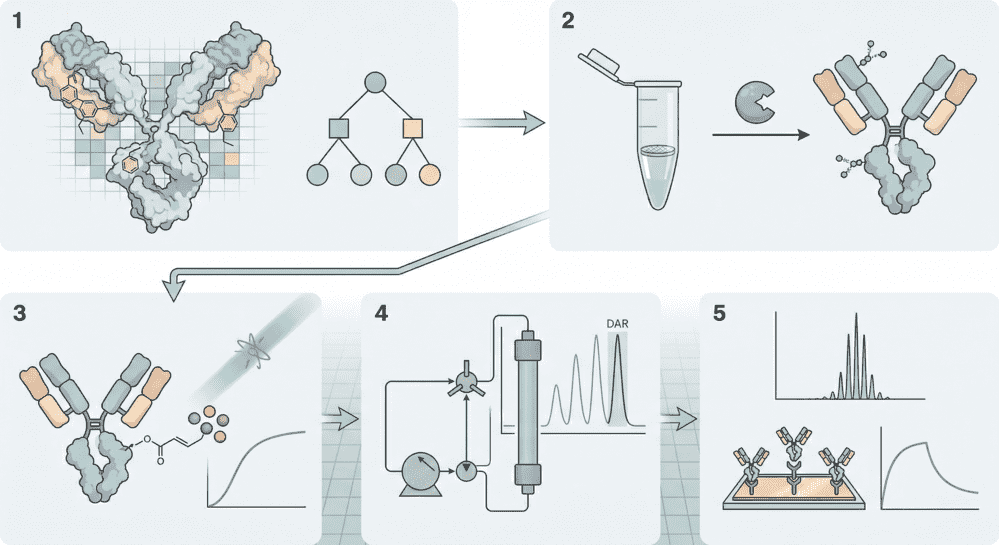
Project Assessment & Strategic Design
Every project begins with a deep dive into your antibody's structure. We perform computational mapping (SASA analysis) to identify solvent-accessible tyrosines and select the optimal strategy (e.g., PTAD vs. Tyrosinase) for minimal CDR interference.
Sample Pre-treatment & Optimization
We handle the rigorous preparation of starting materials, including high-purity buffer exchange, concentration, and site-exposure techniques such as deglycosylation to tune the reactive environment for tyrosine modification.
Site-Selective Conjugation Development
Our chemists execute the selected tyrosine-click or photoredox reaction under precise kinetic control. By monitoring stoichiometry and temperature, we achieve high coupling efficiency while preventing non-specific background labeling.
High-Resolution Purification & Enrichment
Utilizing our FPLC platform, we perform multi-step purification (SEC, IEX, HIC) to remove unreacted payloads and enrich for target DAR species, delivering a homogeneous pre-clinical candidate for in vivo SAR profiling.
Comprehensive Bio-analytical Validation
The final phase involves structural and functional fingerprinting. We provide intact MS for DAR profiling, LC-MS/MS peptide mapping for site confirmation, and in vitro antigen-binding assays (SPR/BLI) to verify target affinity.
💡 Flexible Entry Points: We can initiate your program from any stage—from raw antibody mapping and small-scale condition screening to advanced structural validation of your pre-made intermediates.
Unique Technology Platforms for Tyrosine Conjugation
Our platforms are engineered to transform native antibodies into high-performance drug delivery tools for discovery research:
1. Chemoenzymatic Tyrosine-Click Platform
This flagship platform utilizes the high specificity of fungal or bacterial tyrosinases to convert surface tyrosines into reactive o-quinones. This "handle" is then modified with strained cyclic alkynes or vinyl ethers via bioorthogonal chemistry, yielding homogeneous conjugates from native scaffolds.
- • Site-Specific targeting: Primarily modifies conserved Fc-region tyrosines like Y296.
- • Native IgG Compatibility: Eliminates the need for antibody engineering or mutations.
- • Fast Kinetics: Reaction completes rapidly under mild, non-denaturing conditions.
2. Triazolinedione (PTAD) Precision Platform
A specialized platform for rapid electrophilic modification of tyrosine phenol groups. PTAD-based reagents provide one of the most efficient routes for pre-clinical labeling of antibodies, proteins, and peptides with exceptional DAR control.
- • High Selectivity: Minimizes cross-reactivity with other nucleophilic amino acids.
- • Modular Design: Compatible with a diverse range of discovery payloads and linkers.
- • Stable Amide Linkages: Provides high chemical stability for in vivo circulation studies.
3. Photoredox Native Modification Suite
Leverages visible-light photocatalysis to activate tyrosine residues for covalent modification. This platform is ideal for delicate antibody-drug conjugates where maintaining the native structural integrity is critical for target recognition.
- • Visible Light activation: Uses non-damaging wavelengths to drive site-specific reactions.
- • CDR Protection: Computational modeling guides labeling away from antigen-binding sites.
- • High SAR Efficiency: Enables rapid screening of multiple pre-clinical candidates.
Why Choose Creative Biolabs for Tyrosine Conjugation?
Unrivaled Site-Selectivity on Native IgG
We leverage the natural rarity of surface tyrosines to provide site-selective modification without genetic mutations, simplifying your pre-clinical development timeline.
Enhanced Homogeneity (High-Purity DAR)
Our advanced purification and kinetic control ensure tight DAR distributions, delivering conjugates with defined SAR profiles for superior in vivo performance.
Preserved Binding Affinity
By targeting residues distal from the CDRs and using mild reaction conditions, we guarantee the retention of the antibody's target specificity and biological function.
Integrated Discovery Support
From initial structural mapping to in vitro cell killing and in vivo pharmacokinetic analysis, we provide a seamless solution for pre-clinical evaluation.
Research Insights: Visible-Light Induced Site-Selective Tyrosine Reaction
Based on the work by Chen et al. (2023) published in Advanced Science, achieving residue-level precision on native antibodies is a major leap for targeted immunotherapy. Their research introduced a chemoenzymatic "one-pot" strategy to functionalize a single tyrosine residue, Y296, in the Fc domain of native IgGs.
Key Mechanistic Highlights:
- • Chemoenzymatic Activation: The protocol utilizes mushroom tyrosinase to oxidize the target phenol group into a reactive o-quinone intermediate under mild physiological conditions.
- • [3+2] Photoaddition: Under 456 nm visible light, the o-quinone undergoes a rapid cycloaddition with vinyl ethers. This reaction installs azide or fluorescent handles with exceptional site-selectivity.
- • Structural Stability: The resulting conjugates showed minimal loss of antigen binding affinity and high stability in complex in vitro environments.
- • ADCC Enhancement: The site-selective orientation provided by this method was shown to maximize immune-cell contacts, enhancing antibody-dependent cellular cytotoxicity in in vivo models.
These findings confirm that site-selective tyrosine modification provides a robust path toward homogeneous ADCs with predictable pre-clinical therapeutic indexes.
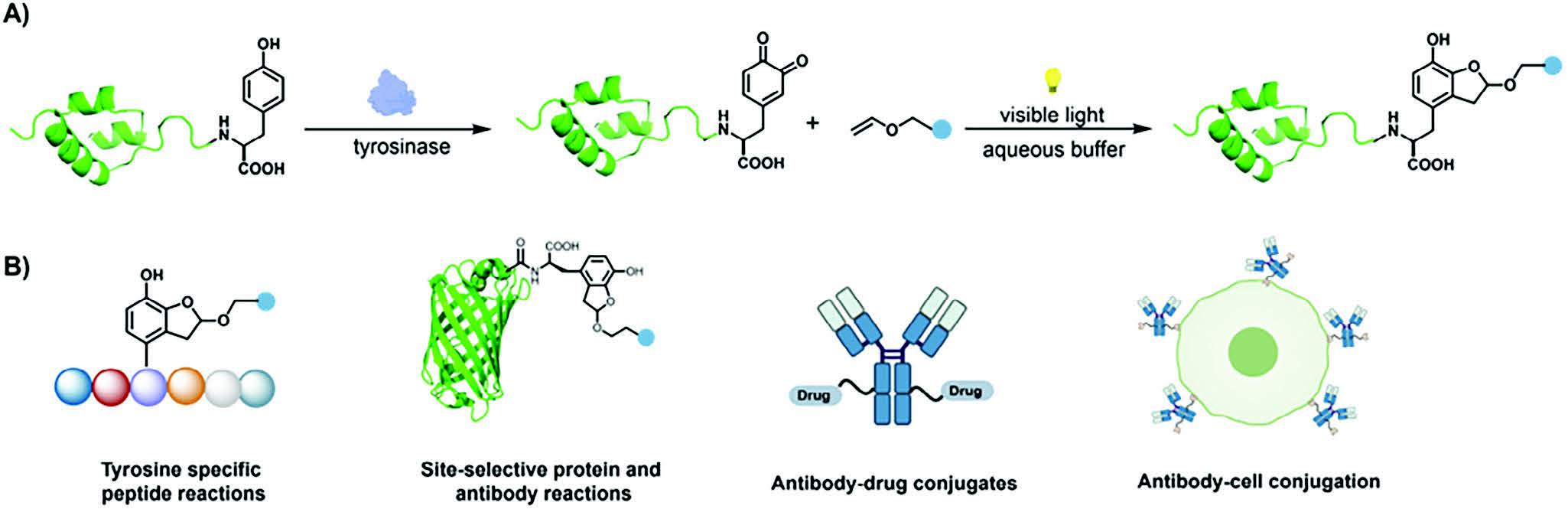
Fig.1 Site-selective tyrosine modification via light-induced o-quinone photoaddition.1,2
FAQs about Tyrosine-Based Conjugation
Q: What is the main advantage of Tyrosine-based conjugation over Lysine methods in pre-clinical research?
A: Tyrosine residues are significantly less abundant on the antibody surface than lysines. This allows for superior site-selectivity and narrower DAR distributions on native antibodies, which is critical for obtaining reproducible results in pre-clinical pharmacokinetic studies.
Q: Does your tyrosine conjugation platform require antibody engineering (e.g., Cys mutation)?
A: No. Our tyrosine strategies are designed specifically for native antibody scaffolds. By utilizing chemical or enzymatic handles that target naturally occurring surface tyrosines, we eliminate the need for time-consuming genetic engineering during the discovery phase.
Q: How do you ensure the antigen-binding affinity (CDR) is not affected?
A: We use computational SASA mapping to identify tyrosines that are distal from the CDR regions. Additionally, our enzymatic and photoredox platforms are highly regioselective, focusing modification on conserved Fc-region sites that do not participate in target recognition.
Q: What level of characterization do you provide for pre-clinical tyrosine conjugates?
A: We provide comprehensive bio-analytical validation, including intact mass spectrometry for DAR distribution, LC-MS/MS peptide mapping for site-identification, and SPR/BLI for antigen binding kinetics to ensure the conjugate's functional integrity.
Q: Are tyrosine-linked payloads stable enough for in vivo circulation studies?
A: Yes. The C-C, C-O, or stable amide bonds formed via tyrosine modification are exceptionally robust. Our in vitro serum stability assays demonstrate superior linkage integrity compared to traditional maleimide-cysteine conjugates, minimizing premature payload release.
Other Conjugation Strategy Solutions
Related Products
Related Resources


References:
1. Chen, Hongfei, et al. "Site-Selective Tyrosine Reaction for Antibody-Cell Conjugation and Targeted Immunotherapy." Advanced Science 11.5 (2024): 2305012. https://doi.org/10.1002/advs.202305012
2. Distributed under Open Access License CC BY 4.0, without modification.
For Research Use Only. NOT FOR CLINICAL USE.
Online Inquiry
Welcome! For price inquiries, please feel free to contact us through the form on the left side. We will get back to you as soon as possible.
