

Non-Human Glycan Antibody Development Service
Non-Human Glycan Antibody Development Service
Non-human or species-restricted glycans can act as xenoantigens, allergenic carbohydrate determinants, microbial signatures, or quality attributes in engineered biologics. Creative Biolabs develops research-use antibodies and assay-ready reagents for detecting subtle carbohydrate structures in defined biological contexts.
Consult
Our Experts
Recommended Platform
Carbohydrate Antigen Support
Custom glycan, glycoconjugate, and carrier strategies for difficult carbohydrate targets.
Learn MoreSpecific Antibodies for Species-Restricted and Xeno-Glycan Targets
Non-human glycans, in the context of antibody development, refer to carbohydrate epitopes that are absent from humans, uncommon in humans, or presented differently in animals, plants, fungi, bacteria, parasites, or non-human production systems. Because these structures can be recognized as foreign or system-specific, they are important in xenotransplantation research, alpha-Gal syndrome studies, biologics quality research, microbial antigen analysis, allergy-related research, and comparative glycobiology.
Representative targets include galactose-alpha-1,3-galactose (alpha-Gal), the non-human sialic acid Neu5Gc, porcine non-Gal carbohydrate epitopes, plant core alpha-1,3-fucose, plant beta-1,2-xylose, bacterial capsular polysaccharides, LPS O-antigens, fungal mannans or beta-glucans, and parasite-derived glycan motifs. Some targets differ from human glycans by a single linkage, terminal residue, or branching pattern. Others require recognition of a glycan displayed on a specific protein, lipid, microbial surface, cell membrane, or tissue architecture.
Creative Biolabs provides custom antigen design, antibody generation, glycan-array or related specificity profiling, and application-oriented validation to help clients obtain antibodies suitable for high-confidence non-human glycan research.
Non-Human Glycan Evidence Snapshot
3Major eukaryotic lineages illustrated in the literature figure: fungi, plants,
and mammals.
3Plant-type N-glycan features highlighted by the study: core
beta-1,2-xylose, core alpha-1,3-fucose, and Lewis a structures.
4Practical cross-reactivity categories considered in project design: animal,
plant, fungal, and microbial or parasite glycans.
Data summarized from a study on the evolution of Golgi protein N-glycosylation machinery and representative N-glycan structures in fungi, plants, and mammals.1
Target Classes We Support
Animal Xeno-Glycans
Alpha-Gal, Neu5Gc, porcine non-Gal carbohydrate epitopes, and other animal-derived motifs relevant to xenotransplantation research and biologics quality studies.
Plant-Type Glycans
Core alpha-1,3-fucose, beta-1,2-xylose, and Lewis a-related plant motifs considered in plant-made biologics and cross-reactive carbohydrate determinant research.
Microbial Glycans
Bacterial capsules, LPS O-antigens, fungal mannans, beta-glucans, and pathogen-associated polysaccharides for research reagent development.
Engineered Glycoforms
Non-human or atypical glycan signatures introduced by cell line, organism, glycoengineering strategy, or manufacturing system.
Schedule a Technical Feasibility Discussion →
Dedicated Tracks
Explore Non-Human Glycan Antibody Development Tracks
4 specialized services one coordinated program
Development Strategy for Subtle Carbohydrate Specificity
1
Structure and Context Definition
We clarify target linkage, terminal residue, anomeric configuration, carrier or display context, biological source, and intended application before immunogen design begins.
2
Immunogen Preparation
Options may include synthetic glycoconjugates, purified glycoproteins, glycolipids, cell membranes, microbial extracts, tissue-derived materials, or engineered antigen controls, depending on target availability and biosafety requirements.
3
Discovery and Enrichment
Monoclonal, polyclonal, recombinant, phage display, or single-domain antibody routes can be considered according to immunogenicity, antigen format, and specificity requirements.
4
Counter-Screening
We screen against carrier binders, human-like glycan binders, linkage-insensitive binders, and clones that react with unrelated plant, microbial, or animal glycans whenever suitable counter-antigens are available.
5
Application Validation
Candidate antibodies can be validated in ELISA, glycan array or related binding assays, flow cytometry, immunostaining, tissue assays, microbial detection assays, or biologics quality research workflows.
6
Format Optimization
Purification, labeling, recombinant expression, sequencing, isotype conversion, and affinity maturation can be added when they are compatible with the antibody format and downstream application.
Project Design, Controls, and Deliverables
Non-human glycan antibody development is heavily dependent on controls. A clone that binds a glycan conjugate may still be unusable if it reacts with the carrier, tolerates the wrong linkage, binds human-like glycans, or loses binding when the target is displayed on cells or tissues. For this reason, Creative Biolabs recommends building the screening panel at the beginning of the project, not after candidates have already been selected. The panel can include the desired glycan, closely related glycan variants, carrier-only controls, unrelated glycoconjugates, human-like glycan counter-screens, and positive or negative biological samples.
Clients may request antibody formats for exploratory screening, analytical assay development, imaging, flow cytometry, tissue staining, biologics quality research, or microbial detection. Deliverables can range from a broad polyclonal reagent for early feasibility work to a monoclonal antibody with recombinant sequence, glycan-array or focused binding-panel specificity profile, and application-specific validation report. When the project involves alpha-Gal, Neu5Gc, plant-type glycans, or microbial polysaccharides, we can also help design controls that distinguish carbohydrate recognition from protein, lipid, carrier, or matrix background.
| Evidence Item | Typical Purpose |
|---|---|
| Target glycan binding curve and carrier-only counter-screen | Separate true glycan recognition from carrier or conjugation-background binding. |
| Related-glycan panel | Assess linkage, branching, terminal-residue, and closely related glycan specificity. |
| Biological matrix validation | Evaluate performance in cells, tissues, microbial samples, glycoprotein lots, or other client-defined matrices. |
| Application data | Support ELISA, flow cytometry, IHC, IF, WB when epitope preservation is feasible, or other research assay formats. |
| Optional downstream package | Antibody sequencing, recombinant expression, labeling, format conversion, and lot-scale production. |
Final deliverables are customized according to target availability, counter-antigen feasibility, required specificity, and the intended research application.
Request a Deliverable Plan →
Application-Focused Validation
Where Non-Human Glycan Antibodies Add Value
A useful anti-glycan antibody must answer the intended research question in the sample format where the target glycan is displayed. Creative Biolabs aligns screening, counter-screening, and validation with the client's final assay context.
01
Xenotransplantation Research
Study residual animal carbohydrate antigens after glycoengineering using cell binding, tissue staining, and serum-reactivity or competition controls.
02
Alpha-Gal and Allergy Research
Detect alpha-Gal-containing research materials and compare glycan presentation with positive and negative controls suitable for allergy-related studies.
03
Plant-Made Biologics
Track plant-specific N-glycan motifs during expression-system development and evaluate cross-reactive carbohydrate determinant controls.
04
Microbial and Comparative Glycobiology
Develop reagents for pathogen-associated glycan antigens or map species- and context-restricted glycan distribution in cells, tissues, and model systems.
Published Data: Structural Diversity of Non-Human Glycans
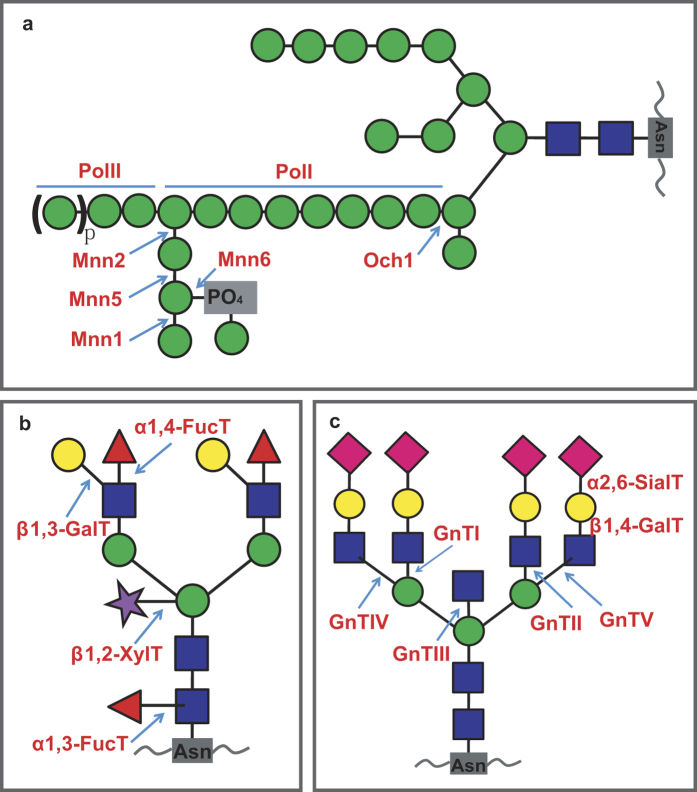
Fig. 1 Comparative N-glycosylation processes in fungi, plants, and mammals. 1
Wang and colleagues illustrate typical protein N-glycan structures and Golgi processing routes in fungi, plants, and mammals. The figure supports a key design principle for non-human glycan antibody projects: specificity should be evaluated at the level of linkage, branching, terminal residues, and organism-specific biosynthetic context, rather than monosaccharide composition alone.
plant-type motifsfungal mannose-rich glycansmammalian complex glycansFor antibody development, this structural diversity can be translated into a practical specificity matrix: target glycan conjugate, carrier-only control, human-like glycan counter-screen, linkage or branch variants, and biological sample panels. This approach helps deprioritize carrier binders, broad carbohydrate binders, and clones that cannot distinguish closely related structures.
Such validation is important for alpha-Gal, Neu5Gc, plant-type glycan motifs, microbial carbohydrate antigens, and beta-Gal or LacNAc-related projects where the intended epitope is defined by linkage, carrier, species, or presentation context. The final report can document what the antibody binds, what it does not bind under the tested conditions, and which assay context has been validated.
How to Start a Non-Human Glycan Antibody Project
A concise starting package helps our scientists design the right antigen and control strategy from the beginning. If the full glycan structure is not yet confirmed, Creative Biolabs can help plan a staged research program that separates antigen characterization from antibody generation and validation.
Target Information
Provide the glycan name, linkage, source species, carrier molecule, sample type, and any known positive or negative controls. For alpha-Gal or Neu5Gc projects, sample origin and processing history are especially useful.
Application Priority
Tell us whether the antibody will be used for ELISA, tissue staining, flow cytometry, biologics QC, microbial detection, or imaging. The intended application determines screening stringency and validation format.
Cross-Reactivity Limits
List human glycans, related animal glycans, plant glycans, microbial structures, or matrix components that the antibody must avoid. These become counter-screening materials whenever feasible.
Discuss a Non-Human Glycan Antibody Strategy →
Frequently Asked Questions
Can Creative Biolabs develop antibodies against alpha-Gal or Neu5Gc?
Yes. Creative Biolabs can design custom immunogens and counter-screens for alpha-Gal, Neu5Gc, plant-type glycans, microbial carbohydrate antigens, and additional non-human or species-restricted glycan targets. Beta-Gal or LacNAc-related projects are also feasible when the desired linkage, carrier, or presentation context is clearly defined.
How do you reduce cross-reactivity with human-like glycans?
We recommend counter-screening against structurally related human-like glycans, carrier-only controls, unrelated glycoconjugates, and glycan arrays or focused glycan panels that include linkage and branch variants.
Can antibodies be validated on tissue, cells, or microbial samples?
Yes. Candidate validation can include ELISA, glycan array or focused binding panels, flow cytometry, immunofluorescence, immunohistochemistry, Western blot when the epitope remains detectable after sample preparation, or sample-specific assay formats when materials are available.
Can you help if the glycan structure is only partially known?
Yes. We can help design an exploratory research plan using available antigen information, comparative controls, and phased screening so that antigen characterization and antibody discovery support each other.
What controls should be included in a non-human glycan project?
Useful controls include carrier-only antigen, human-like glycan analogs, linkage or branch variants, positive biological samples, negative biological samples, and unrelated glycoconjugates.
What antibody formats are available?
Depending on the project goal and antigen feasibility, we can provide polyclonal antibodies, monoclonal antibodies, recombinant antibodies, labeled antibodies, or antibody sequences for further engineering.
Can this service support biologics quality research?
Yes. Antibodies against plant-type, animal-derived, microbial, or engineered glycan motifs can support research-use comparability, process-development, and matrix-specific detection assays.
What information is needed to start?
Please provide the target glycan name or structure, biological source, intended research assay, desired antibody format, required species reactivity, and any known cross-reactivity concerns.
Send Your Project Questions →
Reference:
- Wang, Peng, et al. "Evolution of protein N-glycosylation process in Golgi apparatus which shapes diversity of protein N-glycan structures in plants, animals and fungi." Scientific Reports 7 (2017): 40301. Distributed under Open Access license CC BY 4.0. https://doi.org/10.1038/srep40301
Featured Products





For Research Use Only. Not For Clinical Use.
Loading case studies...
Online Inquiry