
Binding Specificity
Compare how an antibody, protein, lectin, or other binder recognizes defined glycans and closely related structures.


At Creative Biolabs, our glycoarray platforms combine diverse array formats, flexible customization, and experienced technical support for high-throughput glycan analysis. From binding specificity and glycosylation profiling to enzyme and host–pathogen studies, we help you select a platform that fits your research question.
At Creative Biolabs, we offer a broad range of glycoarray platforms for studying glycan recognition, glycosylation patterns, enzyme specificity, and glycan-mediated host–pathogen interactions. Each platform is selected according to the structures, molecular context, and comparison your project needs.
Our portfolio includes glycan, sialoside, glycopeptide, glycolipid, lectin, glycoprotein, antibody, enzyme-substrate, microbial-glycan, viral-receptor, and glyco-gene formats. Standard arrays are available for many common research questions, and customized panel design can be discussed when your project requires different structural coverage or controls.
Whether you are starting with a defined binder, comparing biological samples, or exploring a specialized glycoscience question, our team can help you move from platform selection to assay design, data interpretation, and the next research step.
Creative Biolabs uses glycoarray technology to compare defined structures, molecular contexts, or sample profiles in parallel. The platform can be adapted to different questions without forcing every project into the same array format.
Compare how an antibody, protein, lectin, or other binder recognizes defined glycans and closely related structures.
Profile and compare glycosylation-related patterns across samples, conditions, or experimental groups.
Examine whether recognition changes when glycans are presented as glycopeptides, glycoproteins, glycolipids, or other defined contexts.
Explore enzyme–substrate relationships, microbial glycans, viral receptor preferences, or glycosylation-related pathways with specialized array formats.
If you already know what you need to compare, use the guide below to jump directly to the most relevant platform. Final selection can be refined around your analyte, sample format, controls, and desired readout.
Not sure which route fits? Share your target, sample, and research goal with our team, and we can recommend a suitable platform and control strategy.
Browse the portfolio by platform family, or use the selection guide above to highlight a recommended option.

A broad entry point for profiling glycan recognition across defined structures, with focused subarrays available for specific glycan classes.

Focus recognition studies on sialic-acid-containing glycans and context-dependent sialoside interactions.

Examine recognition that depends on both peptide sequence and attached glycan context.

Profile interactions with glycans presented in glycolipid-associated contexts.
Compare glycosylation patterns across samples using carbohydrate-binding recognition profiles.

Study binding and recognition in an intact glycoprotein context where protein and glycan presentation both matter.
Profile antibody-based recognition patterns when an antibody-centered detection format fits the research question.
Compare enzyme–substrate relationships and substrate preferences across defined glycan contexts.

Profile glycosylation-related gene expression when pathway-level context is part of the study design.
Investigate recognition of microbial glycan antigens and glycan-dependent host–microbe interactions.
Assess viral protein recognition across candidate glycan receptor structures and related controls.
A well-designed glycoarray experiment depends on more than the number of probes on the slide. Our team considers ligand presentation, immobilization, probe orientation, detection strategy, and signal readout so the selected platform fits the analyte and the comparison you want to make.
These design choices are reviewed together with appropriate controls and the intended downstream use of the data. This helps make the resulting binding or profiling patterns easier to interpret and more useful for planning follow-up work.
You do not need to know the final array format before contacting us. We use the biological question, analyte, sample context, and desired evidence to define an appropriate route.
Clarify the biological question, analyte, sample, and decision the data should support.
Match glycan class, presentation context, coverage, and controls to the study.
Define assay conditions and comparison logic around the selected platform.
Run the array and generate signal data with project-relevant controls.
Review patterns, prioritize findings, and define the next validation question.
Clear project inputs help us recommend a platform without over-specifying an array before the biological question is understood.
Creative Biolabs combines broad platform coverage with flexible array design, thoughtful controls, and data support, helping you move from an initial screening question to a practical next step.
Move across glycan recognition, glycosylation profiling, enzyme specificity, and host–pathogen questions within one platform family.
Define panel composition and controls around glycan class, analyte, sample, and the evidence needed next.
Interpret signals in the context of specificity, relative response, presentation, and the limits of the assay.
Link array findings to related glycosylation analysis or follow-up research when orthogonal evidence is needed.
Creative Biolabs combines diverse glycoarray formats with flexible customization, careful control planning, and experienced technical support to help researchers build efficient, project-specific glycan studies.
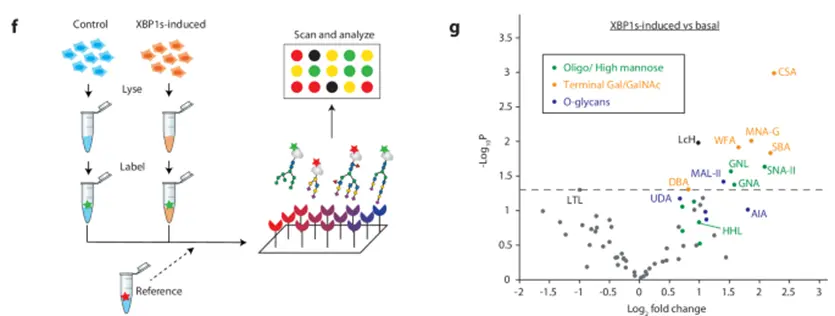
Fig.1 Lectin microarray profiling used to examine glycan-binding patterns under basal or XBP1s-induced conditions.1
A 2024 open-access study combined genetic screening with lectin microarrays to investigate regulators of high-mannose N-glycan processing. The array provided a comparative glycosylation readout that helped connect perturbations in cellular glycan-processing pathways with measurable changes in lectin-binding patterns.
This example illustrates the role of lectin-array profiling as a pattern-level measurement: it can reveal glycosylation changes and help prioritize mechanistic hypotheses, while additional experiments are still needed to establish causal or functional conclusions.
A glycoarray is designed to reveal recognition patterns and prioritize what deserves a closer look. When the next decision requires evidence beyond an array signal, we can help plan a focused follow-up route instead of applying the same validation method to every result.
See Related Follow-up ServicesIdentify reproducible binding or profiling patterns within the selected array context.
Focus on motifs, candidates, or sample differences that best match the biological question.
Select an orthogonal method only when it adds the evidence needed for the next research decision.
These supporting articles provide additional background for choosing a microarray strategy or interpreting glycosylation-related questions.
Review emerging approaches used to study glycosylated RNA and related analytical challenges.
Microbial Glycan ResourceDifferent Microarrays for Exploring Bacterial Surface GlycansCompare array approaches for investigating structurally diverse bacterial surface glycans.
Platform Selection GuideA Four-Platform Guide to Glycosylation MicroarraysCompare glyco-gene, glycan, lectin, and glycopeptide platforms by the question each one is designed to address.
Glycoscience BackgroundHow Does Glycosylation Influence Blood Type?Explore how carbohydrate structures contribute to blood-group antigen identity and recognition.










Start with the biological question and the molecular context you need to preserve. Glycan arrays are useful for defined glycan recognition, lectin arrays for comparative glycosylation patterns, glycopeptide or glycoprotein arrays for context-dependent recognition, and specialized arrays for enzyme, microbial, viral, or gene-level questions. We can help narrow the platform after reviewing your analyte, sample, controls, and required readout.
Sample compatibility depends on the selected platform and detection strategy. During project planning, provide the analyte or sample type, concentration or available amount if known, formulation or matrix constraints, and any labeling or handling requirements that may affect assay design.
Customization can be discussed when an existing panel does not provide the structural coverage or controls needed for the project. The feasibility and final composition depend on the ligand class, availability, presentation requirements, and the comparison the experiment is intended to support.
Specificity is best interpreted against structurally relevant comparators rather than a single positive signal. The panel can therefore include related glycans, presentation variants, negative controls, or other comparators appropriate to the target hypothesis.
Control design depends on the platform and analyte, but may include positive and negative references, structurally related glycans, matrix or detection controls, and repeat or comparison conditions. We select controls according to the interpretation risk of the specific project.
Depending on project scope, deliverables may include array signal data, processed datasets, binding or comparative profiles, visual summaries, and a technical interpretation of the observed patterns. The exact package is defined before the project begins.
Yes. When the next decision requires evidence beyond array recognition, follow-up work can be selected around the specific hypothesis, analyte, and biological context. An array hit should be treated as a prioritization signal until the required independent evidence is obtained.