


Presentation controls that reveal carrier-, linker-, or density-dependent binding.
Custom Anti-α-Gal Antibody Development Service
Creative Biolabs develops α-Gal antibodies with epitope-aware antigen design, structural counter-screening, and application-focused validation for precise research recognition.
Your research may depend on distinguishing the α-Gal epitope from closely related galactose motifs in a xenotransplantation model, a biological-material assessment, or a tissue-mapping assay. The practical goal is not simply to obtain a binder to Galα1-3Galβ1-4GlcNAc-R. It is to identify candidates whose recognition profile remains useful when the epitope moves from a synthetic conjugate into the glycoprotein, glycolipid, particle, or cell-surface environment that matters to the study. Creative Biolabs begins with that experimental endpoint. We translate the target structure, relevant exclusions, sample background, and intended readout into an antigen and screening plan that can separate strong binding from genuinely informative specificity.
Creative Biolabs supports this work through our Non-Human Glycan Antibody Development Service. Every program is for research use only and is configured around the submitted structure, sample context, and intended readout.
Challenges in Developing α-Gal-Specific Antibodies
The α-Gal epitope is defined as Galα1-3Galβ1-4GlcNAc-R, but antibody recognition is rarely determined by the terminal trisaccharide alone. Linkage, underlying chain, carrier surface, local density, and glycoprotein or glycolipid presentation can change epitope accessibility. A candidate selected against a densely coated synthetic conjugate may therefore show a different profile on a native sample.
Low molecular mass and structural similarity to other galactose-containing glycans add two further constraints. Immunogen design must provide sufficient presentation without making the linker or carrier the dominant feature, while screening must distinguish α-linked terminal galactose from β-linked or differently substituted motifs. These factors make matched positive antigens and deliberately selected counter-targets part of the discovery design, not an optional late-stage check.
Candidate selection is strengthened by:
Near-neighbor glycans selected by linkage, underlying chain, and abundance in the intended sample.
Positive and negative materials that test whether a candidate survives the transition from purified antigen to the validation environment.
Defining the α-Gal Epitope Context
A complete target definition records the α1-3 linkage, the Galβ1-4GlcNAc foundation, additional branching or substitution, and whether the epitope is displayed on a glycoprotein, glycolipid, particle, or cell surface. The same terminal motif can be differently accessible across these backgrounds.
For broad α-Gal recognition, the panel should span representative underlying chains and presentation formats. For context-restricted recognition, the desired background should be preserved while close structural neighbors are changed one feature at a time. This distinction determines whether the project seeks a general α-Gal reagent or an antibody for a defined molecular context.
Separating α-Gal Recognition from Related Galactose Motifs
A defensible counter-panel may include β-linked galactose structures, LacNAc-related motifs, terminal galactose presented on alternative chains, and carrier or linker controls. The exact set should reflect the sample environment: a related glycan abundant in the intended specimen deserves higher priority than a remote structural analog.
Competition and orthogonal presentation can clarify whether binding follows the α-Gal determinant or a shared surface feature. Strong target binding without these comparisons cannot establish α-Gal specificity.
Our Anti-α-Gal Antibody Development Services
Creative Biolabs supports custom anti-α-Gal antibody projects from target definition through candidate assessment. The work is scoped around the required recognition pattern, antigen background, intended antibody format, and downstream assay rather than a fixed universal protocol.
Immunogen Design and Antibody Generation
The target structure is reviewed together with the reducing-end attachment, spacer, carrier, and presentation density. Immunization-based or library-based generation can then be considered according to antigen availability, desired output format, and the extent of counter-selection required.
Specificity Screening and Characterization
Screening is organized around target binding, carrier and linker controls, related galactose structures, and application-relevant samples. Orthogonal formats may be used to test whether recognition survives a change in immobilization, density, or biological background.
Our Development Workflow
Define Target Context
Define the complete α-Gal structure, desired breadth, exclusions, sample context, and intended application.
Design Antigen Controls
Design target antigens with carrier-only, linker-only, and structurally related glycan controls.
Generate Candidates
Generate antibody candidates through the selected discovery route and retain sufficient diversity for counter-screening.
Rank Candidates
Rank candidates by target signal and counter-panel behavior rather than target intensity alone.
Confirm Prioritized Binders
Confirm prioritized binders in an orthogonal assay or biologically relevant sample format.
Review Tested Scope
Review the tested scope, unresolved cross-reactivity risks, and appropriate next-step studies.
These stages are a planning framework rather than a locked protocol. Depending on antigen availability and the intended assay, we can discuss immunization-based or library-based discovery, different antibody hosts or formats, and a narrower or broader counter-panel. Experimental parameters and outputs are agreed for the project instead of being presented as universal settings.
Project Requirements and Deliverables
Project scope is defined from the complete glycan structure, antigen or sample background, antibody format, excluded structures, downstream assay, and preferred validation materials. If acceptance boundaries are not yet fixed, they can be converted into a ranked comparison panel before discovery begins.
Project Input
Project Requirements
Useful inputs include the α-Gal structure and linkage notation, conjugation or carrier constraints, expected positive and negative samples, required species or isotype, intended assay, and any known cross-reactivity concern.
Project Output
Deliverables and Interpretation Scope
Project-specific outputs may include antibody material or sequence-defined candidates, antigen and control records, binding and counter-screening results, and application-oriented data. Conclusions remain limited to the antigens, formats, and samples actually tested.
Research Applications
Anti-α-Gal antibodies can support research where α-Gal distribution, accessibility, or structural context needs to be distinguished from related galactose motifs. Validation should follow the intended application because purified antigens, biological materials, fixed tissues, and cell surfaces can present the same determinant differently.
Xenoglycan Distribution
Map α-Gal-associated signals across defined glycoprotein, glycolipid, particle, or cell-surface contexts using matched structural controls.
Immune Recognition Studies
Examine α-Gal recognition in research models where the relevant comparison depends on linkage, surrounding glycan structure, and sample background.
Cell & Tissue Mapping
Assess α-Gal presentation in cells or tissues after structurally defined screening has narrowed candidates with the most informative recognition profiles.
Assay Development
Develop research assays around defined α-Gal target and counter-target panels, with validation aligned to the intended sample and readout format.
Published Data
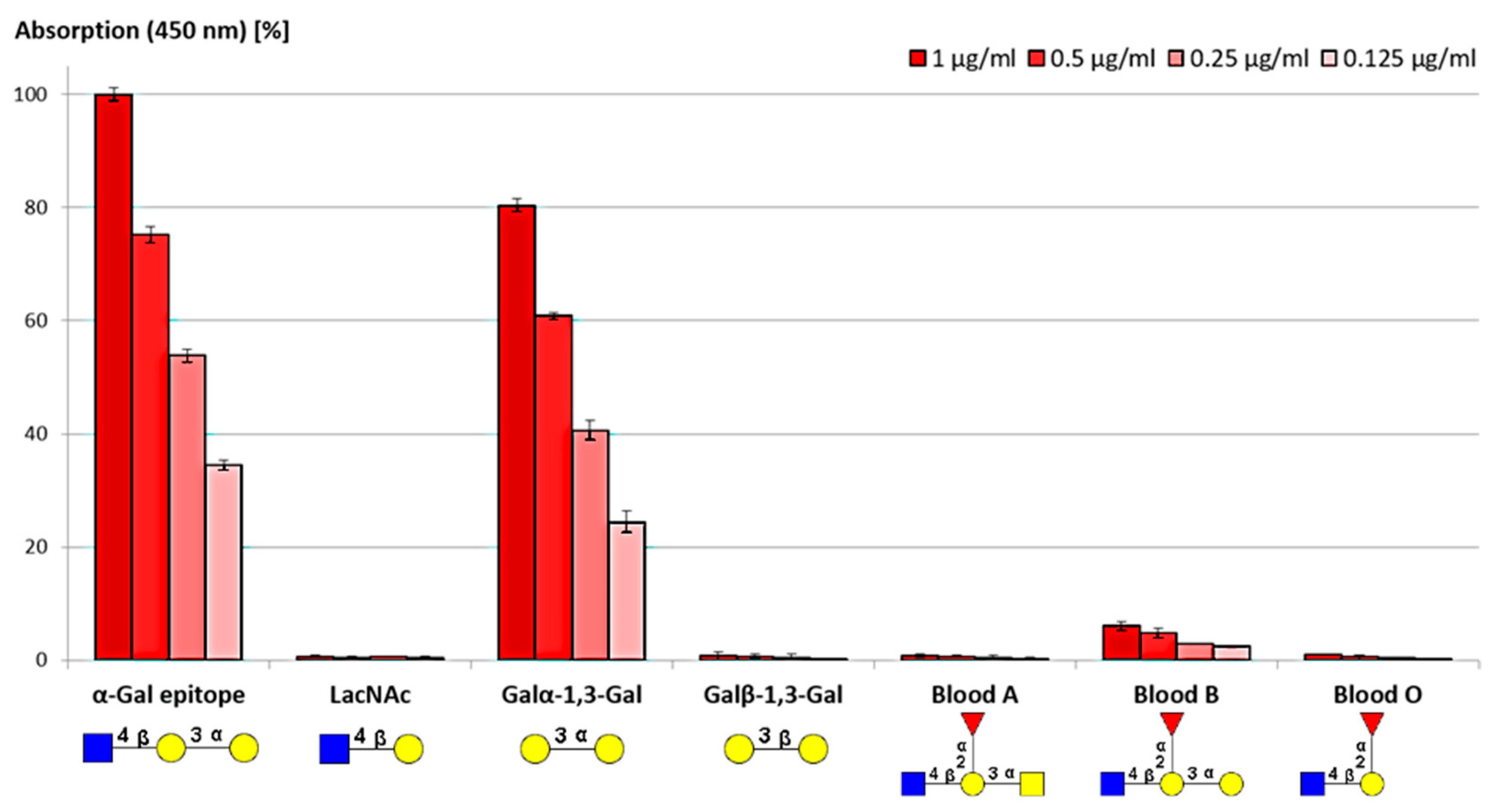
Recent advancements in glyco-immunology have validated a robust methodology for isolating and characterizing antibodies specific to the galactose-alpha-1,3-galactose (α-Gal) epitope. Utilizing a precise affinity chromatography approach involving a synthetic α-Gal matrix, researchers successfully purified a polyclonal antibody population from human plasma sources. Detailed isotype profiling revealed a predominance of the IgG2 subclass (approximately 83%), consistent with an immune response driven by gastrointestinal bacterial flora, rather than the IgG1 profile typically associated with tick-induced sensitization.
Crucially for assay development, these purified antibodies demonstrated remarkable specificity in Enzyme-Linked Immunosorbent Assays (ELISA). As illustrated in the accompanying data, the antibodies exhibited strong, dose-dependent binding to α-Gal trisaccharides and disaccharides while maintaining negligible reactivity towards structurally homologous glycans, including N-acetyllactosamine (LacNAc) and Blood Group A or O antigens. Only minor interaction was observed with Blood Group B, confirming the high selectivity required for distinguishing α-Gal in complex biological matrices. Further kinetic characterization via Surface Plasmon Resonance (SPR) established high-affinity binding with dissociation constants (KD) in the nanomolar range (144 nM), far exceeding the typical affinity of anti-carbohydrate antibodies. This combination of high specificity and strong affinity confirms the suitability of such antibodies for sensitive detection applications, including Western Blotting and flow cytometry, in both xenotransplantation safety and allergy diagnostics.
Start a Project Conversation
To help us prepare a focused feasibility discussion, please share:
• complete target structure and desired recognition breadth
• positive, negative, and counter-target
materials already available
• sample type and intended validation environment
• preferred antibody
format and downstream assay
• known chemistry, handling, timeline, or project constraints
Frequently Asked Questions
What information is most useful for project initiation?
Share the complete α-Gal structure, presentation background,
intended assay, desired antibody format, and the biological question the reagent needs to answer. Available
positive and negative materials are equally valuable. We use these details to shape a feasible antigen panel
and prioritize the comparisons that will matter during candidate selection.
How do you select an α-Gal antigen?
Antigen selection begins with the Galα1-3Galβ1-4GlcNAc-R
determinant, then considers attachment position, spacer, carrier, density, and the native molecular context. A
useful construct exposes the intended surface without making presentation chemistry dominant. When possible,
we pair it with an orthogonal positive antigen for later confirmation.
Which counter-screens help separate α-Gal from related motifs?
The most informative panel may include β-linked galactose
structures, alternative underlying chains, LacNAc-related motifs, carrier-only material, and linker controls.
We prioritize neighbors that are abundant or experimentally plausible in the intended sample. Candidate
ranking reflects the full pattern, not target signal considered in isolation.
Can customer-provided tissue, serum, or cells be included?
Yes, when the material, handling requirements, and assay
suitability are reviewed during scoping. Customer samples can provide valuable biological context, but they
work best after structurally defined comparisons have narrowed the candidate set. Appropriate positive and
negative controls help distinguish epitope recognition from matrix effects or background binding.
Why validate candidates in more than one assay environment?
Immobilization, fixation, glycan density, and surrounding
proteins or lipids can change epitope accessibility. A candidate that performs well on a coated conjugate may
behave differently on cells or tissue. Orthogonal validation therefore tests whether the recognition profile
remains useful in the format that will support the customer's research decision.
Which antibody formats can be considered?
Format selection follows the intended use rather than a single
default. Monoclonal antibodies, recombinant sequence-defined formats, or other project-appropriate outputs may
be discussed, together with isotype, valency, labeling, and reformatting needs. We also consider whether
avidity is helpful for detection or could obscure fine specificity during characterization.
References
- Zappe, A., et al. "Purification and Characterization of Antibodies Directed against the α-Gal Epitope." BioChem 1.2 (2021): 81-97. Distributed under Open Access license CC BY 4.0. https://doi.org/10.3390/biochem1020008
Project Inquiry
For Research Use
Only.Not for clinical or diagnostic use.