


Fungal Cell Wall Polysaccharides: Targets for Antifungal Therapy
Creative Biolabs supports fungal glycan research with customized solutions for antibody generation, specificity profiling, and assay development. For teams investigating beta-glucan accessibility, mannan presentation, or glycan-oriented marker discovery, our Anti-Fungal Glycan Antibody Development service offers a practical route to application-matched reagents for research use only. Fungal cell wall polysaccharides are central to pathogen survival, host recognition, and antifungal response, which makes them valuable targets in mycology, immunology, and drug discovery research.
Why Fungal Cell Wall Polysaccharides Matter
The fungal cell wall is a dynamic extracellular scaffold that preserves morphology, protects against osmotic and mechanical stress, and mediates interactions with host cells and environmental signals. Unlike mammalian cells, fungi possess a rigid wall enriched in polysaccharides and glycoproteins, which immediately distinguishes fungal pathogens at the molecular level. This biochemical separation is one reason fungal wall components remain such attractive antifungal drug targets. The wall is not a static shell. It is continuously remodeled during budding, hyphal growth, nutrient adaptation, stress response, and immune evasion.
In most medically relevant fungi, the dominant polysaccharide classes include beta-glucans, mannans, and chitin. These molecules are structurally and functionally connected. Inner wall beta-1,3-glucan forms a major load-bearing framework. Beta-1,6-glucan links structural elements and wall proteins. Chitin reinforces the wall through insoluble fibrillar assemblies. Mannan-rich glycoproteins decorate the outermost surface and strongly influence permeability, antigenicity, adhesion, and recognition by host receptors. Together, these components define the fungal cell wall structure and explain why wall remodeling often changes susceptibility to immune attack or antifungal compounds.
The relevance of these glycans extends beyond structural biology. Beta-glucan is widely studied as a conserved fungal signature and as a major molecular target of echinocandin-class inhibitors. Mannan-containing surface structures are also widely used in fungal detection and comparative cell wall studies. Chitin, although less abundant than glucan in many yeasts, becomes highly important under drug stress, during morphotype switching, and in compensatory survival programs. Because these layers are coordinated rather than isolated, meaningful target analysis often requires an integrated view of exposure, architecture, masking, and compensatory biosynthesis.
Core Features of the Fungal Cell Wall Structure
The fungal wall is commonly organized as an inner structural network and an outer interactive layer. In Candida albicans cell wall models, the inner compartment is dominated by beta-glucan and chitin, while the outer compartment is enriched in mannoproteins carrying complex mannan chains. This arrangement is functionally significant. Inner polysaccharides contribute rigidity, whereas outer mannans define many of the first host-facing epitopes. The degree to which beta-glucan remains buried or exposed directly affects immune sensing by receptors such as Dectin-1. This is why beta-glucan masking and unmasking have become major topics in fungal pathogenesis and antifungal strategy research.
Species differences are equally important. Candida, Cryptococcus, and Aspergillus all use glucans, chitin, and glycosylated wall constituents, but the abundance, branching pattern, linkage distribution, and accessory molecules vary substantially. Hyphal and yeast forms of the same organism may also differ. In Candida albicans, hyphal walls typically contain more chitin than yeast walls, while mannan arrangement and acid-labile side chains can also shift with morphology. These changes influence antibody accessibility, enzyme sensitivity, and the interpretation of binding data in microscopy, flow cytometry, or plate-based assays.
| Polysaccharide Class | Typical Localization | Main Biological Role | Research Relevance |
|---|---|---|---|
| Beta-glucans | Inner wall core, linked to other wall components | Mechanical strength, scaffold formation, cross-linking support | Beta-glucan target validation, drug mechanism studies, immune recognition |
| Mannans | Outer mannoprotein-rich surface layer | Surface architecture, adhesion, permeability, immune modulation | Mannan antigen detection, strain profiling, surface epitope analysis |
| Chitin | Inner wall reinforcement zones and septal regions | Rigidity, septation, stress adaptation, compensatory remodeling | Cell wall stress studies, resistance biology, combination target analysis |
Beta-Glucan, Mannan, and Chitin as Functional Targets
Beta-Glucan as a Structural and Pharmacological Target
Beta-1,3-glucan is one of the most important load-bearing polymers in fungal walls and a primary target for approved antifungal classes that inhibit glucan synthase. Because it is absent in humans and functionally indispensable in many fungi, beta-glucan remains one of the most validated antifungal drug targets. However, its value is not limited to pharmacology. The degree of beta-glucan exposure on the cell surface influences innate immune recognition, inflammatory signaling, and the apparent performance of beta-glucan-binding reagents. For this reason, beta-glucan target studies increasingly combine structural mapping with exposure analysis rather than relying on total glucan content alone.
Mannan Antigen as a Surface Readout
Mannan-rich glycoproteins dominate the outer surface in many yeasts and directly shape how fungal cells are perceived by the host or by analytical reagents. The term mannan antigen usually refers to these exposed mannose-containing structures that can be recognized by antibodies, lectins, or innate immune receptors. Because mannans can vary with species, growth phase, and environmental adaptation, they are informative markers for comparative studies. They also influence whether deeper wall epitopes remain concealed. In practical assay design, mannan readouts are useful for surface phenotyping, coating validation, and distinguishing changes in cell wall organization under stress or drug exposure.
Chitin as a Reinforcement and Escape Layer
Chitin is generally a smaller fraction of the wall in yeasts than beta-glucan, yet its functional influence is often disproportionate to its abundance. Chitin accumulates in bud scars, septa, and stress-adapted wall regions, where it reinforces integrity and helps compensate for glucan pathway disruption. Increased chitin synthesis is a common adaptive response when fungi encounter glucan synthase inhibitors, making it an important variable in resistance biology. Although chitin is a more challenging direct drug target, it remains essential for integrated cell wall studies because its upregulation can explain reduced sensitivity to agents that primarily disrupt glucan assembly.
Why Candida Albicans Remains a Priority Model
Candida albicans remains one of the best-studied systems for fungal wall biology because it combines clinical relevance with strong experimental tractability. The Candida albicans cell wall is frequently described as a two-layered architecture in which mannoproteins occupy the outer region and a beta-glucan-chitin skeleton forms the inner framework. This layout makes it an informative model for investigating masking, unmasking, morphotype-dependent remodeling, and the relationship between wall synthesis and virulence. Findings from C. albicans often guide target prioritization for other yeasts and filamentous fungi, even when the final architecture differs.
From a reagent development standpoint, C. albicans also illustrates the importance of antigen context. A probe that binds purified beta-glucan may behave differently on intact cells depending on hyphal status, environmental stress, mannan density, and fixation conditions. The same principle applies to mannan antigen mapping. Researchers therefore benefit from tools that are validated across purified glycans, intact cells, and application-specific formats. This need directly supports demand for custom anti-fungal glycan antibodies and orthogonal validation platforms.
Implications for Antifungal Drug Target Discovery
Cell wall-directed discovery depends on more than identifying an essential polymer. A useful target must also be accessible, biologically relevant across strains or morphotypes, and connected to measurable phenotypes. Beta-glucan synthesis remains the most established route, but broader antifungal drug targets increasingly include wall assembly enzymes, glycosyltransferases, remodeling proteins, and pathways that govern exposure of immunogenic polysaccharides. Mannan biosynthesis and cell wall glycoprotein maturation also receive growing attention because they shape host interaction and can alter susceptibility to both immune attack and drug action.
For discovery teams, the key question is often not whether a polysaccharide matters, but how to measure it in the right biological context. Reliable antibodies and glycan-focused analytical tools help answer whether an observed phenotype reflects altered abundance, altered exposure, altered branching, or compensatory remodeling. This distinction is critical when prioritizing candidates, interpreting screening data, or comparing strains under drug pressure.
Target Accessibility
Surface masking can hide beta-glucan or alter mannan antigen presentation, so exposure mapping is often as important as total abundance.
Compensatory Remodeling
Inhibition of one wall pathway may increase chitin deposition or alter mannoprotein display, which can reshape drug response and assay readouts.
Assay Context
Purified glycan binding, intact-cell staining, and fixed-tissue analysis may not produce equivalent results unless reagents are optimized for the intended workflow.
Our Solutions for Fungal Glycan Research
Creative Biolabs provides research-oriented support for investigators working on fungal wall glycans, glycoepitopes, and glycan-mediated host-pathogen interactions. Our workflows are built for specificity, application matching, and reproducible analytical performance. We can support projects focused on beta-glucan target analysis, mannan antigen profiling, chitin-associated wall remodeling, and comparative mapping of fungal surface glycans.
Anti-Fungal Glycan Antibody Development
Custom antibody generation against defined fungal glycan targets, including beta-glucan- and mannan-related epitopes, with screening strategies designed to reduce off-target binding and improve assay fitness.
Glycoarray Platforms
Glycan array solutions for specificity evaluation, epitope differentiation, and comparative profiling across structurally related carbohydrate motifs relevant to fungal cell wall studies.
Glycosylation Analysis
Analytical support for glycan characterization, conjugate quality assessment, and structure-function interpretation in fungal glycan and antibody research projects.
Anti-Glycan Antibody Detection Services
Assay development and validation support for ELISA, immunofluorescence, flow cytometry, and related research formats that require robust glycan-focused reagents.
Typical project scopes include antigen design consultation, immunogen strategy discussion, clone screening against related carbohydrate structures, and validation using purified targets, fungal cells, or customized assay panels. All services are provided for scientific research use only and are not intended for clinical diagnosis or treatment.
Request a Quote for Your Project
If your team is evaluating fungal wall glycans as biomarkers, surface epitopes, or antifungal discovery targets, a clear experimental design at the beginning of the project can save substantial time later. Share your target polysaccharide class, fungal species, preferred application, and any known concerns regarding cross-reactivity or antigen masking. We can then recommend a practical development path aligned with your research objective, timeline, and sample context.
Talk to Our Scientists About Your Fungal Glycan Project
Published Data
An open-access review by Garcia-Rubio and colleagues summarizes how the fungal cell wall is organized in major pathogenic fungi and why beta-glucans, mannans, and chitin remain important in antifungal research. The article states that the fungal cell wall is mainly composed of glucans, chitin, and glycoproteins, notes that these components are not present in humans, and explains why the wall remains an attractive antifungal target. The review also describes the Candida albicans wall as a layered structure in which a beta-glucan-chitin skeleton supports an outer mannoprotein-rich zone. These points provide useful background for studying beta-glucan exposure, outer-wall mannans, and chitin-related remodeling in fungal systems.
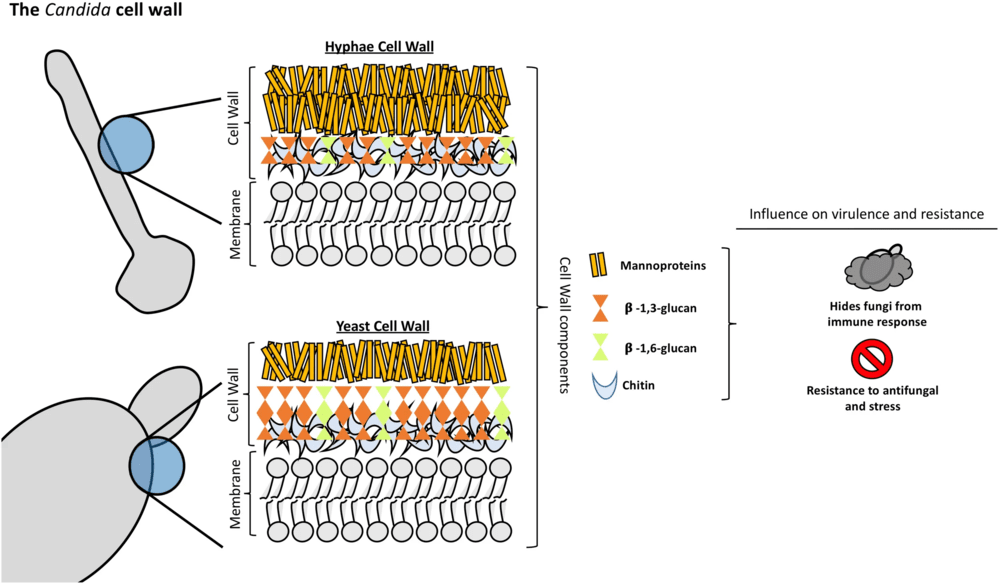 Fig.1
Candida albicans cell wall structure and polysaccharide organization.1
Fig.1
Candida albicans cell wall structure and polysaccharide organization.1
Figure 1 compares hyphal and yeast wall organization in Candida albicans and shows the distribution of mannoproteins, beta-1,3-glucan, beta-1,6-glucan, and chitin. It offers a clear visual reference for the layered organization discussed in the review and helps explain why surface-facing mannoproteins and inner structural polysaccharides should be interpreted in their proper architectural context.
FAQs
Why is beta-glucan considered such an important antifungal target?
Beta-glucan is a major structural polysaccharide in many fungal walls, is absent from human cells, and is directly involved in wall integrity. These features make it both biologically important and selectively attractive for antifungal research.
What does mannan antigen analysis tell researchers?
Mannan-rich structures occupy the fungal outer surface in many species, so mannan antigen profiling can reveal differences in surface architecture, morphotype, strain behavior, and epitope accessibility.
Why should chitin be considered if beta-glucan is the main target?
Chitin often increases during cell wall stress or compensatory remodeling. If a fungus adapts to glucan pathway inhibition by reinforcing chitin, that shift can influence both experimental interpretation and target prioritization.
Is the Candida albicans cell wall a good model for broader fungal research?
Yes. Although different fungi have distinct wall architectures, C. albicans remains a powerful reference system for studying layered wall organization, beta-glucan masking, mannan exposure, and morphology-dependent remodeling.
Can custom antibodies help distinguish related fungal glycans?
Yes. With a suitable antigen design and screening strategy, custom anti-glycan antibodies can be selected to improve specificity against structurally related carbohydrate motifs and support cleaner downstream assays.
What samples can be used for fungal glycan reagent validation?
Validation can be performed using purified glycans, conjugates, fungal cells, wall extracts, or application-specific systems such as immunofluorescence, ELISA, or flow cytometry, depending on project goals.
Are these services intended for clinical diagnosis or treatment?
No. The services and reagents described on this page are provided for scientific research use only and are not intended for clinical diagnosis, patient management, or therapeutic use.
Reference:
- Garcia-Rubio, Rocio, Haroldo C. de Oliveira, Johanna Rivera, and Nuria Trevijano-Contador. The Fungal Cell Wall: Candida, Cryptococcus, and Aspergillus Species. Frontiers in Microbiology 10 (2020): 2993. Distributed under Open Access license CC BY 4.0, without modification. https://doi.org/10.3389/fmicb.2019.02993