


Linkage-matched antigens that define the desired β-Gal surface.
Anti-β-Gal Glycan Antibody Development Service
Creative Biolabs develops β-Gal glycan antibodies with linkage-aware antigen design, structural counter-screening, and application-focused validation for precise research recognition.
Your project may need an antibody that recognizes a β-linked galactose in one defined chain, discriminates β1-3 from β1-4 presentation, or detects a broader family of β-Gal-terminated structures. Those objectives lead to different antigens and different candidate-ranking logic. Creative Biolabs first resolves the molecular target—distinct from the β-galactosidase enzyme—and connects it to the sample and assay in which the antibody will be used. By preserving linkage, neighboring sugars, substitution, and glycoconjugate context in the planning stage, we can help customers pursue a reagent that answers a specific research question rather than a binder to an ambiguous “beta-Gal” label.
Creative Biolabs supports this work through our Non-Human Glycan Antibody Development Service. Every program is for research use only and is configured around the submitted structure, sample context, and intended readout.
Challenges in Developing β-Gal Glycan Antibodies
In this service, β-Gal denotes a beta-linked galactose glycan epitope, not the β-galactosidase enzyme. That distinction must be explicit because the two targets require different antigen designs, screening reagents, and validation logic. Even within glycans, β-Gal is incomplete as a structural definition: β1-3 and β1-4 linkages, underlying sugars, substitutions, branching, and glycoconjugate context can alter the recognized surface.
A useful development strategy therefore begins with a full glycan notation and a decision about recognition breadth. An antibody intended to detect a family of β-Gal-terminated glycans requires a different positive panel from one intended to distinguish a single linkage or LacNAc-related context.
Candidate selection is strengthened by:
α-Gal, alternative β-Gal linkages, and substituted LacNAc structures for informative counter-selection.
Application-relevant materials that reveal whether immobilization or biological context changes candidate behavior.
Defining the β-Gal Linkage and Glycoconjugate Context
The target record should state the anomeric configuration, linkage position, neighboring monosaccharides, branching, reducing-end attachment, and whether the epitope occurs on a glycoprotein, glycolipid, soluble conjugate, or cell surface. These variables control which hydroxyl groups are exposed and how closely the test antigen resembles the research sample.
When the desired reagent should recognize several β-Gal contexts, the positive panel needs deliberate structural diversity. When context selectivity is required, matched glycans that differ only in linkage or neighboring residue become essential discriminators.
Specificity Mapping Across Related Galactose Structures
The counter-panel should distinguish the intended β-Gal linkage from α-Gal, LacNAc-related motifs, terminal galactose in alternative chains, and shared carrier features. Comparisons that alter one structural feature at a time are more informative than an unrelated library of negative glycans.
Orthogonal confirmation helps identify candidates that depend on coating density or attachment chemistry. A binder should not be described as broadly β-Gal-specific unless the positive panel actually spans the claimed contexts.
Our Anti-β-Gal Glycan Antibody Development Services
Creative Biolabs supports β-Gal glycan antibody development through antigen planning, candidate generation, structural counter-screening, and application-oriented assessment. Each project is configured around the target linkage and biological presentation rather than a generic anti-galactose workflow.
Glycan Antigen and Antibody Development
Target antigens may use defined glycans, glycopeptides, carrier conjugates, or a biological presentation selected for the intended recognition question. Candidate generation is matched to antigen properties, required format, and the need to retain clones with distinct structural preferences.
Specificity Mapping and Validation
A staged panel measures target binding, removes carrier or linker reactivity, compares α-Gal and related β-Gal structures, and then tests prioritized candidates in the intended assay context.
Our Development Workflow
Resolve Exact Structure
Resolve the exact β-Gal structure and exclude β-galactosidase-related search intent.
Select Target and Controls
Select target antigens and matched carrier, linker, α-Gal, and related β-Gal controls.
Generate Candidates
Generate candidates using a route compatible with the antigen and desired antibody format.
Screen Target Recognition
Screen for target recognition while preserving clones with distinct linkage profiles.
Map Cross-Reactivity
Map cross-reactivity across structurally informative glycans and confirm performance in the intended assay.
Report Recognition Scope
Report the tested recognition scope and remaining interpretation limits.
The workflow can be adjusted around target availability, recognition breadth, antibody format, and validation environment. Discovery route, host, assay sequence, panel size, and delivery package are discussed for each program. This flexibility is especially useful when early results show that a candidate class recognizes the terminal sugar broadly rather than the requested linkage context.
Project Requirements and Deliverables
The project definition should connect molecular structure to the assay decision the antibody must support. A label such as beta-Gal is insufficient unless the linkage and surrounding chain are supplied.
Project Input
Project Requirements
Provide the complete glycan notation, intended antigen format, non-target glycans, positive and negative samples, assay conditions, preferred antibody format, and desired recognition breadth.
Project Output
Deliverables and Interpretation Scope
Depending on the agreed scope, outputs may include antibody material or recombinant sequences, antigen and control documentation, binding profiles, counter-screening data, and application-specific results. Interpretation is restricted to the evaluated structures and formats.
Research Applications
β-Gal glycan antibodies can support research where linkage-defined galactose recognition, distribution, or glycosylation context needs to be measured. Validation should follow the intended application because soluble conjugates, arrays, fixed samples, and live cells can expose the same terminal sugar at different densities and orientations.
Glycoconjugate Mapping
Profile β-Gal-containing glycoconjugates across defined molecular or cell-surface contexts while keeping linkage and neighboring residues explicit.
Linkage-Resolved Studies
Compare β1-3, β1-4, α-Gal, and related LacNAc contexts when the research question depends on structural discrimination rather than terminal galactose alone.
Biological Sample Detection
Evaluate prioritized candidates in cells, tissues, fluids, or other biological materials after defined antigens establish the required structural recognition pattern.
Assay Development
Build research assays around the intended β-Gal linkage, positive and negative materials, and an application format that reflects the final experimental decision.
Published Data
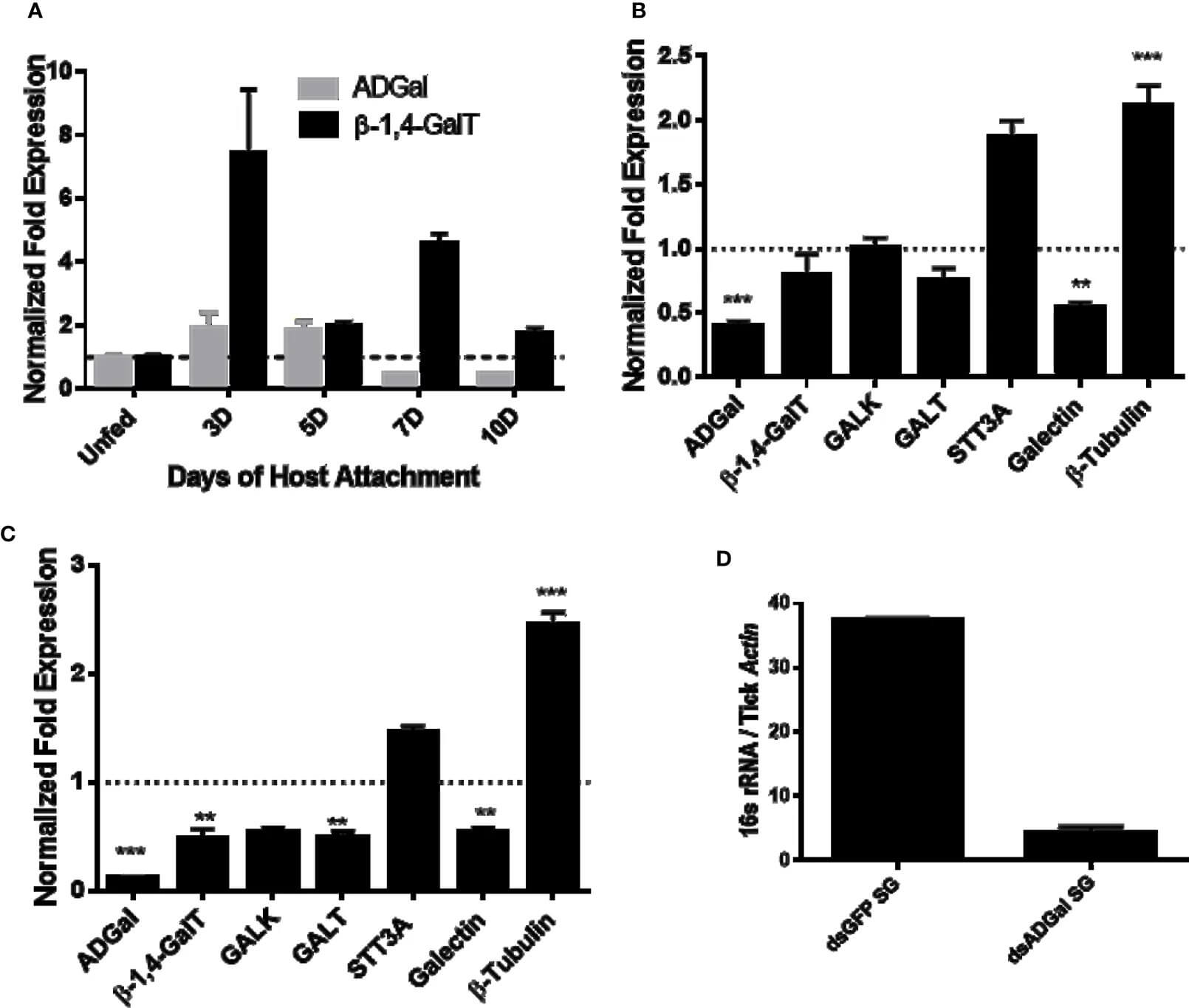
Sharma and colleagues reported β-1,4-galactosyltransferase expression together with other enzymes involved in α-Gal metabolism. The study is not evidence of antibody performance, but it illustrates that a beta-galactose-forming enzyme operates within a coordinated processing system. For reagent development, this makes linkage, neighboring sugars, and biosynthetic context relevant counter-screening variables.
Start a Project Conversation
To help us prepare a focused feasibility discussion, please share:
• complete target structure and desired recognition breadth
• positive, negative, and counter-target
materials already available
• sample type and intended validation environment
• preferred antibody
format and downstream assay
• known chemistry, handling, timeline, or project constraints
Frequently Asked Questions
What information is needed to start a β-Gal antibody project?
Provide the complete glycan notation, linkage, neighboring
residues, substitutions, presentation background, intended assay, and desired recognition breadth. Please also
distinguish the glycan target from β-galactosidase. Available positive and negative samples help us propose an
antigen set and candidate-ranking strategy aligned with the actual research objective.
How is the most suitable β-Gal antigen selected?
We consider whether the antibody should recognize one linkage,
one glycoconjugate context, or several β-Gal-terminated structures. Attachment position, carrier, spacer, and
density are chosen to preserve the relevant surface. An orthogonal antigen can then help confirm that
candidate binding follows the glycan rather than one presentation component.
What belongs in a β-Gal counter-screening panel?
Useful controls may include α-linked galactose, alternative
β-Gal linkages, different underlying sugars, substituted LacNAc structures, and carrier or linker controls.
The final panel reflects the intended specimen and the nearest plausible interferents. We compare response
patterns across this set when selecting candidates for deeper characterization.
Can biological samples be introduced during screening?
Customer-provided cells, tissues, fluids, or glycoconjugates
may be considered after sample suitability and controls are reviewed. Defined antigens provide structural
resolution, while biological samples test accessibility and background. Using both types of material helps
avoid advancing clones that bind a synthetic display but not the customer’s relevant environment.
How does the validation assay affect candidate choice?
Coated glycans, arrays, cells, and tissue can present the same
terminal sugar at different densities and orientations. A candidate’s apparent affinity or specificity may
therefore shift between formats. We prioritize confirmation in an orthogonal system and, where feasible, the
intended application so the final ranking reflects practical performance.
Can the antibody be reformatted after selection?
Reformatting may be discussed when sequence-defined candidates
are available and the research application benefits from a different isotype, valency, species framework, or
label. Because format can change avidity and background, we recommend comparing the reformatted antibody in
key target, counter-target, and application assays before drawing broader conclusions.
References
- Sharma, Surendra Raj, et al. Alpha-Gal Syndrome: Involvement of Amblyomma americanum α-D-Galactosidase and β-1,4 Galactosyltransferase Enzymes in α-Gal Metabolism. Frontiers in Cellular and Infection Microbiology 11 (2021): 775371. Distributed under Open Access license CC BY 4.0, without modification. https://doi.org/10.3389/fcimb.2021.775371
Project Inquiry
For Research Use
Only.Not for clinical or diagnostic use.