- Home
- ADC Development
- ADC In Vitro Analysis
- 3D Cell Culture for ADC Evaluation: Targeting, Penetration & Efficacy Assays
- 2D vs 3D Cell Culture Models for ADC Efficacy: A Comparative Analysis Guide
2D vs 3D Cell Culture Models for ADC Efficacy: A Comparative Analysis Guide
Selecting the appropriate cell culture model is critical for accurate pre-clinical ADC efficacy evaluation. Creative Biolabs provides comprehensive comparison and analysis services using both traditional 2D monolayer and advanced 3D cell culture systems. Our integrated approach enables thorough assessment of ADC tissue penetration, bystander killing effects, and in vivo relevance, bridging the gap between in vitro screening and in vivo performance.
Inquire About 2D/3D Culture ServicesOverview: 2D vs 3D Cell Culture Models for ADC Analysis
Antibody-drug conjugate (ADC) pre-clinical development relies heavily on in vitro efficacy evaluation to predict in vivo performance. The choice between two-dimensional (2D) and three-dimensional (3D) cell culture models significantly impacts the physiological relevance, data quality, and translational value of pre-clinical research findings.
Fundamental Differences Between 2D and 3D Models
Traditional 2D cell culture has been the workhorse of ADC screening for decades, offering simplicity, speed, and high-throughput compatibility. However, 3D cell culture systems—including tumor spheroids and patient-derived organoids (PDOs)—more accurately mimic the in vivo tumor microenvironment, cell-cell interactions, and drug penetration dynamics. Key considerations include:
- • Microenvironment Complexity: 3D models replicate tissue architecture, extracellular matrix (ECM) interactions, and hypoxic gradients that 2D monolayers cannot simulate.
- • Drug Penetration Assessment: 3D spheroids enable evaluation of ADC tissue penetration and heterogeneous drug distribution, critical parameters that cannot be assessed in 2D cultures.
- • Bystander Killing Evaluation: The bystander effect—whereby ADCs kill both target antigen-positive and adjacent antigen-negative cells—can only be accurately quantified in 3D models with heterogeneous cell populations.
- • Translational Relevance: 3D culture data often correlates better with in vivo efficacy and clinical outcomes, reducing the risk of costly late-stage failures.
Comprehensive Comparative Analysis Services
At Creative Biolabs, we offer parallel 2D and 3D culture analysis to provide a complete picture of your ADC candidate's pre-clinical performance. Our services include direct comparative assessment of cytotoxicity, penetration, and bystander effects, enabling informed decision-making and optimized ADC design before costly in vivo studies.
Overcoming the Limitations of 2D Culture Models
While 2D cell culture remains valuable for initial screening, it has significant limitations that can lead to misleading pre-clinical conclusions and failed in vivo translation:
- ▶ Lack of Physiological Relevance: 2D monolayers lack cell-cell and cell-ECM interactions, resulting in altered cell signaling, metabolism, and drug response compared to in vivo tissues.
- ▶ Inability to Assess Penetration: ADCs must penetrate deeply into tumor masses in vivo. 2D cultures provide no spatial dimension to evaluate tissue penetration or heterogeneous drug distribution.
- ▶ Bystander Effect Blind Spot: The bystander killing effect—a key mechanism for treating heterogeneous tumors—cannot be accurately modeled in uniform 2D monolayers where all cells are equally accessible.
2D vs 3D Culture Comparative Analysis Services
We provide comprehensive comparative analysis services to evaluate your ADC candidates in both 2D and 3D culture systems. Our integrated platform enables direct head-to-head comparison, revealing critical insights that single-model studies may miss.
| Service Name | Technical Specifications | Analysis Capabilities | Service Deliverables |
|---|---|---|---|
|
Primary Service Comparative Cytotoxicity Analysis (2D vs 3D) Parallel IC50/EC50 determination in 2D monolayers and 3D spheroids to assess potency differences. |
• 2D Analysis: Standard MTS/SRB assays in 96/384-well plates. • 3D Analysis: Spheroid formation and dose-response in ultralow attachment plates. • Readouts: Viability, ATP production, apoptosis markers. • Best For: Initial potency comparison, lead candidate screening. |
• Side-by-side IC50 comparison (2D vs 3D) • Dose-response curves with R² values • Viability kinetics over 72-168 hours • Statistical analysis of potency shifts |
• Comparative cytotoxicity report with IC50 table • Dose-response curves (2D and 3D overlay) • Spheroid formation and growth kinetics • Expert interpretation of 2D-to-3D translation |
|
Penetration Analysis 3D Tissue Penetration Assessment Quantitative evaluation of ADC distribution within 3D spheroids using confocal imaging and quantitative analysis. |
• Spheroid Models: Homogeneous and heterogeneous spheroids (antigen +/- mixed populations). • Imaging: Confocal Z-stack acquisition (optical sectioning). • Quantification: Mean fluorescence intensity (MFI) radial profiling. • Best For: ADCs with suspected penetration limitations, high molecular weight conjugates. |
• Radial penetration profiles (core vs. periphery) • Quantitative MFI gradient analysis • Penetration depth measurement (µm) • Comparison across ADC candidates |
• Confocal images (Z-stack maximum projections) • Radial MFI quantification report • Penetration depth summary table • Recommendations for linker/payload optimization |
|
Bystander Effect Bystander Killing Quantification (3D) Precise quantification of bystander killing in 3D heterogeneous spheroids using flow cytometry and imaging. |
• Heterogeneous Models: Mixed spheroids (e.g., 80% antigen+, 20% antigen-). • Readouts: Flow cytometry (viability dyes), live/dead imaging, cleaved caspase 3 staining. • Quantification: Percentage of antigen-negative cells killed. • Best For: ADCs designed for heterogeneous antigen expression, payload selection. |
• Bystander killing efficiency (%) • Antigen+ vs. antigen- cell viability comparison • Spatial distribution of cell death (imaging) • Dose-dependent bystander effect curves |
• Bystander killing report with flow plots • Confocal images of heterogeneous spheroids • Quantitative bystander efficiency table • Correlation with payload membrane permeability |
|
Advanced Model Patient-Derived Organoid (PDO) Efficacy Highest physiological relevance using patient-derived organoids to evaluate ADC efficacy in 3D ex vivo models. |
• PDO Models: Established PDOs from various tumor types (breast, lung, colorectal, etc.). • Culture: Matrigel or synthetic hydrogel embedding. • Readouts: Organoid viability, size reduction, histology. • Best For: Pre-clinical validation, patient-specific ADC response prediction. |
• PDO viability and size quantification • Histological assessment (H&E, Ki-67) • Dose-response in physiologically relevant models • Comparison across patient-derived lines |
• PDO efficacy report with phase-contrast images • Histological analysis (if applicable) • Viability dose-response curves • Translational relevance assessment |
Standardized Workflow for 2D vs 3D Comparative Analysis
Our streamlined pre-clinical workflow ensures reproducible, comparative data across 2D and 3D culture systems, from initial model setup to final data interpretation:
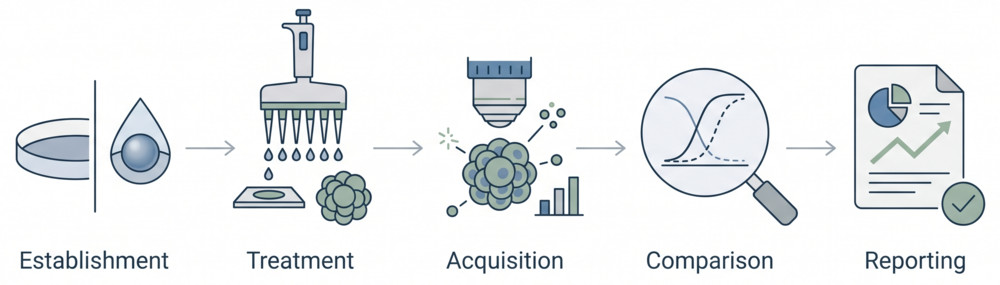
Phase 1: 2D and 3D Model Establishment
Parallel setup of 2D monolayer cultures (standard tissue culture plates) and 3D spheroid/organoid cultures (ultralow attachment plates or Matrigel embedding). Model validation ensures physiological relevance and reproducibility for comparative analysis.
Phase 2: ADC Treatment and Dose-Response
Treatment of both 2D and 3D models with serially diluted ADCs. Careful control of dosing, incubation time, and media conditions ensures fair comparison and data integrity across culture systems.
Phase 3: Multi-Parameter Data Acquisition
Parallel data collection including viability assays (2D/3D), confocal imaging (3D penetration), flow cytometry (bystander effect), and quantitative analysis. Orthogonal readouts validate findings across multiple methodologies.
Phase 4: Comparative Data Analysis
Advanced bioinformatics and statistical analysis to compare 2D and 3D outcomes. Key metrics include IC50 shifts, penetration depth, bystander killing efficiency, and correlation with in vivo data (if available).
Phase 5: Comprehensive Reporting and Interpretation
Delivery of a complete comparative analysis report including side-by-side data visualization, statistical analysis, and expert interpretation. Recommendations for ADC optimization and in vivo study design are provided to maximize pre-clinical success.
Advanced Platforms for 2D vs 3D Comparative Analysis
Our multi-platform approach ensures comprehensive evaluation of ADC efficacy across both 2D and 3D culture systems:
1. 2D Monolayer High-Throughput Screening Platform
A foundational platform for rapid ADC cytotoxicity screening. Utilizes standard tissue culture-treated plates for fast, cost-effective initial assessment of ADC potency across multiple cell lines and dosing conditions.
- • High Throughput: 96/384-well format compatible, enabling screening of multiple ADC candidates and dosing regimens simultaneously.
- • Established Protocols: MTS, XTT, SRB, and ATP-based viability assays with robust Z-factors for quality control.
- • Rapid Turnaround: Results within 3-5 days, ideal for early-stage lead candidate prioritization.
2. 3D Spheroid Efficacy Assessment Platform
An advanced platform for evaluating ADC efficacy in 3D spheroid models that mimic solid tumor architecture. Enables assessment of tissue penetration, heterogeneous drug distribution, and bystander killing effects.
- • Spheroid Formation: Ultralow attachment plates, hanging drop, or AgreeLow™ technology for reproducible spheroid generation.
- • Penetration Imaging: Confocal microscopy with Z-stack acquisition for quantitative radial penetration profiling.
- • Bystander Quantification: Heterogeneous spheroids (antigen +/- mixed) with flow cytometry or imaging readouts.
3. Patient-Derived Organoid (PDO) Evaluation Platform
A cutting-edge platform using patient-derived organoids to evaluate ADC efficacy in physiologically relevant 3D ex vivo models. Provides the highest level of translational relevance for pre-clinical ADC development.
- • PDO Establishment: Established organoid lines from multiple tumor types (breast, lung, colorectal, pancreatic, etc.).
- • 3D Culture: Matrigel or synthetic hydrogel embedding to maintain physiological architecture and cell-ECM interactions.
- • Translational Readouts: Organoid viability, size reduction, histological assessment, and correlation with patient response data.
4. Comparative Data Integration and Bioinformatics Platform
A specialized platform for integrating and analyzing comparative data from 2D and 3D culture systems. Advanced statistical modeling identifies correlations, predicts in vivo translation, and guides ADC optimization.
- • Multi-Parameter Integration: IC50 values, penetration depths, bystander efficiencies, and in vivo PK/PD data (if available) in unified analysis.
- • Predictive Modeling: Machine learning algorithms to predict in vivo efficacy based on 2D/3D in vitro data.
- • Custom Reporting: Interactive dashboards and comparative visualizations for clear data interpretation and decision-making.
Why Choose Our 2D vs 3D Comparative Analysis Services?
Bridging the 2D-to-In Vivo Gap
Our 3D culture platforms provide physiologically relevant data that correlates better with in vivo efficacy, reducing the risk of costly late-stage failures in ADC development.
Comprehensive Bystander Effect Assessment
Only 3D heterogeneous models can accurately quantify bystander killing—a critical mechanism for treating antigen-heterogeneous tumors. Our platforms provide quantitative bystander efficiency metrics.
Quantitative Penetration Profiling
Advanced confocal imaging and radial MFI analysis enable precise quantification of ADC penetration depth and heterogeneous distribution within 3D tumor spheroids.
Accelerated Pre-Clinical Decision-Making
Parallel 2D/3D analysis within 2-3 weeks delivers comprehensive pre-clinical data, enabling informed decisions on ADC candidate selection and optimization before costly in vivo studies.
Research Insights: Advances in 2D vs 3D Culture Models
Recent studies in pharmacology have demonstrated that three-dimensional (3D) models provide superior physiological relevance and more predictive screening of drug candidates than traditional two-dimensional (2D) monolayers. According to a comprehensive review by Vella et al. (2024), advanced 3D cell culture systems—including homotypic and heterotypic spheroids, patient-derived organoids (PDOs), and microfluidics—accurately recapitulate the spatial architecture, genomic diversity, and multi-layered biochemical gradients of the in vivo tumor microenvironment (TME).
Key Pharmacological Insights from Vella et al. (2024):
- • The Spheroid Size & Diffusion Threshold: Passive drug diffusion across cellular layers generally reaches a maximum depth of approximately 200μm. Vella et al. (2024) note that spheroids must reach a diameter of at least 400μm to establish authentic intratumoral gradients (outer proliferative, middle quiescent, and inner hypoxic/necrotic zones). Models smaller than this threshold fail to accurately simulate physical barriers to drug penetration, explaining frequent discrepancies in IC50 potency values between 2D and 3D assays.
- • Heterotypic Co-Cultures & Resistance Modeling: Solid tumors do not exist in isolation. Co-culturing cancer cells with stromal elements, such as cancer-associated fibroblasts (CAFs), endothelial cells, and immune cells (e.g., tumor-associated macrophages or T-cells), enables researchers to investigate cell-to-cell and cell-to-ECM (extracellular matrix) signaling. These interactions are critical for modeling stromal-mediated resistance to target therapies and evaluating antigen-heterogeneous bystander killing of ADCs.
- • Biomechanical & Dynamic Microenvironments: Modern pharmacology leverages microfluidic platforms (such as organ-on-a-chip or breathing lungs-on-a-chip) and decellularized extracellular matrix (dECM) hydrogels to introduce physiological biomechanics. Simulating cyclic mechanical stretching (breathing motions), blood vessel perfusion, and specialized delivery methods (e.g., aerosolized/inhalable pathways vs. systemic circulation) significantly enhances the predictive accuracy of therapeutic responses.
Integrating these advanced, physiologically relevant 3D cell culture models into preclinical workflows bridges the gap between in vitro screening and in vivo performance, successfully accelerating drug development and paving the way for personalized medicine.
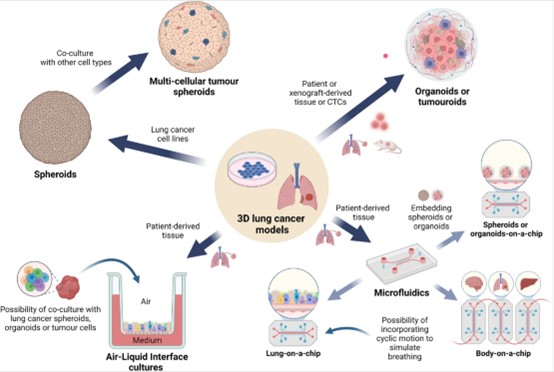
Fig.1 Overview of 3D cell culture models for lung cancer pharmacological research.1,2
FAQs about 2D vs 3D Culture Comparison
Q: Why is 3D cell culture important for pre-clinical ADC efficacy evaluation?
A: 3D cell culture models more accurately mimic the in vivo tumor microenvironment, including cell-cell interactions, extracellular matrix, and drug penetration dynamics. They enable assessment of ADC tissue penetration and bystander killing effects—critical parameters that cannot be evaluated in 2D monolayers. 3D data often correlates better with in vivo efficacy, reducing the risk of costly late-stage failures.
Q: Can you quantify the bystander killing effect of our ADC in 3D models?
A: Yes. We use heterogeneous 3D spheroids composed of both antigen-positive and antigen-negative cells. By quantifying the viability of antigen-negative cells after ADC treatment, we provide a precise measurement of bystander killing efficiency. This is particularly important for ADCs designed to treat antigen-heterogeneous tumors.
Q: How do you assess ADC penetration in 3D spheroids?
A: We use confocal microscopy with Z-stack acquisition to image ADC distribution within 3D spheroids. Quantitative radial profiling of mean fluorescence intensity (MFI) reveals penetration depth and heterogeneous drug distribution. This enables identification of ADC candidates with penetration limitations, guiding linker/payload optimization for improved in vivo performance.
Q: What are patient-derived organoids (PDOs) and how do they enhance ADC efficacy evaluation?
A: Patient-derived organoids (PDOs) are 3D culture models established from patient tumor tissues. They maintain the genetic, epigenetic, and architectural features of the original tumor, providing the highest level of physiological relevance for pre-clinical ADC evaluation. PDO efficacy data correlates better with clinical response, supporting patient-specific ADC development and personalized medicine approaches.
Q: How long does a comprehensive 2D vs 3D comparative analysis take?
A: A comprehensive comparative analysis—including 2D cytotoxicity, 3D spheroid efficacy, penetration assessment, and bystander effect quantification—typically takes 2-3 weeks. Faster turnaround (1-2 weeks) is available for 2D-only screening or simplified 3D analysis. Contact us to discuss your specific timeline requirements and project scope.
Other 3D Cell In Vitro Evaluation Services
Related Products
Related Resources

References:
1. Vella, Nathan, Anthony G. Fenech, and Vanessa Petroni Magri. "3D cell culture models in research: applications to lung cancer pharmacology." Frontiers in Pharmacology 15 (2024): 1438067. https://doi.org/10.3389/fphar.2024.1438067
2. Distributed under Open Access License CC BY 4.0, without modification.
For Research Use Only. NOT FOR CLINICAL USE.
Online Inquiry
Welcome! For price inquiries, please feel free to contact us through the form on the left side. We will get back to you as soon as possible.
