- Home
- ADC Development
- ADC In Vitro Analysis
- ADC Biochemical Analysis
- ADC Conjugate Site Analysis: Precision Mapping & Occupancy Quantification
ADC Conjugate Site Analysis: Precision Mapping & Occupancy Quantification
Precise identification and quantification of drug attachment sites is critical for understanding antibody-drug conjugate (ADC) structure-activity relationships. Creative Biolabs provides comprehensive conjugate site analysis services using advanced LC-MS/MS peptide mapping platforms. Our analytical solutions enable researchers to map exact conjugation sites, assess site occupancy, and characterize drug-linker adduct integrity—essential data for preclinical ADC development and optimization.
Inquire About Site AnalysisOverview: The Importance of Conjugate Site Analysis in ADC Research
Conjugate site analysis determines where and how drug molecules are attached to antibodies in ADC constructs. This structural characterization is fundamental to understanding how conjugation chemistry affects ADC properties, including antigen binding affinity, pharmacokinetics, stability, and in vivo efficacy.
Why Site-Specific Information Matters in Preclinical Development
In antibody-drug conjugate research, the location of drug attachment significantly impacts the biological performance of the conjugate. Understanding conjugation sites enables researchers to:
- • Assess Antigen Binding Integrity: Identify whether drug attachment occurs in complementarity-determining regions (CDRs) that could compromise target recognition and binding affinity.
- • Optimize Conjugation Chemistry: Evaluate the selectivity of different conjugation methods (lysine, cysteine, site-specific) and their impact on conjugate homogeneity.
- • Predict In Vivo Performance: Correlate site occupancy profiles with pharmacokinetic behavior, stability, and therapeutic efficacy in preclinical models.
- • Support Regulatory Requirements: Provide detailed structural characterization data required for regulatory submissions and IND applications.
Our Site Analysis Capabilities
Our conjugate site analysis services combine proteolytic digestion, liquid chromatography separation, and high-resolution mass spectrometry to deliver comprehensive site mapping data. We analyze both standard conjugation platforms (lysine, cysteine) and advanced site-specific technologies to support your ADC development pipeline.
Overcoming Conjugate Site Characterization Challenges
Accurate site analysis of ADC conjugates presents significant analytical challenges due to the complexity of antibody structures and the heterogeneous nature of conjugation reactions:
- ▶ Complex Proteome Complexity: Antibodies contain numerous potential modification sites. Identifying which specific residues carry drug-linker adducts requires high-resolution mass spectrometry and sophisticated data analysis algorithms.
- ▶ Drug-Linker Mass Interference: Drug-linker adducts introduce significant mass shifts that complicate peptide identification. Distinguishing modified peptides from unmodified variants requires careful method optimization.
- ▶ Site Occupancy Quantification: Determining the percentage of each modification site that carries a drug molecule is essential for understanding conjugate heterogeneity and lot-to-lot consistency.
Conjugate Site Analysis Services
We provide comprehensive site analysis services tailored to your ADC characterization needs. Our integrated LC-MS/MS platforms deliver precise site identification, occupancy quantification, and structural validation for informed preclinical development decisions. Each service is designed to address specific analytical requirements in your ADC research program.
Tailored Analytical Solutions for Your Research
Every ADC project presents unique characterization challenges. Our site analysis services can be customized to match your specific conjugation platform, antibody format, and research objectives. Whether you need rapid site screening for early-stage candidate evaluation or comprehensive multi-site analysis for regulatory documentation, we collaborate with you to design the optimal analytical approach for your preclinical development timeline.
| Service Name | Technical Specifications | Analysis Capabilities | Service Deliverables |
|---|---|---|---|
|
Primary Method Peptide Mapping & Site Identification Service Comprehensive LC-MS/MS analysis for precise identification of drug conjugation sites at the amino acid level. |
• Proteolytic Digestion: Optimized trypsin, chymotrypsin, and alternative protease protocols for comprehensive sequence coverage. • Chromatographic Separation: Nano-flow LC with gradient elution for optimal peptide resolution. • Mass Spectrometry: High-resolution Q-TOF or Orbitrap system for accurate mass measurement. • Database Searching: Specialized algorithms for modified peptide identification. |
• Single-amino-acid resolution site identification • Identification of all modified and unmodified peptides • Sequence coverage assessment • Drug-linker adduct mass verification |
• Annotated peptide mapping report • Modification site identification with sequence location • Mass spectrum of key modified peptides • Expert interpretation of results |
|
Quantitative Site Occupancy Quantification Service Determination of the percentage of each conjugation site that carries a drug molecule. |
• Peak Area Integration: Quantification of modified vs. unmodified peptide abundances. • Reference Standards: Use of unmodified peptides as internal references for relative quantification. • Multiple Reaction Monitoring: Targeted MS approaches for enhanced precision (optional). • Statistical Analysis: Assessment of measurement variability and confidence intervals. |
• Quantitative site occupancy for each modification site • Percentage distribution across all identified sites • Comparative analysis across multiple samples • Batch-to-batch consistency assessment |
• Quantitative occupancy report with percentage values • Site-by-site modification summary • Comparison charts and graphs • Method validation documentation |
|
Structural Validation Drug-Linker Adduct Integrity Analysis Service Assessment of drug-linker adduct stability and structural integrity at conjugation sites. |
• Adduct Mass Confirmation: Verification of intact drug-linker mass at each modification site. • Linker Stability Assessment: Detection of linker cleavage or degradation products. • Comparative Analysis: Assessment of adduct integrity under different storage conditions. • Fragmentation Studies: MS/MS analysis to confirm drug-linker connectivity. |
• Drug-linker mass confirmation at each site • Linker integrity assessment • Degradation product identification • Stability comparison across conditions |
• Adduct integrity report with mass verification • Structural characterization documentation • Stability assessment summary • Recommendations for formulation optimization |
|
Comparative Analysis Conjugation Site Comparison Service Side-by-side analysis of conjugation sites across different ADC candidates or conjugation methods. |
• Parallel Sample Processing: Simultaneous analysis of multiple ADC samples under identical conditions. • Direct Site Comparison: Mapping of modification sites across different conjugation platforms. • Homogeneity Assessment: Evaluation of site distribution uniformity for different ADC formats. • Method Comparison: Analysis of site selectivity for various conjugation chemistries. |
• Site mapping comparison across samples • Conjugation selectivity assessment • Homogeneity index calculation • Method optimization recommendations |
• Comparative site mapping report • Conjugation efficiency analysis • Selectivity comparison summary • Technical consultation for method selection |
Custom Analytical Services
Method Development & Optimization
Custom method development for novel ADC platforms, non-standard linkers, or specific characterization requirements. We optimize digestion protocols, separation conditions, and MS parameters to achieve optimal results for your unique conjugate format.
Stability Study Support
Time-point conjugate site analysis for forced degradation studies, formulation optimization, and shelf-life determination. Track site-specific changes in occupancy and drug-linker integrity over time under various stress conditions.
Regulatory Package Support
Comprehensive analytical reports formatted for regulatory submission, including method validation data, system suitability records, and Certificate of Analysis documentation meeting ICH.
Site-Specific DAR Analysis
Integration of site occupancy data with DAR calculations to provide site-specific drug loading profiles. Correlate individual site modification levels with conjugate biological activity and stability.
Standardized Workflow for Conjugate Site Analysis
Our streamlined preclinical analysis workflow ensures data integrity, reproducibility, and comprehensive site characterization from sample receipt to final reporting:
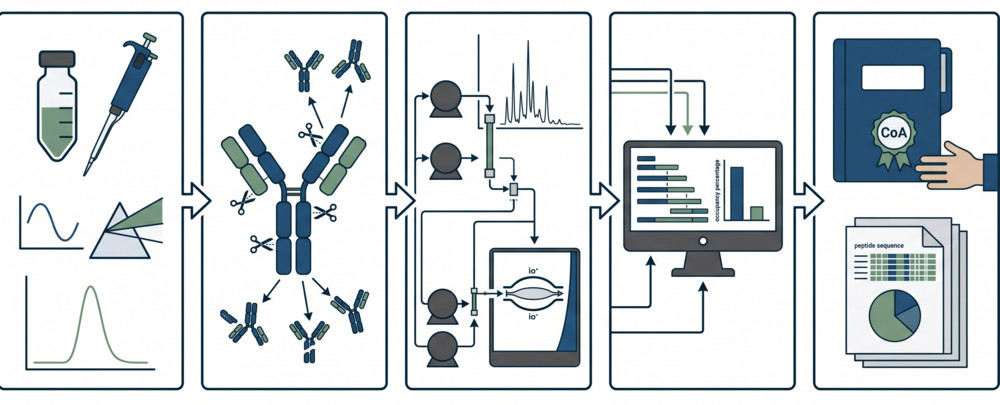
Phase 1: Sample Preparation & Quality Assessment
Upon sample receipt, we conduct initial quality checks including concentration determination, purity assessment, and buffer exchange if necessary. Sample preparation includes denaturation, reduction/alkylation if required, and proteolytic digestion to generate peptides for LC-MS analysis.
Phase 2: Proteolytic Digestion Optimization
Optimization of proteolytic digestion conditions for your specific ADC format. We evaluate multiple protease combinations (trypsin, chymotrypsin, Asp-N, etc.) to achieve maximum sequence coverage and optimal cleavage around modification sites.
Phase 3: LC-MS/MS Analysis
High-resolution LC-MS/MS analysis using nano-flow chromatography coupled to high-field Orbitrap or Q-TOF mass spectrometry. Optimized gradient methods ensure separation of complex peptide mixtures, including modified and unmodified variants.
Phase 4: Data Processing & Site Identification
Advanced bioinformatics pipelines for peptide identification, modification site localization, and occupancy quantification. Specialized algorithms distinguish modified peptides and calculate site-specific modification percentages.
Phase 5: Comprehensive Reporting
Delivery of detailed analytical reports including peptide mapping results, site identification data, occupancy quantification, and expert interpretation. Certificate of Analysis (CoA) provided for each batch, supporting your preclinical development decisions.
Advanced Platforms for Conjugate Site Analysis
Our multi-platform approach ensures comprehensive site characterization across various ADC architectures and conjugation chemistries:
1. High-Resolution LC-MS/MS Platform
State-of-the-art liquid chromatography-mass spectrometry system for comprehensive peptide mapping and site identification. High-field Orbitrap or Q-TOF mass spectrometers provide sub-ppm mass accuracy for unambiguous modification site assignment.
- • High-Resolution Mass Accuracy: Sub-ppm mass measurement enables confident peptide identification and modification site localization.
- • Advanced Fragmentation: HCD and ETD fragmentation methods for comprehensive peptide characterization.
- • Deep Sequence Coverage: Optimized protocols achieve >95% sequence coverage for most antibody formats.
2. Nano-Flow LC Platform
Nano-flow chromatography system for enhanced sensitivity and resolution in peptide separation. Ideal for analyzing limited sample quantities or detecting low-abundance modified peptides.
- • High Sensitivity: Detection of low-abundance modified peptides in complex mixtures.
- • Superior Resolution: Excellent peptide separation for accurate quantitation.
- • Low Sample Consumption: Ideal for precious preclinical samples with limited availability.
3. Bioinformatic Analysis Platform
Advanced data analysis pipeline for peptide identification, modification site localization, and occupancy quantification. Specialized algorithms designed for ADC characterization.
- • Automated Data Processing: Streamlined workflows for efficient sample throughput.
- • Custom Modification Databases: Accurate identification of drug-linker adducts.
- • Quantitative Analysis Tools: Precise site occupancy calculations with statistical validation.
4. Comparative Analysis Platform
Integrated platform for side-by-side comparison of conjugation sites across different ADC candidates or conjugation methods. Supports method selection and clone selection decisions.
- • Direct Sample Comparison: Parallel analysis under identical conditions for reliable comparisons.
- • Homogeneity Assessment: Quantitative evaluation of site distribution uniformity.
- • Method Selection Support: Data-driven recommendations for conjugation platform selection.
Why Choose Our Conjugate Site Analysis Services?
Single-Amino-Acid Resolution Site Mapping
Our LC-MS/MS platforms provide precise identification of drug attachment sites at the single-amino-acid level, enabling detailed structure-activity relationship studies for your ADC candidates.
Quantitative Site Occupancy Analysis
Beyond site identification, we provide quantitative occupancy data for each modification site, enabling assessment of conjugate homogeneity and correlation with biological activity.
Multi-Conjugation Platform Expertise
Our analytical methods are optimized for various conjugation chemistries including lysine, cysteine, and site-specific technologies. We select the optimal approach based on your ADC format and research objectives.
Integrated ADC Characterization Solutions
Site analysis data can be combined with DAR determination, stability studies, and efficacy testing to provide comprehensive ADC characterization for informed preclinical development decisions.
Research Insights: Advances in Conjugate Site Analysis
Recent advances in conjugate site analysis methodologies have significantly improved our understanding of ADC structure-function relationships. According to Fan et al. (2025), site-specific conjugation technologies enable precise control over drug attachment positions, which is critical for optimizing ADC therapeutic index and manufacturing consistency.
Key Insights from Recent Research:
- • Site Selection Impact: Research demonstrates that conjugation at different antibody positions (hinge, CH1, CH3, Fc) results in distinct PK/PD profiles and stability characteristics (Zulkvereli et al., 2024).
- • Occupancy Correlation: Studies show strong correlation between site occupancy uniformity and ADC homogeneity, which directly impacts manufacturing consistency and preclinical reproducibility.
- • Linker Stability: Site-specific analysis has revealed that drug-linker stability varies depending on the conjugation site, informing linker design optimization (Fan et al., 2025).
These analytical advances enable more informed ADC design decisions and support the development of next-generation conjugate platforms with enhanced therapeutic profiles.
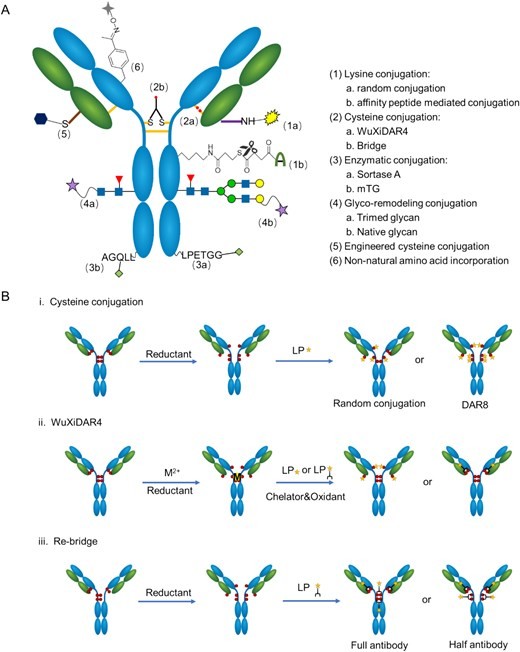
Fig.1 Schematic illustration of site-specific conjugation techniques and the interchain cysteine conjugation process.1,3
FAQs about Conjugate Site Analysis
Q: What is the difference between peptide mapping and site occupancy analysis?
A: Peptide mapping identifies WHERE drugs are attached (which amino acid residues), while site occupancy analysis determines HOW MUCH drug is attached at each site (what percentage of that site carries a drug). Both are complementary and together provide a complete picture of your ADC's conjugation profile.
Q: How much sample is required for conjugate site analysis?
A: For standard peptide mapping and site occupancy analysis, we typically require 100-200 μg of purified ADC. For nano-flow LC-MS analysis with limited samples, we can work with as little as 10-50 μg. Contact us to discuss optimization for your specific sample constraints.
Q: Can you analyze site-specifically conjugated ADCs?
A: Yes. Site-specifically conjugated ADCs are ideal for our analysis platforms. We can confirm precise site occupation, verify homogeneity, and validate that the intended conjugation site is the primary modification location.
Q: How long does conjugate site analysis take?
A: Standard conjugate site analysis (peptide mapping + occupancy) is completed within 2-3 weeks from sample receipt. Expedited services are available for time-sensitive projects. Complex samples or custom method development may require additional time.
Q: Can you compare conjugation sites across different ADC candidates?
A: Absolutely. Our comparative analysis service enables side-by-side comparison of conjugation sites across multiple ADC candidates, conjugation methods, or production batches. This is valuable for clone selection, process optimization, and consistency testing.
Other ADC Analysis Services
Related Products
Related Resources


References:
1. Fan Q, Chen H, Wei G, et al. A review of conjugation technologies for antibody drug conjugates. Antib Ther. 2025;8(2):157-170. https://doi.org/10.1093/abt/tbaf010
2. Zulkvereli V, Iancu RI, Minea RD, et al. Site-specific conjugation technologies for next-generation antibody-drug conjugates. Pharmaceutics. 2024;16(3):394. https://doi.org/10.3390/pharmaceutics16030394
3. Distributed under Open Access License CC BY 4.0, without modification.
For Research Use Only. NOT FOR CLINICAL USE.
Online Inquiry
Welcome! For price inquiries, please feel free to contact us through the form on the left side. We will get back to you as soon as possible.
