- Home
- ADC Development
- ADC In Vitro Analysis
- ADC Biochemical Analysis
- DAR & Payload Distribution Analysis: Characterizing Pre-clinical ADC Homogeneity
DAR & Payload Distribution Analysis: Characterizing Pre-clinical ADC Homogeneity
Precise determination of drug-to-antibody ratio (DAR) and payload distribution is fundamental to antibody-drug conjugate (ADC) preclinical development. Creative Biolabs provides comprehensive analytical services to characterize the homogeneity, stability, and biochemical properties of your ADC candidates. Our integrated platform combines orthogonal analytical techniques—including HIC, LC-MS, and UV/Vis spectroscopy—to deliver accurate, reproducible data for informed decision-making in early-stage research.
Inquire About DAR AnalysisOverview: The Critical Role of DAR in ADC Pre-Clinical Research
Antibody-drug conjugates (ADCs) represent a sophisticated class of targeted therapeutics where cytotoxic payloads are covalently attached to monoclonal antibodies via chemical linkers. The in vivo efficacy and safety profile of an ADC is intrinsically linked to its drug-to-antibody ratio (DAR)—the average number of drug molecules conjugated per antibody. Equally important is the payload distribution profile, which describes the relative abundance of species carrying different numbers of drugs.
Why DAR & Payload Distribution Matter in Pre-Clinical Studies
In the preclinical discovery phase, understanding the relationship between DAR, pharmacokinetics, and antitumor activity is essential for optimizing lead candidates. Key considerations include:
- • Therapeutic Window Optimization: Both overly conjugated (high DAR) and under-conjugated (low DAR) species can compromise the therapeutic index. High DAR often increases systemic toxicity without proportional efficacy gains, while low DAR may result in suboptimal in vitro cytotoxicity.
- • Pharmacokinetic (PK) Impact: DAR directly influences ADC hydrodynamic radius, charge, and hydrophobicity, all of which affect clearance rates and tissue distribution in in vivo models.
- • Manufacturing Reproducibility: A well-defined payload distribution profile ensures batch-to-batch consistency—a prerequisite for meaningful preclinical comparison studies.
Comprehensive Analytical Coverage
Our DAR and payload distribution analysis services provide multi-dimensional characterization tailored to your conjugation chemistry (lysine-based, cysteine-based, site-specific, etc.). We deliver not only average DAR values but also detailed distribution profiles, stability assessments, and conjugation site mapping to support your preclinical development objectives.
Overcoming Analytical Challenges in DAR Determination
Accurate DAR and payload distribution analysis is technically demanding due to the structural complexity and heterogeneity of ADC products. Common challenges in preclinical characterization include:
- ▶ Sample Heterogeneity: Conventional conjugation methods produce mixtures of species with DAR ranging from 0 to 8, complicating both in vitro potency assays and in vivo PK/PD correlation.
- ▶ Method Limited Dynamic Range: No single analytical technique is universally applicable. UV/Vis may lack sensitivity for low-DAR species, while LC-MS can face ionization challenges with highly hydrophobic conjugates.
- ▶ Conjugation Site Complexity: For lysine-conjugated ADCs, the large number of potential modification sites creates significant spectral complexity in mass spectrometry, requiring advanced deconvolution and sample preparation strategies.
DAR & Payload Distribution Analysis Services
We provide comprehensive DAR analysis services tailored to your ADC development needs. Our integrated analytical platforms enable accurate determination of drug-to-antibody ratio, payload distribution profiling, and site-specific characterization. Each service is designed to deliver actionable data for your preclinical research and development decisions.
Tailored Analytical Solutions for Your Research
Every ADC project has unique characterization requirements. Our services can be customized to match your specific conjugation platform, payload chemistry, and research objectives. Whether you need rapid DAR screening for early-stage candidate evaluation or comprehensive multi-parameter analysis for regulatory submission, we work with you to design the optimal analytical strategy for your preclinical development timeline. Contact us to discuss your specific needs.
| Service Name | Technical Specifications | Analysis Capabilities | Service Deliverables |
|---|---|---|---|
|
Primary Method HIC-Based DAR Analysis Service Native hydrophobic interaction chromatography for accurate DAR determination and species distribution profiling. |
• Separation Principle: Ammonium sulfate gradient under native conditions separates ADC species by hydrophobicity. • DAR Calculation: Integrated peak areas correlate directly to drug load (DAR 0–8). • Native Conditions: Preserves ADC conformation for physiologically relevant analysis. • Best For: Cysteine-conjugated ADCs, drug load distribution monitoring, process control. |
• DAR value calculation with % species distribution • Chromatographic resolution of individual DAR species • Batch-to-batch comparison capability • Method transfer and validation available |
• Labeled chromatograms with DAR species peaks • Quantitative DAR report with distribution table • Method development documentation (optional) • Technical support for result interpretation |
|
High-Resolution Intact Mass Analysis Service LC-ESI-MS for precise mass determination and DAR calculation across various ADC conjugation platforms. |
• Mass Accuracy: Sub-ppm precision for unambiguous DAR species identification. • Native & Denaturing: Multiple ionization modes available for different ADC formats. • Deconvolution: Advanced algorithms resolve heterogeneous lysine-conjugated ADC spectra. • Chain Analysis: Reduced sample analysis for heavy-chain vs. light-chain drug loading assessment. |
• Deconvoluted mass spectrum with DAR species assignment • Calculated DAR value with confidence interval • Relative abundance quantification of each DAR species • Cysteine/lysine conjugation pattern analysis |
• Mass spectrum with annotated DAR species • Comprehensive DAR calculation report • Comparison report with HIC data (if requested) • Raw data and processing parameters |
|
Rapid Screening UV/Vis Spectroscopy DAR Service Fast, cost-effective DAR estimation for conjugation optimization and high-throughput screening applications. |
• Method: Dual-wavelength measurement using extinction coefficients for antibody and drug. • Calculation: Simultaneous equations provide rapid DAR estimate. • Sample Volume: Minimal sample requirement, ideal for precious materials. • Throughput: Suitable for screening multiple reaction conditions simultaneously. |
• Rapid DAR estimation for screening studies • Low-volume measurement option available • Multi-sample comparison capability • Quick turnaround for time-sensitive projects |
• DAR estimate report with standard deviation • Extinction coefficient verification • Rapid screening results for multiple samples • Recommendations for orthogonal validation |
|
Advanced Characterization Peptide Mapping & Site Localization Service Site-specific conjugation analysis for precise drug attachment site identification and occupancy quantification. |
• Proteolytic Digestion: Trypsin/chymotrypsin digestion for peptide generation. • Site Identification: Single-amino-acid resolution for modification site localization. • Occupancy Quantification: Percentage of drug attachment at each modification site. • Linker Analysis: Drug-linker adduct mass confirmation and integrity assessment. |
• Peptide mapping with modification site identification • Site occupancy percentage for each conjugation site • Drug-linker adduct mass verification • Heavy-chain/light-chain analysis capability |
• Peptide mapping report with site modification map • Quantitative site occupancy analysis • Mass shift summary for drug-linker adducts • Structural interpretation and site-specific DAR summary |
Custom Analytical Services
Method Development & Optimization
Custom analytical method development for novel ADC platforms, non-standard payloads, or specific regulatory requirements. We optimize separation conditions and validate methods to your project specifications.
Comparative Analysis Service
Side-by-side characterization of multiple ADC candidates or batch-to-batch comparison studies. Ideal for clone selection, process optimization, and stability comparison.
Stability Study Support
Time-point DAR and payload distribution analysis for forced degradation studies, formulation optimization, and shelf-life determination. Flexible scheduling for multiple analytical timepoints.
Regulatory Package Support
Comprehensive analytical reports formatted for regulatory submission, including method validation data, system suitability records, and Certificate of Analysis documentation.
Standardized Workflow for DAR & Payload Distribution Analysis
Our streamlined preclinical analysis workflow ensures data integrity, reproducibility, and comprehensive DAR characterization from sample receipt to final reporting:
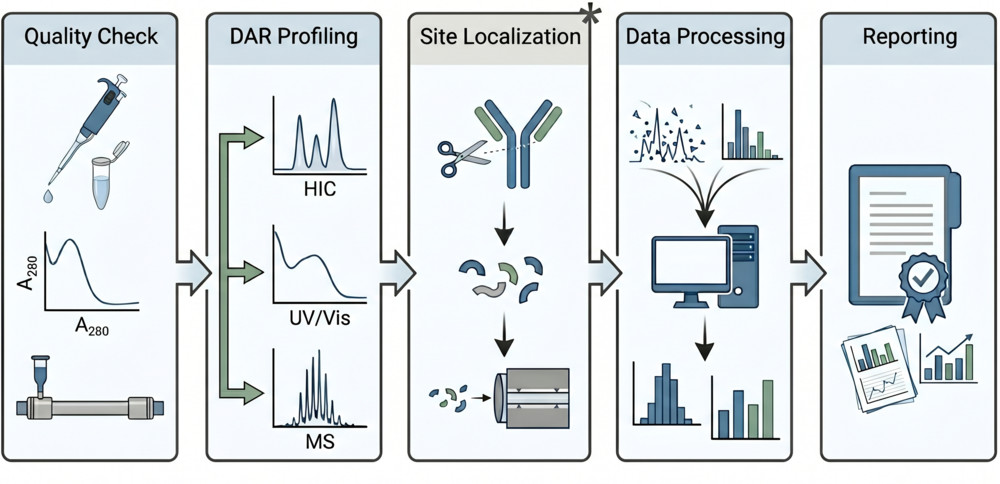
Phase 1: Sample Receipt & Quality Assessment
Upon sample receipt, we conduct initial quality checks including concentration determination (A280), purity assessment (SEC-HPLC), and visual inspection. This ensures the ADC sample is suitable for downstream DAR analysis and prevents misleading results from degraded materials.
Phase 2: Multi-Method DAR Profiling
Parallel analysis using HIC for species separation, UV/Vis for rapid DAR estimation, and intact mass LC-MS for high-resolution DAR determination. This orthogonal approach provides comprehensive coverage of the ADC's drug distribution profile.
Phase 3: Site-Specific Localization (Optional)
For advanced characterization, proteolytic digestion followed by LC-MS/MS peptide mapping identifies exact drug attachment sites. This is particularly valuable for lysine-conjugated ADCs where multiple modification sites exist.
Phase 4: Data Processing & Deconvolution
Advanced bioinformatics pipelines deconvolute complex mass spectra, calculate precise DAR values, and generate detailed payload distribution histograms. Quality control metrics ensure data accuracy and reproducibility across technical replicates.
Phase 5: Comprehensive Reporting
Delivery of a complete analytical report including HIC chromatograms, mass spectra, DAR calculations, distribution tables, and expert interpretation. Certificate of Analysis (CoA) provided for each batch, supporting your preclinical development decisions.
Advanced Platforms for DAR & Payload Distribution Analysis
Our multi-platform approach ensures accurate DAR determination across a wide range of ADC architectures and conjugation chemistries:
1. HIC-Based DAR Profiling Platform
A cornerstone platform for DAR analysis, particularly suited for cysteine-conjugated ADCs. Using a non-denaturing ammonium sulfate gradient, this platform separates ADC species based on hydrophobicity differences imparted by varying drug loads.
- • High Resolution: Baseline separation of ADC species from DAR 0 to DAR 8 on butyl-NPR columns.
- • Dual-Wavelength Detection: Simultaneous monitoring at 280 nm (antibody) and drug-specific wavelength enables precise integration.
- • Minimal Sample Preparation: Direct injection of native ADC samples without denaturation or reduction.
2. High-Resolution Intact Mass Platform
Employs state-of-the-art Orbitrap and Q-TOF mass spectrometers to directly measure the mass of intact ADC molecules. Advanced deconvolution algorithms resolve heterogeneous DAR populations with sub-Da accuracy.
- • Sub-ppm Mass Accuracy: Enables unambiguous DAR assignment even for complex conjugates.
- • Native & Denaturing Modes: Flexibility to analyze ADCs under conditions that preserve or disrupt non-covalent interactions.
- • Reduced & Non-Reduced Analysis: Assess heavy-chain vs. light-chain drug loading patterns.
3. UV/Vis Spectrophotometric Platform
A rapid, cost-effective platform for DAR estimation using well-established spectroscopic principles. Ideal for high-throughput screening of conjugation reaction conditions during method development.
- • Simultaneous Equation Method: Calculates DAR from A280 and drug λmax absorbance values.
- • Low-Volume Compatibility: NanoDrop-compatible assays require as little as 2 μL of sample.
- • Orthogonal Validation Support: Quick DAR estimates to guide more intensive HIC or MS analyses.
4. Peptide Mapping & Site-Occupancy Platform
A specialized platform for conjugation site mapping and site-occupancy quantification. Essential for understanding structure-activity relationships in site-specific and lysine-conjugated ADCs.
- • High-Coverage Digestion: Optimized trypsin, chymotrypsin, and Asp-N protocols for comprehensive sequence coverage.
- • HDMSE Technology: Ion mobility separation enhances peptide identification confidence.
- • Quantitative Site Occupancy: Calculates the percentage of each modification site that carries a drug-linker adduct.
Why Choose Our DAR & Payload Distribution Analysis Services?
Orthogonal Multi-Platform Validation
We employ orthogonal analytical methods—HIC, LC-MS, and UV/Vis—to cross-validate DAR measurements, ensuring data accuracy and reliability for your preclinical decision-making.
Conjugation Chemistry Expertise
Our analytical strategies are tailored to your ADC's conjugation chemistry. Whether lysine-based, cysteine-based, or site-specific, we select the optimal platform for accurate DAR determination.
High-Resolution Site Mapping
Beyond average DAR, we provide peptide-level resolution of drug attachment sites, enabling structure-activity relationship studies and optimization of conjugation strategies.
Accelerated Turnaround for Preclinical Research
Our streamlined workflow and dedicated analytical team deliver comprehensive DAR analysis reports within 2-3 weeks, supporting fast-paced preclinical ADC development timelines.
Research Insights: Advances in DAR Analytical Methodologies
Recent advances in DAR (drug-to-antibody ratio) analytics have demonstrated that orthogonal analytical platforms provide the most comprehensive characterization of ADC payload distribution. According to Tang et al. (2017), real-time monitoring of DAR during conjugation reactions enables precise control over drug loading, ensuring consistent product quality and batch-to-batch reproducibility.
Key Analytical Insights from Recent Research:
- • Method Correlation: HIC-derived DAR values show strong correlation with LC-MS intact mass analysis, validating the reliability of both methods for preclinical characterization (Matsuda et al., 2020).
- • Payload Distribution Impact: ADCs with homogeneous DAR profiles (e.g., DAR = 2.0 or 4.0) demonstrate superior in vivo PK and safety profiles compared to heterogeneous, randomly conjugated counterparts.
- • Automation & Reproducibility: Recent studies highlight the potential of automated conjugation platforms coupled with real-time DAR monitoring to enhance therapeutic development efficiency.
These analytical advances enable more informed candidate selection and optimization in the preclinical ADC pipeline.
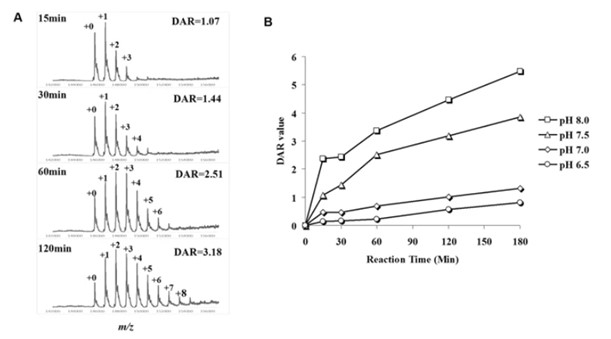
Fig.1 Real-time DAR detection of lysine-linked ADC facilitates the optimization of conjugation conditions.1,3
FAQs about DAR & Payload Distribution Analysis
Q: Which analytical method is best for DAR determination in preclinical ADC research?
A: HIC is the most widely accepted method for DAR analysis in preclinical research due to its non-denaturing conditions and excellent correlation with in vivo performance. For definitive characterization, we recommend orthogonal validation using intact mass LC-MS.
Q: Can you analyze DAR for site-specifically conjugated ADCs?
A: Absolutely. Site-specifically conjugated ADCs typically yield a single, homogeneous DAR species. Our high-resolution LC-MS platform can confirm the exact mass and purity of site-specific conjugates, while HIC verifies the absence of unreacted antibody or over-conjugated species.
Q: How much ADC sample is required for comprehensive DAR analysis?
A: For a complete DAR analysis package (HIC + LC-MS + UV/Vis), we typically require 200-500 μg of purified ADC. For HIC-only analysis, 50-100 μg is sufficient. Contact us if your sample is limited—we can often optimize methods for low-input preclinical samples.
Q: Can you identify the exact sites of drug conjugation on our ADC?
A: Yes. Our peptide mapping and site-localization platform uses LC-MS/MS to identify exact drug attachment sites at the amino acid level. We also provide site-occupancy quantification, reporting the percentage of each residue that carries a drug molecule.
Q: Do you provide stability assessment of DAR over time?
A: Yes. We offer forced degradation and real-time stability studies where DAR and payload distribution are monitored at specified time points. This is particularly important for ADCs intended for in vivo preclinical studies where linker stability affects drug release kinetics.
Other ADC Analysis Services
Related Products
Related Resources
References:
1. Tang, Y., Tang, F., Yang, Y., et al. Real-Time Analysis on Drug-Antibody Ratio of Antibody-Drug Conjugates for Synthesis, Process Optimization, and Quality Control. Sci Rep. 2017;7:7763. https://doi.org/10.1038/s41598-017-08151-2
2. Matsuda, Y., Leung, M., Okuzumi, T., Mendelsohn, B. A Purification Strategy Utilizing Hydrophobic Interaction Chromatography to Obtain Homogeneous Species from a Site-Specific Antibody Drug Conjugate. Antibodies (Basel). 2020;9(2):16. https://doi.org/10.3390/antib9020016
3. Distributed under Open Access License CC BY 4.0, without modification.
For Research Use Only. NOT FOR CLINICAL USE.
Online Inquiry
Welcome! For price inquiries, please feel free to contact us through the form on the left side. We will get back to you as soon as possible.
