- Home
- Resources
- Featured Solutions
- Universal Therapeutic Conjugate (UTC) Development Solution
- Antibody-Antibiotic Conjugate (AAC) Development Solution
- Bacterial Infection related Antibody Discovery
- S. aureus Antibody Development Services for AAC Research
S. aureus Antibody Development Services for AAC Research
Staphylococcus aureus remains one of the most formidable Gram-positive pathogens in both community and healthcare settings, with methicillin-resistant strains (MRSA) driving an urgent search for alternatives to conventional antibiotics. Creative Biolabs provides a comprehensive suite of monoclonal antibody discovery services targeting the full spectrum of S. aureus surface proteins — including ClfA, IsdB, SpA, SasA, PBP-2a, and the cell-wall carbohydrate β-GlcNAc-WTA — purpose-built for pre-clinical antibody-antibiotic conjugate (AAC) development. Our multi-platform discovery engine combines hybridoma technology, phage display, and individual-cell BCR repertoire profiling to deliver high-affinity, target-specific mAbs ready for linker conjugation and in vitro evaluation against both planktonic and intracellular S. aureus.
Inquire for Pre-clinical SupportS. aureus Target-Specific Antibody Development Services
Overview: The Case for Antibody-Based Strategies Against S. aureus
Staphylococcus aureus is a leading cause of bacteremia, infective endocarditis, osteomyelitis, and device-associated infections worldwide. Approximately 15% of documented invasive staphylococcal infections manifest as pneumonia, and up to half of these pneumonic isolates are classified as methicillin-resistant S. aureus (MRSA). The pathogen's capacity to invade and persist within host cells — particularly macrophages and osteoblasts — creates an intracellular sanctuary where conventional antibiotics often fail to achieve bactericidal concentrations, contributing to relapsing and refractory infections despite treatment.
Why Surface Proteins Are Prime AAC Targets
The surface of S. aureus is decorated with a rich repertoire of cell wall-anchored (CWA) proteins and glycopolymers that mediate host adhesion, immune evasion, nutrient acquisition, and biofilm formation. These surface-exposed molecules are accessible to circulating antibodies without requiring bacterial lysis, making them ideal docking points for AAC delivery. Key targets under active investigation include:
- • Protein A (SpA): A bifunctional virulence factor that binds IgG Fc regions and shields the bacterium from opsonophagocytic killing. Anti-SpA antibodies neutralize immune evasion and restore protective host antibody responses.
- • Clumping Factor A (ClfA): A fibrinogen-binding MSCRAMM that promotes bacterial clumping and thrombus formation on damaged endothelium, critical in endovascular infections.
- • Iron-regulated Surface Determinant B (IsdB): A hemoglobin receptor that extracts heme iron from the host, essential for S. aureus survival in iron-limited environments such as the bloodstream.
- • S. aureus Surface Protein A (SasA): A large serine-rich adhesin mediating platelet binding, with a highly conserved NRR domain present in >90% of clinical isolates.
- • Penicillin-Binding Protein 2a (PBP-2a): The β-lactam resistance determinant in MRSA, expressed on the membrane surface with extracellular domains accessible to antibodies.
- • β-GlcNAc Wall Teichoic Acid (WTA): A glycopolymer with approximately 50,000 copies per cell, providing exceptional surface density for antibody-mediated targeting.
The AAC Approach and Our Service Scope
Antibody-antibiotic conjugates merge the targeting precision of monoclonal antibodies with the potent bactericidal activity of covalently linked antibiotics. Upon antibody-mediated binding and opsonization, AACs are internalized into phagolysosomes where linker cleavage releases the antibiotic payload directly onto intracellular bacteria — a delivery mechanism that overcomes the permeability barriers protecting intracellular S. aureus from free antibiotics. Our antibody discovery services support every stage of AAC pre-clinical development: target-specific mAb generation, epitope characterization, affinity maturation, species cross-reactivity profiling, and preliminary conjugation compatibility assessment — all under one program.
Antibody Discovery Challenges Specific to S. aureus
Developing monoclonal antibodies for AAC applications against S. aureus presents unique hurdles that distinguish it from oncology-focused antibody programs. Our discovery approach is built to address each one systematically:
- ▶ Immune Evasion Interference: SpA binds the Fc region of IgG, masking the bacterium from antibody-mediated clearance. Antibodies generated against SpA itself must be carefully characterized to ensure they block, rather than participate in, this evasion mechanism during in vitro opsonophagocytic killing assays.
- ▶ Target Sequence Heterogeneity: Surface proteins such as ClfA and SasA exhibit allelic variation across clinical lineages (e.g., USA300 vs. ST239). Monoclonal antibodies must be screened against panels representing multiple clonal complexes to confirm broad strain coverage before AAC candidate nomination.
- ▶ Glycoform Discrimination for β-GlcNAc-WTA: S. aureus produces wall teichoic acid in both α- and β-GlcNAc glycoforms. AAC efficacy requires antibodies that discriminate the β-glycoform with high selectivity, as α-WTA is not reliably expressed in vivo. Cross-reactivity with the α-glycoform must be stringently eliminated during counter-screening.
- ▶ Intracellular Accessibility Validation: For AACs targeting ingested bacteria, the selected antibody must mediate efficient opsonophagocytic uptake into professional phagocytes. Post-internalization trafficking to acidified phagolysosomes — where linker cleavage occurs — must also be verified during early candidate screening.
Target-Specific Antibody Discovery Solutions
Our antibody discovery portfolio covers six validated S. aureus surface targets, each supported by dedicated immunization strategies, screening cascades, and characterization workflows designed for AAC development:
| Target & Service Module | Discovery Rationale | Key Screening & Characterization Tools |
|---|---|---|
|
Immune Evasion Anti-SpA Antibody Development Targeting Protein A to neutralize Fc-binding activity and restore opsonophagocytic clearance of S. aureus. |
• SpA is universally expressed across clinical S. aureus isolates. • Neutralizing SpA unmasks the bacterium to host IgG, enabling natural immune clearance mechanisms. • Recombinant SpAKKAA mutants (Fc-binding deficient) serve as immunogens to bias the response toward Fab-mediated neutralization. |
• Fc-Binding Competition ELISA: Confirms SpA-neutralizing activity of candidate mAbs. • Whole-Blood Opsonophagocytic Killing Assay: Quantifies restoration of bacterial clearance in the presence of anti-SpA antibodies. |
|
Adhesion Anti-ClfA Antibody Development Blocking fibrinogen-binding MSCRAMM to prevent endovascular adhesion and thrombus colonization. |
• ClfA is a virulence determinant in infective endocarditis and catheter-related bloodstream infections. • Antibodies that block the fibrinogen γ-chain binding pocket prevent bacterial-platelet aggregate formation. • ClfA ligand-binding domain (residues 221–559) serves as a well-characterized immunogen. |
• Fibrinogen Binding Inhibition Assay: Surface plasmon resonance (SPR)-based quantification of ligand-blocking activity. • Static Adhesion Assay: Evaluates mAb-mediated inhibition of bacterial attachment to fibrinogen-coated surfaces. |
|
Nutrient Acquisition Anti-IsdB Antibody Development Intercepting heme-iron scavenging to starve S. aureus in the bloodstream during systemic infection. |
• IsdB is the primary hemoglobin receptor, critical for iron acquisition during bacteremia. • Blocking the NEAT2 heme-binding domain restricts bacterial proliferation in iron-depleted host environments. • Anti-IsdB mAbs may also interfere with vitronectin and von Willebrand factor binding. |
• Hemin-Agar Growth Inhibition Assay: Measures mAb-mediated restriction of S. aureus growth under iron-limited conditions. • Hemoglobin Binding Competition ELISA: Confirms blockade of the IsdB-hemoglobin interaction. |
|
Adhesion Anti-SasA Antibody Development Targeting the conserved NRR domain of SasA to block platelet adhesion and promote opsonophagocytosis. |
• The NRR domain of SasA is >90% conserved across clinical S. aureus lineages. • Anti-SasA mAbs confer protection in murine sepsis and peritonitis models via opsonophagocytic killing. • SasA is expressed on both MRSA (USA300) and MSSA (ST239) strains. |
• Multi-Strain Flow Cytometry: Confirms SasA surface expression and mAb binding across clinical isolate panels. • Opsonophagocytic Killing Assay: Quantifies antibody-dependent bacterial clearance by human neutrophils. |
|
Antibiotic Resistance Anti-PBP-2a Antibody Development Targeting the β-lactam resistance determinant on MRSA to enable strain-specific recognition and AAC delivery. |
• PBP-2a is the defining resistance marker of MRSA, with extracellular transpeptidase domains accessible to antibodies. • Anti-PBP-2a mAbs enable MRSA-selective AAC delivery without affecting commensal flora. • The allosteric domain and β-lactam-binding pocket provide distinct epitope options. |
• PBP-2a Latex Agglutination: Rapid confirmation of target specificity against MRSA isolates. • MRSA vs. MSSA Differential Binding: Flow cytometry panels confirming selective recognition of resistant strains. • β-Lactam Synergy Assay: Evaluates whether mAb binding sensitizes PBP-2a to β-lactam antibiotics. |
|
Cell Wall Carbohydrate Anti-β-GlcNAc-WTA Antibody Development Leveraging the exceptionally abundant β-GlcNAc-modified wall teichoic acid (~50,000 copies/cell) for high-avidity AAC targeting. |
• β-GlcNAc-WTA is an immunodominant surface glycan absent from human cells. • Requires glycoform-discriminatory antibodies that distinguish β-O-GlcNAc (TarS product) from α-O-GlcNAc (TarM product). • Synthetic β-WTA oligosaccharide conjugates serve as defined immunogens for hybridoma and phage display campaigns. |
• Glycan Microarray Counter-Screening: Quantifies β vs. α glycoform selectivity of candidate antibodies. • ΔtarS / ΔtarM Mutant Flow Cytometry: Confirms glycoform-specific binding using knockout strain panels. • Opsonophagocytic Uptake Imaging: Confocal microscopy tracking of AAC internalization into macrophages. |
Standardized Antibody Discovery Workflow for AAC Programs
Our end-to-end discovery process is optimized for AAC development, with built-in checkpoints for conjugation compatibility and intracellular delivery validation:
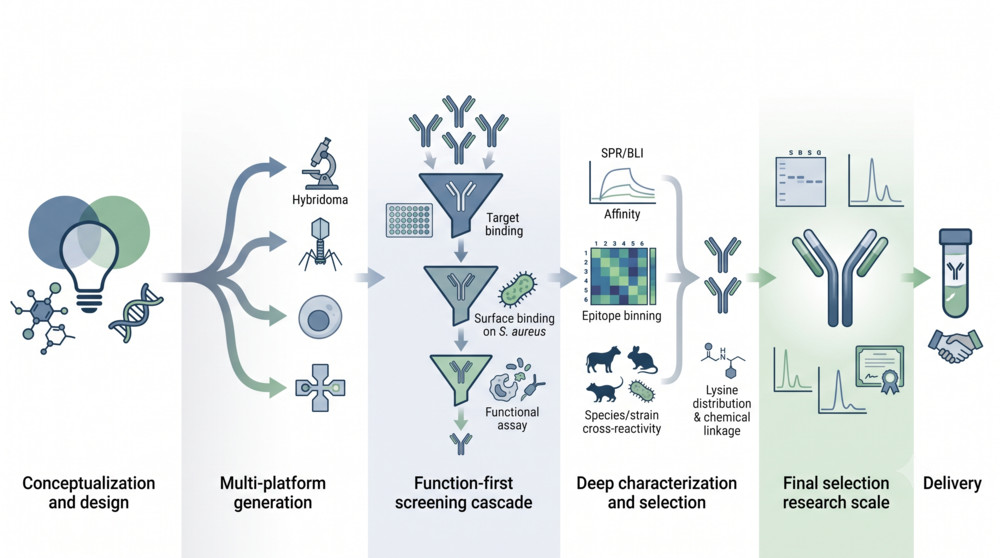
Phase 1: Target Consultation & Immunogen Design
We work with your team to select the optimal surface protein target(s) based on your AAC payload and indication of interest. Recombinant immunogens — including full-length ectodomains, functional subdomains, or synthetic glycan conjugates — are designed and produced under quality-controlled conditions to maximize the probability of isolating functional, surface-reactive antibodies.
Phase 2: Multi-Platform Antibody Generation
Depending on target properties, we deploy hybridoma technology (for native conformational epitopes), phage display libraries (for difficult or glycan targets), or individual-cell BCR repertoire profiling (for rapid lead identification from immunized animals). Multiple platforms can run in parallel to maximize lead diversity.
Phase 3: Function-First Screening Cascade
Primary hits are triaged through a sequential screening cascade: target-binding ELISA → surface-binding flow cytometry on live S. aureus → functional assays (ligand-blocking, opsonophagocytic killing, or glycoform specificity as appropriate). Only antibodies demonstrating both surface accessibility and functional activity advance.
Phase 4: Lead Characterization & Conjugation Assessment
Lead candidates undergo comprehensive biophysical characterization: affinity measurement (SPR/BLI), epitope binning, species and strain cross-reactivity profiling, and thermal stability analysis. A preliminary conjugation compatibility screen evaluates lysine content and distribution at the paratope to inform linker chemistry selection.
Phase 5: Pre-clinical Candidate Nomination & Delivery
Final lead antibodies are produced at research scale with full analytical documentation — SDS-PAGE, SEC-HPLC, endotoxin testing, and Certificate of Analysis — ready for linker conjugation and in vitro AAC evaluation. Sequence information and expression vectors are transferred for downstream engineering if required.
Discovery Platforms Optimized for Anti-S. aureus Antibody Generation
Each platform in our discovery arsenal is configured to address the specific challenges of bacterial surface protein targeting:
1. Hybridoma Platform for Native Conformational Epitopes
Traditional hybridoma technology remains the gold standard for generating antibodies against native protein conformations. Recombinant ectodomains of ClfA, IsdB, and SasA are used as immunogens in mice or rats, and hybridoma supernatants are screened directly on live S. aureus to select only clones recognizing surface-accessible epitopes. This platform is particularly effective for MSCRAMM family proteins where conformational integrity of the ligand-binding domain is essential for functional antibody activity.
- • Native Conformation Preservation: Recombinant immunogens produced in mammalian expression systems maintain domain folding.
- • Live-Bacteria Screening: Direct flow cytometry screening on S. aureus ensures surface accessibility from day one.
- • Fusion Partner Flexibility: Multiple myeloma fusion partners available for optimized hybridoma stability.
2. Phage Display for Glycan and Difficult Protein Targets
For carbohydrate targets such as β-GlcNAc-WTA where conventional immunization may yield predominantly α-glycoform antibodies, and for conserved protein targets requiring fine epitope specificity, our synthetic and immune phage display libraries offer superior epitope control. Counter-selection against α-WTA glycoforms or mutant proteins during panning enriches for glycoform-specific or epitope-selective binders with defined specificity profiles.
- • Glycoform Discrimination: Negative selection rounds eliminate cross-reactive clones early in the campaign.
- • High-Throughput Screening: Thousands of clones screened per campaign for rare specificity profiles.
- • scFv-to-IgG Conversion: Streamlined reformatting pipeline for rapid full-length IgG production.
3. Individual-cell BCR Repertoire Profiling for Accelerated Lead Identification
For programs requiring rapid candidate nomination, antigen-specific memory B cells are isolated from immunized animals by fluorescence-activated cell sorting, followed by individual cells profiling. Paired heavy- and light-chain sequences are cloned directly into expression vectors, bypassing hybridoma generation and enabling recombinant antibody production within weeks. This approach is especially powerful when screening against complex immunogens such as whole formaldehyde-fixed S. aureus cells.
- • Native VH/VL Pairing: Preserves natural heavy-light chain combinations from individual B cells.
- • Rapid Recombinant Production: Direct cloning into IgG expression vectors for immediate recombinant antibody production.
- • Deep Repertoire Mining: Sequence analysis of hundreds of paired antibodies reveals clonal families and affinity maturation trajectories.
4. Functional Characterization Suite for AAC-Relevant Assays
Our dedicated bacteriology characterization unit supports every functional assay required for AAC antibody validation. The suite includes opsonophagocytic killing assays using human neutrophils or differentiated macrophages, intracellular bacterial burden quantification by gentamicin protection assay, confocal microscopy for phagolysosomal trafficking verification, and multi-strain binding panels covering MRSA and MSSA clinical isolates from major clonal complexes.
- • Opsonophagocytic Killing Assay: Quantifies antibody-dependent bacterial clearance by professional phagocytes.
- • Gentamicin Protection Assay: Measures intracellular S. aureus survival after antibody-mediated uptake.
- • Phagolysosomal Trafficking Imaging: Confocal microscopy with Lysotracker co-localization confirming delivery to linker-cleavage compartment.
Why Partner with Creative Biolabs for Anti-S. aureus Antibody Discovery
Target Coverage Across the S. aureus Surface Proteome
Unlike providers offering generic antibody discovery, our team has pre-built immunogen panels, screening reagents, and functional assay protocols for all six validated AAC targets — from immune evasion factors (SpA) to cell wall glycopolymers (β-GlcNAc-WTA). This target-specific readiness accelerates project timelines and reduces the risk of campaign failure.
Function-First Screening Philosophy
Every antibody in our discovery pipeline is screened on live S. aureus cells — not just recombinant protein — ensuring that selected candidates recognize surface-accessible epitopes in their native context. Secondary functional assays (ligand blocking, opsonophagocytic killing, or glycoform discrimination) are integrated into the primary screening cascade so that non-functional binders are eliminated early.
AAC-Aware Antibody Engineering
Antibodies destined for AAC conjugation require properties beyond target binding: solvent-exposed lysine residues for conjugation compatibility, structural stability under reducing conditions, and Fc regions competent for Fcγ receptor-mediated phagocytosis. Our characterization package includes preliminary conjugation assessment and Fc functionality testing, ensuring leads are fit-for-purpose for linker chemistry.
Seamless Integration with Downstream AAC Development
Lead antibodies transition directly into our in-house linker conjugation, payload synthesis, and in vitro AAC characterization workflows — eliminating the handoff risks and data gaps that occur when discovery and conjugation are performed by separate vendors. From target selection to conjugated AAC candidate, your program remains under unified scientific oversight.
Research Insights: Advances in Anti-S. aureus Antibody Discovery
According to Speziale & Pietrocola (2021), monoclonal antibodies targeting surface-exposed and secreted proteins of staphylococci represent a rational strategy against multidrug-resistant infections. Their comprehensive review catalogs the full landscape of anti-S. aureus antibody candidates, including AACs that combine WTA-targeting antibodies with rifamycin-class antibiotics for intracellular bacterial clearance.
Key Research Findings Shaping AAC Design:
- • Target Surface Density Matters: The ~50,000 copies of β-GlcNAc-WTA per S. aureus cell provide an antigen density orders of magnitude higher than most protein targets, correlating with superior opsonophagocytic uptake in in vitro assays.
- • Multi-Target Cocktails Outperform Single Specificities: Combinations of antibodies targeting SpA (immune evasion) plus a surface adhesin (ClfA or IsdB) show additive or synergistic protection in murine bacteremia models, supporting the rationale for multi-epitope AAC strategies.
- • Glycoform-Specific Recognition Is Achievable: Synthetic oligosaccharide immunogens and phage display counter-selection successfully yield antibodies discriminating β-GlcNAc-WTA from α-GlcNAc-WTA with >100-fold selectivity — a critical requirement for AACs targeting the physiologically relevant β-glycoform.
- • Anti-SasA mAbs Protect Across Clonal Complexes: The conserved NRR domain of SasA enables a single monoclonal antibody to bind USA300 (CA-MRSA) and ST239 (HA-MRSA) with equivalent affinity, supporting broad-strain AAC development.
These convergent findings from structural biology, functional assays, and in vivo models establish a strong foundational framework for AAC antibody discovery — a framework our services are built to operationalize.
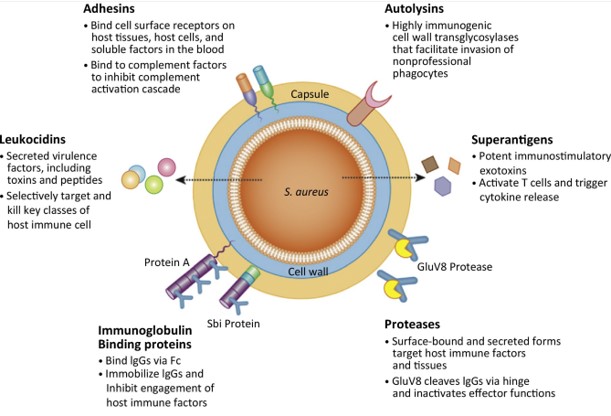
Fig.1 Whole view of S. aureus and its components.4,5
FAQs about S. aureus Antibody Discovery for AAC
Q: Which S. aureus surface protein is the best target for an AAC program?
A: Target selection depends on your AAC payload class, desired spectrum of coverage, and intended infection model. β-GlcNAc-WTA offers the highest surface density (~50,000 copies/cell) for maximum antibody loading, while ClfA and IsdB offer well-characterized functional domains for ligand-blocking strategies. SpA is compelling for immune evasion neutralization, and PBP-2a provides MRSA-selective targeting. Our team can advise on target selection based on your program goals during the initial consultation.
Q: Can you generate antibodies against multiple S. aureus targets simultaneously?
A: Yes. Parallel discovery campaigns against two or more targets — for example, SpA and ClfA, or IsdB and β-GlcNAc-WTA — can be executed concurrently using shared immunogen production and screening resources. This approach is ideal for programs developing multi-specific AAC cocktails or evaluating multiple targets in parallel before committing to a lead candidate.
Q: How do you confirm that antibodies bind S. aureus surface proteins in their native conformation?
A: All antibody candidates in our pipeline are screened by flow cytometry on live, non-fixed S. aureus cells to confirm binding to surface-accessible, native epitopes. This critical step eliminates antibodies that recognize only denatured recombinant protein — a common pitfall in discovery campaigns that rely exclusively on ELISA-based screening against immobilized antigens.
Q: What strain coverage can I expect from the antibodies you generate?
A: Strain coverage depends on the target's conservation profile. SasA NRR-directed antibodies typically bind >90% of clinical isolates due to high domain conservation. ClfA and IsdB antibodies generally cover 80–95% of strains. β-GlcNAc-WTA antibodies require glycoform-level characterization across TarS-positive clinical isolates. We validate each lead antibody against a panel of 10–20 clinical isolates spanning major clonal complexes (USA300, USA100, ST239, ST22) and provide quantitative binding data for your records.
Q: What antibody formats and quantities do you deliver for downstream AAC conjugation?
A: Lead antibodies are delivered as purified full-length IgG (typically IgG1 or IgG2a isotype for murine antibodies) at research-scale quantities suitable for initial conjugation trials and in vitro AAC characterization. Each delivery includes SDS-PAGE and SEC-HPLC purity data, endotoxin certification, concentration determination, and a Certificate of Analysis. Antibody sequences and expression vectors are also provided for scale-up or humanization if needed.
Related Bacterial Infection Antibody Discovery
Related AAC Development Services
Related Resources

References:
1. Touaitia, Rahima, et al. "Staphylococcus aureus: A Review of the Pathogenesis and Virulence Mechanisms." Antibiotics 14, no. 5 (2025): 470. https://doi.org/10.3390/antibiotics14050470
2. Speziale, Pietro, and Giampiero Pietrocola. "Monoclonal Antibodies Targeting Surface-Exposed and Secreted Proteins from Staphylococci." Vaccines 9, no. 5 (2021): 459. https://doi.org/10.3390/vaccines9050459
3. Yang, Yilong, et al. "Monoclonal Antibody Targeting Staphylococcus aureus Surface Protein A (SasA) Protect Against Staphylococcus aureus Sepsis and Peritonitis in Mice." PLOS ONE 11, no. 2 (2016): e0149460. https://doi.org/10.1371/journal.pone.0149460
4. Sause, William E., et al. "Antibody-based biologics and their promise to combat Staphylococcus aureus infections." Trends in pharmacological sciences 37.3 (2016): 231-241. https://doi.org/10.1016/j.tips.2015.11.008
5. Distributed under Open Access licenses: CC BY 4.0, without modification.
For Research Use Only. NOT FOR CLINICAL USE.
Online Inquiry
Welcome! For price inquiries, please feel free to contact us through the form on the left side. We will get back to you as soon as possible.
